

IV. INVESTIGATION OF C. DIPHTHERIAE
125
7. Pathogenicity
It is not pathogenic.
8. Antigenic structure
Antigenic structure differs from that of C. diphtheriae and C. xerosis.
It is never agglutinated by antibacterial C. diphtheriae sera. Two main
precipitating antigens A and B were isolated and characterised (Banach
and Hawirko, 1966). Both antigens consist of a major protein with polysaccharide and nucleic acid. Antigen A contains less protein and carbohydrate than antigen B. The principal sugars of antigen A are arabinose
and glucose. Both are heat stable, acid resistant, and species specific. Acid
extracts of heterologous species fail to cross-react, even with high-titred
C. hofmannii sera.
9. Lysogenicity and phage sensitivity
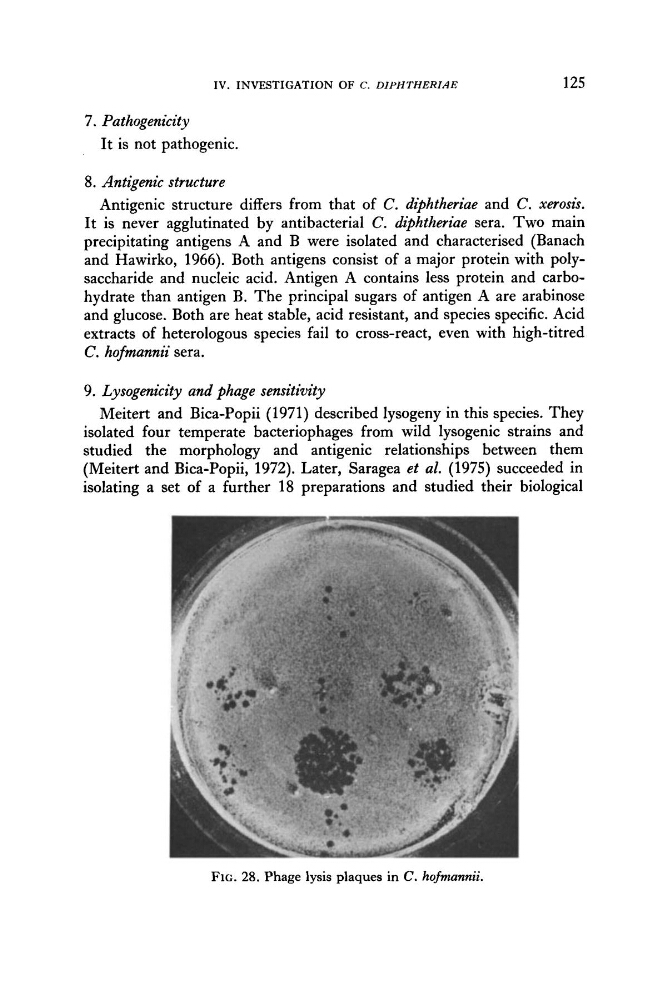
Meitert and Bica-Popii (1971) described lysogeny in this species. They
isolated four temperate bacteriophages from wild lysogenic strains and
studied the morphology and antigenic relationships between them
(Meitert and Bica-Popii, 1972). Later, Saragea et al. (1975) succeeded in
isolating a set of a further 18 preparations and studied their biological
FIG. 28. Phage lysis plaques in C. hofmannii.
125
7. Pathogenicity
It is not pathogenic.
8. Antigenic structure
Antigenic structure differs from that of C. diphtheriae and C. xerosis.
It is never agglutinated by antibacterial C. diphtheriae sera. Two main
precipitating antigens A and B were isolated and characterised (Banach
and Hawirko, 1966). Both antigens consist of a major protein with polysaccharide and nucleic acid. Antigen A contains less protein and carbohydrate than antigen B. The principal sugars of antigen A are arabinose
and glucose. Both are heat stable, acid resistant, and species specific. Acid
extracts of heterologous species fail to cross-react, even with high-titred
C. hofmannii sera.
9. Lysogenicity and phage sensitivity
Meitert and Bica-Popii (1971) described lysogeny in this species. They
isolated four temperate bacteriophages from wild lysogenic strains and
studied the morphology and antigenic relationships between them
(Meitert and Bica-Popii, 1972). Later, Saragea et al. (1975) succeeded in
isolating a set of a further 18 preparations and studied their biological
FIG. 28. Phage lysis plaques in C. hofmannii.