

124
A. SARAGEA E?' AL.
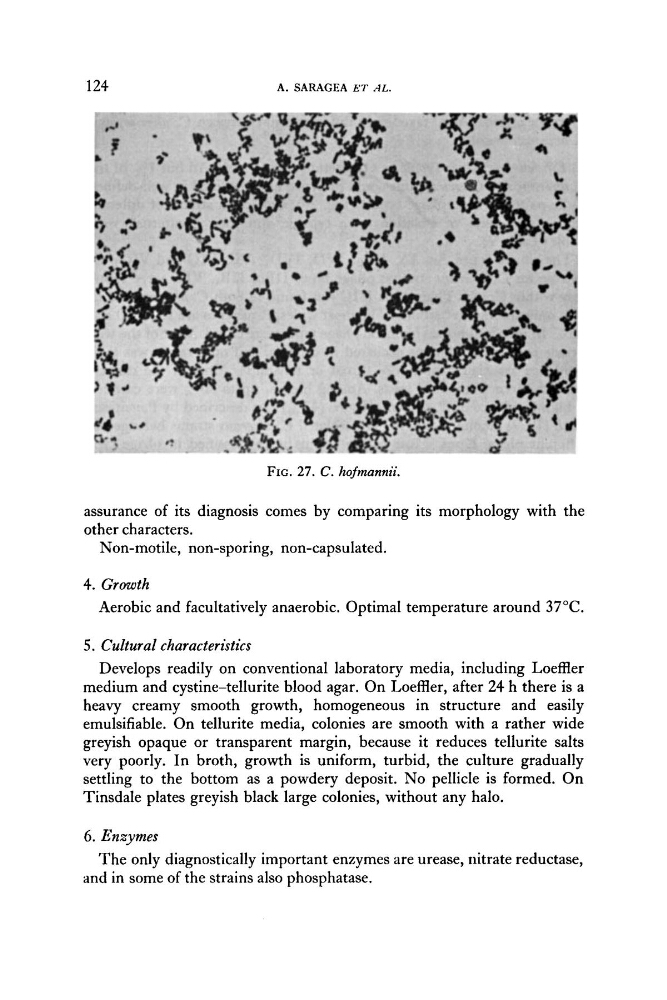
FIG. 27. C. hofmannii.
assurance of its diagnosis comes by comparing its morphology with the
other characters.
Non-motile, non-sporing, non-capsulated.
4. Growth
Aerobic and facultatively anaerobic. Optimal temperature around 37°C.
5 . Cultural characteristics
Develops readily on conventional laboratory media, including Loeffler
medium and cystine-tellurite blood agar. On Loeffler, after 24 h there is a
heavy creamy smooth growth, homogeneous in structure and easily
emulsifiable. On tellurite media, colonies are smooth with a rather wide
greyish opaque or transparent margin, because it reduces tellurite salts
very poorly. In broth, growth is uniform, turbid, the culture gradually
settling to the bottom as a powdery deposit. No pellicle is formed. On
Tinsdale plates greyish black large colonies, without any halo.
6. Eizzy mes
and in some of the strains also phosphatase.
The only diagnostically important enzymes are urease, nitrate reductase,
A. SARAGEA E?' AL.
FIG. 27. C. hofmannii.
assurance of its diagnosis comes by comparing its morphology with the
other characters.
Non-motile, non-sporing, non-capsulated.
4. Growth
Aerobic and facultatively anaerobic. Optimal temperature around 37°C.
5 . Cultural characteristics
Develops readily on conventional laboratory media, including Loeffler
medium and cystine-tellurite blood agar. On Loeffler, after 24 h there is a
heavy creamy smooth growth, homogeneous in structure and easily
emulsifiable. On tellurite media, colonies are smooth with a rather wide
greyish opaque or transparent margin, because it reduces tellurite salts
very poorly. In broth, growth is uniform, turbid, the culture gradually
settling to the bottom as a powdery deposit. No pellicle is formed. On
Tinsdale plates greyish black large colonies, without any halo.
6. Eizzy mes
and in some of the strains also phosphatase.
The only diagnostically important enzymes are urease, nitrate reductase,