

2.5. Sources of Data for the Mathematical
Model
61
spent much effort in attempting to relate the water requirements of crops
to various atmospheric phenomena and soil properties, resulting in a variety
of complex empirical methods. Some of the better-known methods for
estimating the consumptive use include the methods of Blaney and Criddle
[Criddle, 1958], Hargreaves [1957], and Penman [1956]. Of these, the
Blaney-Criddle method is most widely used. To simplify the application of
the model being used, the prediction of irrigation requirements in this book
have not been determined from atmospheric and soil properties, but rather
from tabulated values taken from the literature [McDaniels, I960].
(b)
MUNICIPAL AND INDUSTRIAL WATER USE
Municipal and industrial demand is directly used in calculating the profile of future municipal and irrigation demands [Fu in constraint (2.11)].
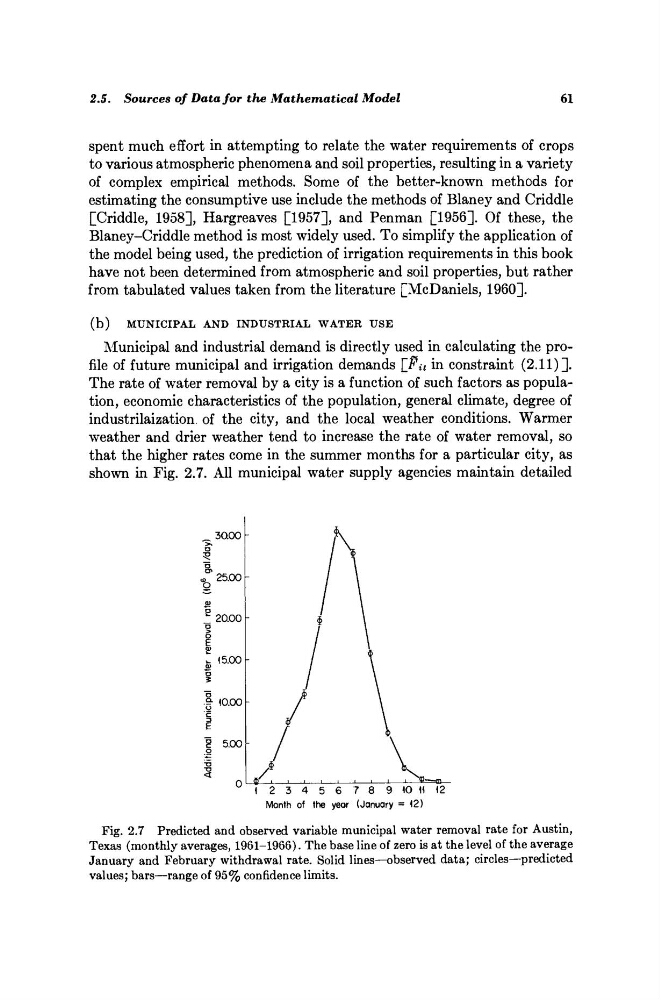
The rate of water removal by a city is a function of such factors as population, economic characteristics of the population, general climate, degree of
industrilaization of the city, and the local weather conditions. Warmer
weather and drier weather tend to increase the rate of water removal, so
that the higher rates come in the summer months for a particular city, as
shown in Fig. 2.7. All municipal water supply agencies maintain detailed
Fig. 2.7 Predicted and observed variable municipal water removal rate for Austin,
Texas (monthly averages, 1961-1966). The base line of zero is at the level of the average
January and February withdrawal rate. Solid lines—observed data; circles—predicted
values; bars—range of 95% confidence limits.
I
I
I
I
I
Φ—FFL
Model
61
spent much effort in attempting to relate the water requirements of crops
to various atmospheric phenomena and soil properties, resulting in a variety
of complex empirical methods. Some of the better-known methods for
estimating the consumptive use include the methods of Blaney and Criddle
[Criddle, 1958], Hargreaves [1957], and Penman [1956]. Of these, the
Blaney-Criddle method is most widely used. To simplify the application of
the model being used, the prediction of irrigation requirements in this book
have not been determined from atmospheric and soil properties, but rather
from tabulated values taken from the literature [McDaniels, I960].
(b)
MUNICIPAL AND INDUSTRIAL WATER USE
Municipal and industrial demand is directly used in calculating the profile of future municipal and irrigation demands [Fu in constraint (2.11)].
The rate of water removal by a city is a function of such factors as population, economic characteristics of the population, general climate, degree of
industrilaization of the city, and the local weather conditions. Warmer
weather and drier weather tend to increase the rate of water removal, so
that the higher rates come in the summer months for a particular city, as
shown in Fig. 2.7. All municipal water supply agencies maintain detailed
Fig. 2.7 Predicted and observed variable municipal water removal rate for Austin,
Texas (monthly averages, 1961-1966). The base line of zero is at the level of the average
January and February withdrawal rate. Solid lines—observed data; circles—predicted
values; bars—range of 95% confidence limits.
I
I
I
I
I
Φ—FFL