

324
E. B. EDNEY
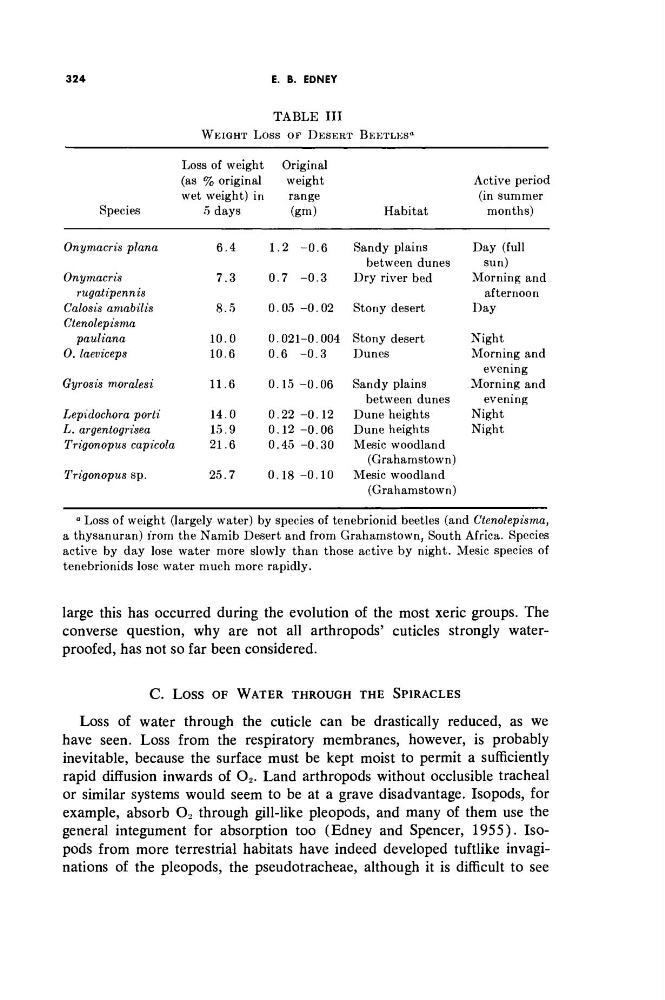
TABLE I I I
W E I G H T LOSS OF D E S E R T BEETLES'
1
Loss of weight
Original
(as % original
weight
Active period
wet weight) in
range
(in summer
Species
Onymacris plana
Onymacris
rugatipennis
Calosis amabilis
Ctenolepisma
pauliana
0. laeviceps
Gyrosis moralesi
Lepidochora porti
L. argentogrisea
Trigonopus capicola
Trigonopus sp.
5 days
6.4
7.3
8.5
10.0
10.6
11.6
14.0
15.9
21.6
25.7
(gm)
1.2 - 0 . 6
0.7 - 0 . 3
0.05 - 0 . 0 2
0.021-0.004
0.6 - 0 . 3
0.15 - 0 . 0 6
0.22 - 0 . 1 2
0.12 - 0 . 0 6
0.45 - 0 . 3 0
0.18 - 0 . 1 0
Habitat
Sandy plains
between dunes
Dry river bed
Stony desert
Stony desert
Dunes
Sandy plains
between dunes
Dune heights
Dune heights
Mesic woodland
(Grahamstown)
Mesic woodland
months)
Day (full
sun)
Morning and
afternoon
Day
Night
Morning and
evening
Morning and
evening
Night
Night
(Grahamstown)
a Loss of weight (largely water) by species of tenebrionid beetles (and Ctenolepisma,
a thysanuran) from the Namib Desert and from Grahamstown, South Africa. Species
active by day lose water more slowly than those active by night. Mesic species of
tenebrionids lose water much more rapidly.
large this has occurred during the evolution of the most xeric groups. The
converse question, why are not all arthropods' cuticles strongly waterproofed, has not so far been considered.
C. Loss OF WATER THROUGH THE SPIRACLES
Loss of water through the cuticle can be drastically reduced, as we
have seen. Loss from the respiratory membranes, however, is probably
inevitable, because the surface must be kept moist to permit a sufficiently
rapid diffusion inwards of 0 2 . Land arthropods without occlusible trachéal
or similar systems would seem to be at a grave disadvantage. Isopods, for
example, absorb 0 2 through gill-like pleopods, and many of them use the
general integument for absorption too (Edney and Spencer, 1955). Isopods from more terrestrial habitats have indeed developed tuftlike invaginations of the pleopods, the pseudotracheae, although it is difficult to see
E. B. EDNEY
TABLE I I I
W E I G H T LOSS OF D E S E R T BEETLES'
1
Loss of weight
Original
(as % original
weight
Active period
wet weight) in
range
(in summer
Species
Onymacris plana
Onymacris
rugatipennis
Calosis amabilis
Ctenolepisma
pauliana
0. laeviceps
Gyrosis moralesi
Lepidochora porti
L. argentogrisea
Trigonopus capicola
Trigonopus sp.
5 days
6.4
7.3
8.5
10.0
10.6
11.6
14.0
15.9
21.6
25.7
(gm)
1.2 - 0 . 6
0.7 - 0 . 3
0.05 - 0 . 0 2
0.021-0.004
0.6 - 0 . 3
0.15 - 0 . 0 6
0.22 - 0 . 1 2
0.12 - 0 . 0 6
0.45 - 0 . 3 0
0.18 - 0 . 1 0
Habitat
Sandy plains
between dunes
Dry river bed
Stony desert
Stony desert
Dunes
Sandy plains
between dunes
Dune heights
Dune heights
Mesic woodland
(Grahamstown)
Mesic woodland
months)
Day (full
sun)
Morning and
afternoon
Day
Night
Morning and
evening
Morning and
evening
Night
Night
(Grahamstown)
a Loss of weight (largely water) by species of tenebrionid beetles (and Ctenolepisma,
a thysanuran) from the Namib Desert and from Grahamstown, South Africa. Species
active by day lose water more slowly than those active by night. Mesic species of
tenebrionids lose water much more rapidly.
large this has occurred during the evolution of the most xeric groups. The
converse question, why are not all arthropods' cuticles strongly waterproofed, has not so far been considered.
C. Loss OF WATER THROUGH THE SPIRACLES
Loss of water through the cuticle can be drastically reduced, as we
have seen. Loss from the respiratory membranes, however, is probably
inevitable, because the surface must be kept moist to permit a sufficiently
rapid diffusion inwards of 0 2 . Land arthropods without occlusible trachéal
or similar systems would seem to be at a grave disadvantage. Isopods, for
example, absorb 0 2 through gill-like pleopods, and many of them use the
general integument for absorption too (Edney and Spencer, 1955). Isopods from more terrestrial habitats have indeed developed tuftlike invaginations of the pleopods, the pseudotracheae, although it is difficult to see