

VI. DESERT ARTHROPODS
325
the advantage of these unless the openings are occlusible, and spiracles
seem to be absent. Perhaps these crustaceans do not have a morphological
or physiological basis appropriate to really dry environments, although
some of them do show some degree of adaptation and a few species inhabit deserts. Hemilepistus has already been mentioned above; Venezillo
arizonicus is another from Arizona in which Warburg (1965a) has found
evidence suggesting a cuticular-lipid waterproofing layer. It would be
interesting to know about the water loss from the respiratory system of
this species.
In those arthropods with trachéal systems, stringent control over water
loss by closing the spiracles has been demonstrated. It seems that the degree of control so exercised by an insect such as the tsetse fly depends
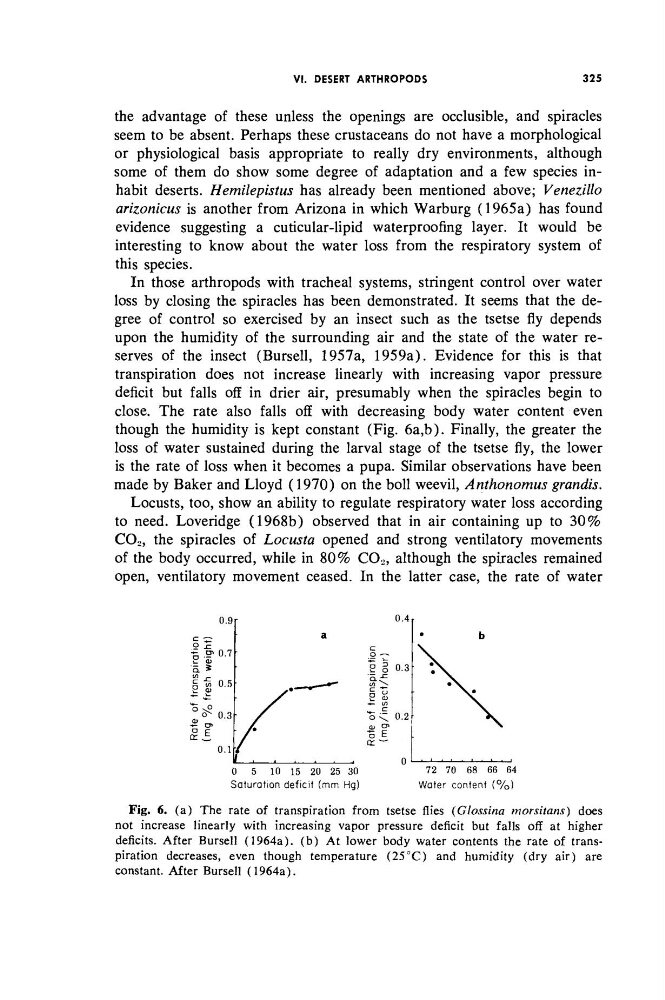
upon the humidity of the surrounding air and the state of the water reserves of the insect (Bursell, 1957a, 1959a). Evidence for this is that
transpiration does not increase linearly with increasing vapor pressure
deficit but falls off in drier air, presumably when the spiracles begin to
close. The rate also falls off with decreasing body water content even
though the humidity is kept constant (Fig. 6a,b). Finally, the greater the
loss of water sustained during the larval stage of the tsetse fly, the lower
is the rate of loss when it becomes a pupa. Similar observations have been
made by Baker and Lloyd (1970) on the boll weevil, Anthonomus grandis.
Locusts, too, show an ability to regulate respiratory water loss according
to need. Loveridge (1968b) observed that in air containing up to 30%
C0 2 , the spiracles of Locusta opened and strong ventilatory movements
of the body occurred, while in 80% C0 2 , although the spiracles remained
open, ventilatory movement ceased. In the latter case, the rate of water
9 Έ
P ΰ
Q *
P 3
°a£
O)
*- σ>
or. £
0.9
Ü.7
0.5
0 3
0.1
II
·
1
i
i
i
.
0 ' ' '
■ ' '
0 5 10 15 20 25 30
72 70 68 66 64
Saturation deficit (mm Hg)
Water content (%)
Fig. 6. (a) The rate of transpiration from tsetse flies (Glossina morsitans) does
not increase linearly with increasing vapor pressure deficit but falls off at higher
deficits. After Bursell (1964a). (b) At lower body water contents the rate of transpiration decreases, even though temperature (25°C) and humidity (dry air) are
constant. After Bursell (1964a).
0.3
o
0)
Π
or
ω
\ σ>
b
—'
0.2
325
the advantage of these unless the openings are occlusible, and spiracles
seem to be absent. Perhaps these crustaceans do not have a morphological
or physiological basis appropriate to really dry environments, although
some of them do show some degree of adaptation and a few species inhabit deserts. Hemilepistus has already been mentioned above; Venezillo
arizonicus is another from Arizona in which Warburg (1965a) has found
evidence suggesting a cuticular-lipid waterproofing layer. It would be
interesting to know about the water loss from the respiratory system of
this species.
In those arthropods with trachéal systems, stringent control over water
loss by closing the spiracles has been demonstrated. It seems that the degree of control so exercised by an insect such as the tsetse fly depends
upon the humidity of the surrounding air and the state of the water reserves of the insect (Bursell, 1957a, 1959a). Evidence for this is that
transpiration does not increase linearly with increasing vapor pressure
deficit but falls off in drier air, presumably when the spiracles begin to
close. The rate also falls off with decreasing body water content even
though the humidity is kept constant (Fig. 6a,b). Finally, the greater the
loss of water sustained during the larval stage of the tsetse fly, the lower
is the rate of loss when it becomes a pupa. Similar observations have been
made by Baker and Lloyd (1970) on the boll weevil, Anthonomus grandis.
Locusts, too, show an ability to regulate respiratory water loss according
to need. Loveridge (1968b) observed that in air containing up to 30%
C0 2 , the spiracles of Locusta opened and strong ventilatory movements
of the body occurred, while in 80% C0 2 , although the spiracles remained
open, ventilatory movement ceased. In the latter case, the rate of water
9 Έ
P ΰ
Q *
P 3
°a£
O)
*- σ>
or. £
0.9
Ü.7
0.5
0 3
0.1
II
·
1
i
i
i
.
0 ' ' '
■ ' '
0 5 10 15 20 25 30
72 70 68 66 64
Saturation deficit (mm Hg)
Water content (%)
Fig. 6. (a) The rate of transpiration from tsetse flies (Glossina morsitans) does
not increase linearly with increasing vapor pressure deficit but falls off at higher
deficits. After Bursell (1964a). (b) At lower body water contents the rate of transpiration decreases, even though temperature (25°C) and humidity (dry air) are
constant. After Bursell (1964a).
0.3
o
0)
Π
or
ω
\ σ>
b
—'
0.2