

Myriapods
Lithobius sp.
Glomeris marginata
Arachnids
Pandinus imperator (scorpion)
Androctonus australis (scorpion)
Leirurus quinquestriatus (scorpion)
Hadrurus arizonensis
d
(scorpion)
Hadrurus hirsutus (scorpion)
Galeodes arabs (solfugid)
Eurypelma sp. (tarantula)
Ixodes ricinus (tick)
Ornithodorus moubata (tick)
Mastigoproctus (Uropygi)
d (whip scorpion)
hygric
hygric
mesic
xeric
xeric
xeric
xeric
xeric
xeric
mesic
xeric
mesic
270
200
82
0.8
2 . 1
2 . 0
25.0
6.6
10.3
60
4 . 0
21.0
792
588
212
2.4
6.2
5.9
74.0
19.4
31.2
176
12
62.0
Mead-Briggs (1956)
Edney (1951)
Cloudsley-Thompson (1959)
Cloudsley-Thompson (1956)
Cloudsley-Thompson (1961a)
Hadley (1970a)
Cloudsley-Thompson (1967)
Cloudsley-Thompson (1961b)
Cloudsley-Thompson (1967)
Lees (1947)
Lees (1947)
Ahearn (1970c)
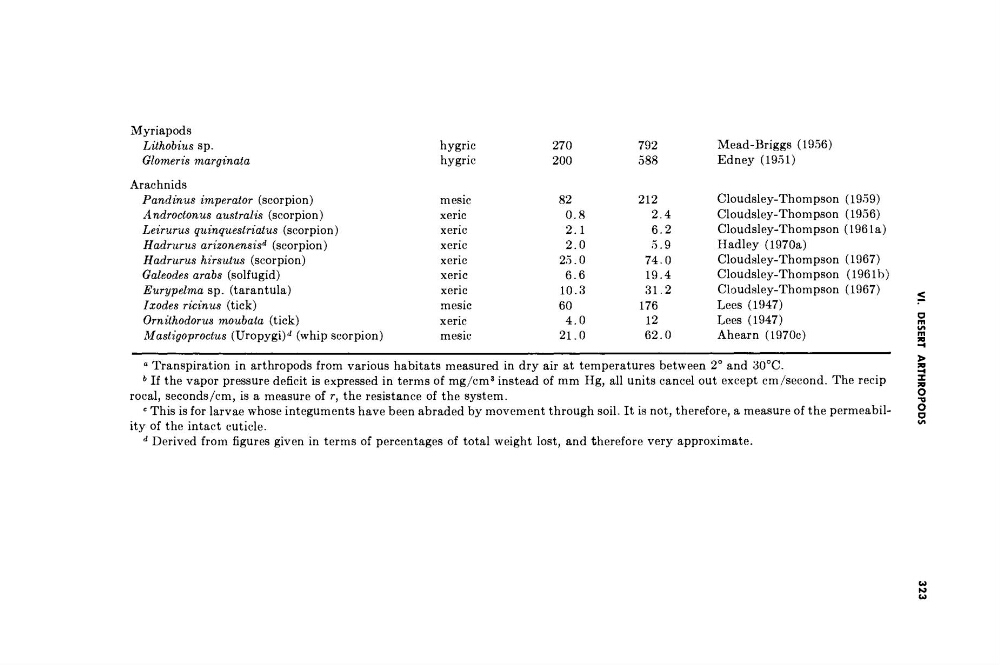
α Transpiration in arthropods from various habitats measured in dry air at temperatures between 2° and 30°C.
6 If the vapor pressure deficit is expressed in terms of m g / c m
3 instead of mm Hg, all units cancel out except cm/second. The recip
rocal, seconds/cm, is a measure of r, the resistance of the system.
c This is for larvae whose integuments have been abraded by movement through soil. It is not, therefore, a measure of the permeability of the intact cuticle.
d Derived from figures given in terms of percentages of total weight lost, and therefore very approximate.
VI. DESERT ARTHROPODS
323
Lithobius sp.
Glomeris marginata
Arachnids
Pandinus imperator (scorpion)
Androctonus australis (scorpion)
Leirurus quinquestriatus (scorpion)
Hadrurus arizonensis
d
(scorpion)
Hadrurus hirsutus (scorpion)
Galeodes arabs (solfugid)
Eurypelma sp. (tarantula)
Ixodes ricinus (tick)
Ornithodorus moubata (tick)
Mastigoproctus (Uropygi)
d (whip scorpion)
hygric
hygric
mesic
xeric
xeric
xeric
xeric
xeric
xeric
mesic
xeric
mesic
270
200
82
0.8
2 . 1
2 . 0
25.0
6.6
10.3
60
4 . 0
21.0
792
588
212
2.4
6.2
5.9
74.0
19.4
31.2
176
12
62.0
Mead-Briggs (1956)
Edney (1951)
Cloudsley-Thompson (1959)
Cloudsley-Thompson (1956)
Cloudsley-Thompson (1961a)
Hadley (1970a)
Cloudsley-Thompson (1967)
Cloudsley-Thompson (1961b)
Cloudsley-Thompson (1967)
Lees (1947)
Lees (1947)
Ahearn (1970c)
α Transpiration in arthropods from various habitats measured in dry air at temperatures between 2° and 30°C.
6 If the vapor pressure deficit is expressed in terms of m g / c m
3 instead of mm Hg, all units cancel out except cm/second. The recip
rocal, seconds/cm, is a measure of r, the resistance of the system.
c This is for larvae whose integuments have been abraded by movement through soil. It is not, therefore, a measure of the permeability of the intact cuticle.
d Derived from figures given in terms of percentages of total weight lost, and therefore very approximate.
VI. DESERT ARTHROPODS
323