

314
E. B. EDNEY
II. The Insect Organization
The great importance of size in matters of heat and water balance is
well known. If certain assumptions are made, it can be shown that the
rate at which a mammal must lose water in order to remain in thermal
equilibrium is proportional to its surface area, and that the absolute
amounts involved become prohibitively large in relation to the total water
reserves in small animals such as kangaroo rats (Schmidt-Nielson, 1954).
For an insect to cool itself by transpiration, the penalty in terms of water
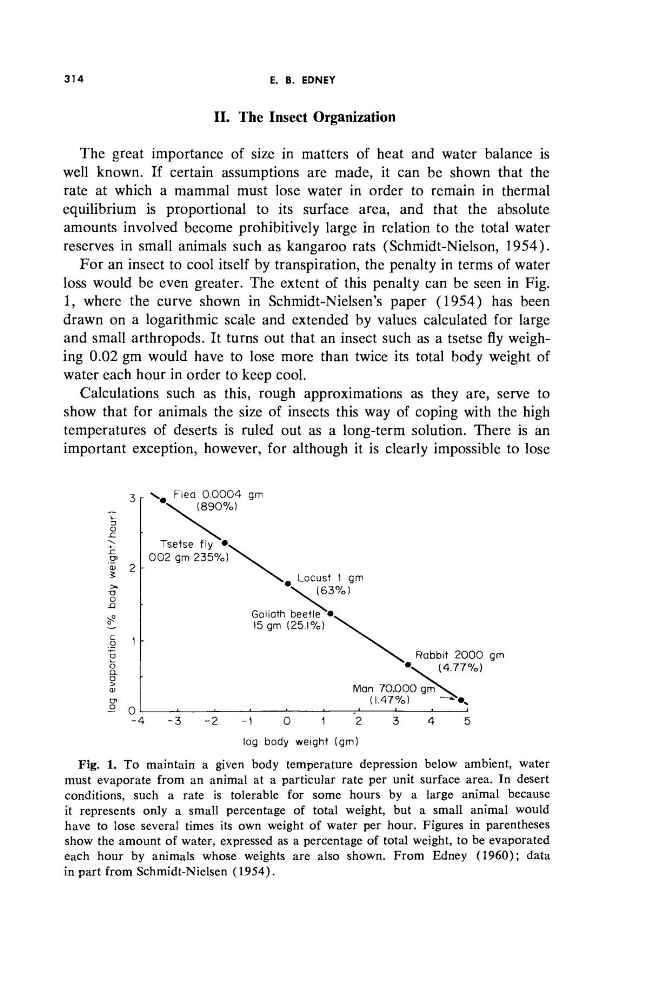
loss would be even greater. The extent of this penalty can be seen in Fig.
1, where the curve shown in Schmidt-Nielsen's paper (1954) has been
drawn on a logarithmic scale and extended by values calculated for large
and small arthropods. It turns out that an insect such as a tsetse fly weighing 0.02 gm would have to lose more than twice its total body weight of
water each hour in order to keep cool.
Calculations such as this, rough approximations as they are, serve to
show that for animals the size of insects this way of coping with the high
temperatures of deserts is ruled out as a long-term solution. There is an
important exception, however, for although it is clearly impossible to lose
3 \
Flea 0.0004 gm
1
· '
(890%)
Tsetse fly · Ν
0 0 2 gm 235%)
2 r
Locust 1 gm
V
(63%)
Goliath beetle · ^
15 gm (25.1%)
Rabbit 2000 gm
(4.77%)
Man 70,000 gm^
(1.47%)
- ^ « L
-
4
-
3
-
2
-
1
0
1
2
3
4
5
log body weight (gm)
Fig. 1. To maintain a given body temperature depression below ambient, water
must evaporate from an animal at a particular rate per unit surface area. In desert
conditions, such a rate is tolerable for some hours by a large animal because
it represents only a small percentage of total weight, but a small animal would
have to lose several times its own weight of water per hour. Figures in parentheses
show the amount of water, expressed as a percentage of total weight, to be evaporated
each hour by animals whose weights are also shown. From Edney (1960); data
in part from Schmidt-Nielsen (1954).
E. B. EDNEY
II. The Insect Organization
The great importance of size in matters of heat and water balance is
well known. If certain assumptions are made, it can be shown that the
rate at which a mammal must lose water in order to remain in thermal
equilibrium is proportional to its surface area, and that the absolute
amounts involved become prohibitively large in relation to the total water
reserves in small animals such as kangaroo rats (Schmidt-Nielson, 1954).
For an insect to cool itself by transpiration, the penalty in terms of water
loss would be even greater. The extent of this penalty can be seen in Fig.
1, where the curve shown in Schmidt-Nielsen's paper (1954) has been
drawn on a logarithmic scale and extended by values calculated for large
and small arthropods. It turns out that an insect such as a tsetse fly weighing 0.02 gm would have to lose more than twice its total body weight of
water each hour in order to keep cool.
Calculations such as this, rough approximations as they are, serve to
show that for animals the size of insects this way of coping with the high
temperatures of deserts is ruled out as a long-term solution. There is an
important exception, however, for although it is clearly impossible to lose
3 \
Flea 0.0004 gm
1
· '
(890%)
Tsetse fly · Ν
0 0 2 gm 235%)
2 r
Locust 1 gm
V
(63%)
Goliath beetle · ^
15 gm (25.1%)
Rabbit 2000 gm
(4.77%)
Man 70,000 gm^
(1.47%)
- ^ « L
-
4
-
3
-
2
-
1
0
1
2
3
4
5
log body weight (gm)
Fig. 1. To maintain a given body temperature depression below ambient, water
must evaporate from an animal at a particular rate per unit surface area. In desert
conditions, such a rate is tolerable for some hours by a large animal because
it represents only a small percentage of total weight, but a small animal would
have to lose several times its own weight of water per hour. Figures in parentheses
show the amount of water, expressed as a percentage of total weight, to be evaporated
each hour by animals whose weights are also shown. From Edney (1960); data
in part from Schmidt-Nielsen (1954).