

VI. DESERT ARTHROPODS
313
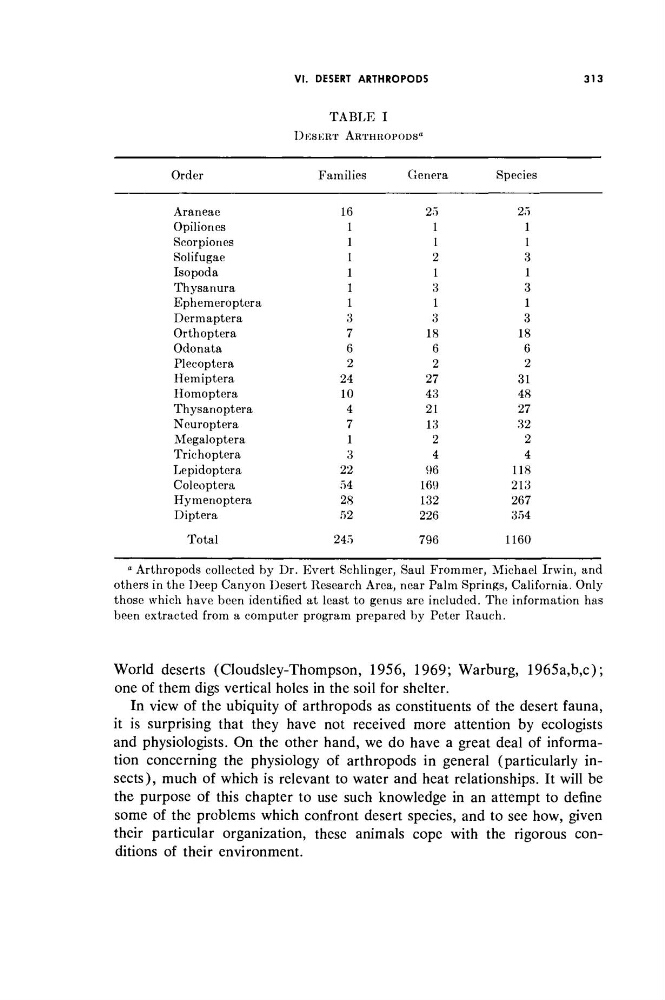
TABLE I
D E S E R T ARTHROPODS
0
Order
Araneae
Opiliones
Scorpiones
Solifugae
Isopoda
Thysanura
Ephemeroptera
Dermaptera
Orthoptera
Odonata
Plecoptera
Hemiptera
Homoptera
Thysanoptera
Neuroptera
Megaloptera
Trichoptera
Lepidoptera
Coleoptera
Hymenoptera
Diptera
Total
Families
16
3
7
6
2
24
10
4
7
1
3
22
54
28
52
245
Genera
25
1
1
2
1
3
1
3
18
6
2
27
43
21
13
2
4
96
169
132
226
796
Species
25
1
1
3
1
3
1
3
18
6
2
31
48
27
32
2
4
118
213
267
354
1160
α Arthropods collected by Dr. Evert Schlinger, Saul Frommer, Michael Irwin, and
others in the Deep Canyon Desert Research Area, near Palm Springs, California. Only
those which have been identified at least to genus are included. The information has
been extracted from a computer program prepared by Peter Rauch.
World deserts (Cloudsley-Thompson, 1956, 1969; Warburg, 1965a,b,c);
one of them digs vertical holes in the soil for shelter.
In view of the ubiquity of arthropods as constituents of the desert fauna,
it is surprising that they have not received more attention by ecologists
and physiologists. On the other hand, we do have a great deal of information concerning the physiology of arthropods in general (particularly insects), much of which is relevant to water and heat relationships. It will be
the purpose of this chapter to use such knowledge in an attempt to define
some of the problems which confront desert species, and to see how, given
their particular organization, these animals cope with the rigorous conditions of their environment.
313
TABLE I
D E S E R T ARTHROPODS
0
Order
Araneae
Opiliones
Scorpiones
Solifugae
Isopoda
Thysanura
Ephemeroptera
Dermaptera
Orthoptera
Odonata
Plecoptera
Hemiptera
Homoptera
Thysanoptera
Neuroptera
Megaloptera
Trichoptera
Lepidoptera
Coleoptera
Hymenoptera
Diptera
Total
Families
16
3
7
6
2
24
10
4
7
1
3
22
54
28
52
245
Genera
25
1
1
2
1
3
1
3
18
6
2
27
43
21
13
2
4
96
169
132
226
796
Species
25
1
1
3
1
3
1
3
18
6
2
31
48
27
32
2
4
118
213
267
354
1160
α Arthropods collected by Dr. Evert Schlinger, Saul Frommer, Michael Irwin, and
others in the Deep Canyon Desert Research Area, near Palm Springs, California. Only
those which have been identified at least to genus are included. The information has
been extracted from a computer program prepared by Peter Rauch.
World deserts (Cloudsley-Thompson, 1956, 1969; Warburg, 1965a,b,c);
one of them digs vertical holes in the soil for shelter.
In view of the ubiquity of arthropods as constituents of the desert fauna,
it is surprising that they have not received more attention by ecologists
and physiologists. On the other hand, we do have a great deal of information concerning the physiology of arthropods in general (particularly insects), much of which is relevant to water and heat relationships. It will be
the purpose of this chapter to use such knowledge in an attempt to define
some of the problems which confront desert species, and to see how, given
their particular organization, these animals cope with the rigorous conditions of their environment.