

VI. DESERT ARTHROPODS
315
water at this rate for an hour, the same rate for a minute or so in emergencies is not out of the question, and as we shall see, there are several
cases where evaporative cooling in arthropods has been demonstrated.
In general, however, even apart from desert environments, any small
animal with pretensions to full terrestrialness must have a relatively waterproof integument, for even at low temperatures their surface-to-volume ratio
is so high that evaporation of water would soon lead to desiccation.
Size, then, is one important aspect of insect organization, and this in
turn implies an impermeable integument. The properties of the integument
are very relevant to our present purpose and may be considered briefly
before proceeding further. Information about the physical and chemical
properties of arthropod cuticles in relation to function has been reviewed
byHackman (1971).
Impermeability is to a large extent conferred by a layer of orientated lipid
molecules near the outer surface, as demonstrated by Beament (1945,
1958, 1961, although theoretical considerations suggest that the apical
membranes of the underlying epithelial cells may be of more importance
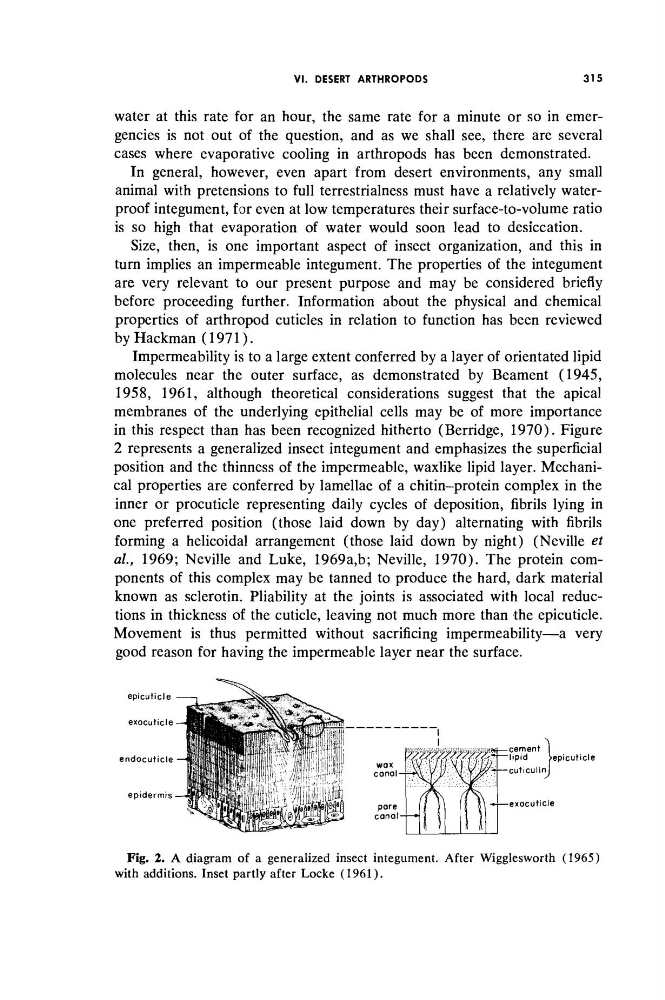
in this respect than has been recognized hitherto (Berridge, 1970). Figure
2 represents a generalized insect integument and emphasizes the superficial
position and the thinness of the impermeable, waxlike lipid layer. Mechanical properties are conferred by lamellae of a chitin-protein complex in the
inner or procuticle representing daily cycles of deposition, fibrils lying in
one preferred position (those laid down by day) alternating with fibrils
forming a hélicoïdal arrangement (those laid down by night) (Neville et
al, 1969; Neville and Luke, 1969a,b; Neville, 1970). The protein components of this complex may be tanned to produce the hard, dark material
known as sclerotin. Pliability at the joints is associated with local reductions in thickness of the cuticle, leaving not much more than the epicuticle.
Movement is thus permitted without sacrificing impermeability—a very
good reason for having the impermeable layer near the surface.
Fig. 2. A diagram of a generalized insect integument. After Wigglesworth (1965)
with additions. Inset partly after Locke (1961).
315
water at this rate for an hour, the same rate for a minute or so in emergencies is not out of the question, and as we shall see, there are several
cases where evaporative cooling in arthropods has been demonstrated.
In general, however, even apart from desert environments, any small
animal with pretensions to full terrestrialness must have a relatively waterproof integument, for even at low temperatures their surface-to-volume ratio
is so high that evaporation of water would soon lead to desiccation.
Size, then, is one important aspect of insect organization, and this in
turn implies an impermeable integument. The properties of the integument
are very relevant to our present purpose and may be considered briefly
before proceeding further. Information about the physical and chemical
properties of arthropod cuticles in relation to function has been reviewed
byHackman (1971).
Impermeability is to a large extent conferred by a layer of orientated lipid
molecules near the outer surface, as demonstrated by Beament (1945,
1958, 1961, although theoretical considerations suggest that the apical
membranes of the underlying epithelial cells may be of more importance
in this respect than has been recognized hitherto (Berridge, 1970). Figure
2 represents a generalized insect integument and emphasizes the superficial
position and the thinness of the impermeable, waxlike lipid layer. Mechanical properties are conferred by lamellae of a chitin-protein complex in the
inner or procuticle representing daily cycles of deposition, fibrils lying in
one preferred position (those laid down by day) alternating with fibrils
forming a hélicoïdal arrangement (those laid down by night) (Neville et
al, 1969; Neville and Luke, 1969a,b; Neville, 1970). The protein components of this complex may be tanned to produce the hard, dark material
known as sclerotin. Pliability at the joints is associated with local reductions in thickness of the cuticle, leaving not much more than the epicuticle.
Movement is thus permitted without sacrificing impermeability—a very
good reason for having the impermeable layer near the surface.
Fig. 2. A diagram of a generalized insect integument. After Wigglesworth (1965)
with additions. Inset partly after Locke (1961).