

298
H. WALTER AND E. STADELMANN
Ash
Ash (%)
Sali cor nia europaea
33
Sa I so la turcomanica
24.5
Halocnemum sirobilaceum 31.5
Halostachys belangeriana 3 I
(% dry weight)
0 l 0 20 30 40 50
Νοζθ'
* " ' " '
Kalidium caspicum
Anabasis aphylla
Salsola rigida
Karelinia caspia
Halimocnemis mollissima
Salsola dendroides
Suaeda microphylla
Haloxylon aphyllum
Anabasis salsa
Anabasis salsa
32.5
18
15.5
16.5
14.5
21
35
22.5
|K20
äso
-%$
1
VA
W///////A
-jsm
V/////////A
5=
225
S
22
'
W
Tamarix laxa
16
% Tamarix romosissima
14.5
σ» Aeluropus litoralis
6
Aeluropus litoralis
1 1
V////////////A
7///////////Λ
*m
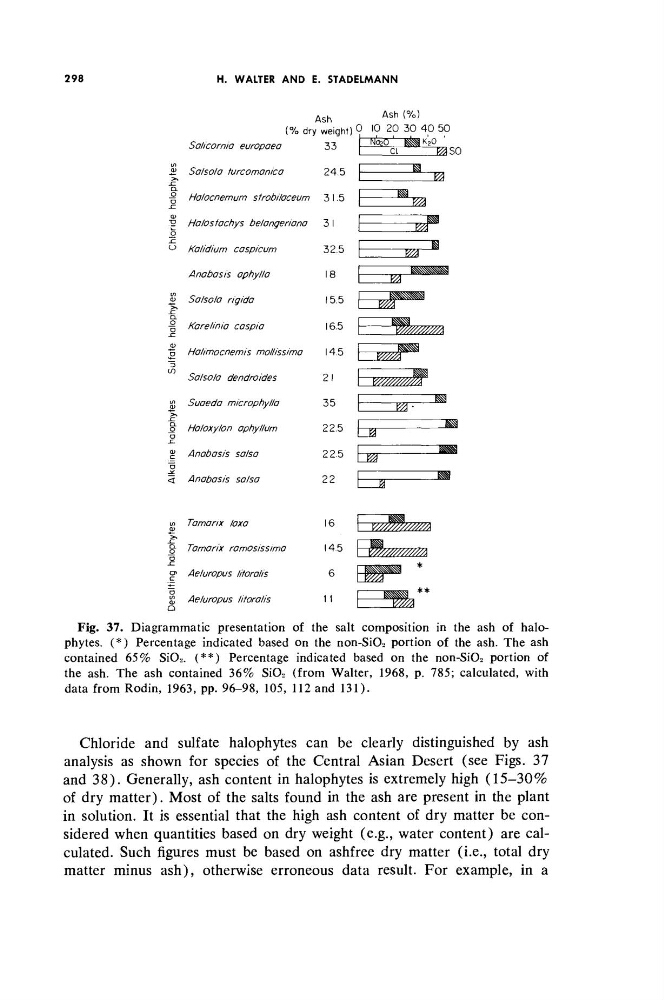
Fig. 37. Diagrammatic presentation of the salt composition in the ash of halophytes. (*) Percentage indicated based on the non-Si0 2 portion of the ash. The ash
contained 65% Si0 2 . (**) Percentage indicated based on the non-Si0 2 portion of
the ash. The ash contained 36% SiO> (from Walter, 1968, p. 785; calculated, with
data from Rodin, 1963, pp. 96-98, 105, 112 and 131).
Chloride and sulfate halophytes can be clearly distinguished by ash
analysis as shown for species of the Central Asian Desert (see Figs. 37
and 38). Generally, ash content in halophytes is extremely high (15-30%
of dry matter). Most of the salts found in the ash are present in the plant
in solution. It is essential that the high ash content of dry matter be considered when quantities based on dry weight (e.g., water content) are calculated. Such figures must be based on ashfree dry matter (i.e., total dry
matter minus ash), otherwise erroneous data result. For example, in a
H. WALTER AND E. STADELMANN
Ash
Ash (%)
Sali cor nia europaea
33
Sa I so la turcomanica
24.5
Halocnemum sirobilaceum 31.5
Halostachys belangeriana 3 I
(% dry weight)
0 l 0 20 30 40 50
Νοζθ'
* " ' " '
Kalidium caspicum
Anabasis aphylla
Salsola rigida
Karelinia caspia
Halimocnemis mollissima
Salsola dendroides
Suaeda microphylla
Haloxylon aphyllum
Anabasis salsa
Anabasis salsa
32.5
18
15.5
16.5
14.5
21
35
22.5
|K20
äso
-%$
1
VA
W///////A
-jsm
V/////////A
5=
225
S
22
'
W
Tamarix laxa
16
% Tamarix romosissima
14.5
σ» Aeluropus litoralis
6
Aeluropus litoralis
1 1
V////////////A
7///////////Λ
*m
Fig. 37. Diagrammatic presentation of the salt composition in the ash of halophytes. (*) Percentage indicated based on the non-Si0 2 portion of the ash. The ash
contained 65% Si0 2 . (**) Percentage indicated based on the non-Si0 2 portion of
the ash. The ash contained 36% SiO> (from Walter, 1968, p. 785; calculated, with
data from Rodin, 1963, pp. 96-98, 105, 112 and 131).
Chloride and sulfate halophytes can be clearly distinguished by ash
analysis as shown for species of the Central Asian Desert (see Figs. 37
and 38). Generally, ash content in halophytes is extremely high (15-30%
of dry matter). Most of the salts found in the ash are present in the plant
in solution. It is essential that the high ash content of dry matter be considered when quantities based on dry weight (e.g., water content) are calculated. Such figures must be based on ashfree dry matter (i.e., total dry
matter minus ash), otherwise erroneous data result. For example, in a