

V. NEW APPROACH TO WATER RELATIONS OF DESERT PLANTS
297
TABLE ΧΧλ^
GROWTH OF Suaeda glauca IN SALINE SOILS'
1
Height of plant (in cm)
Number of branches
Fresh weight of plant (in gm)
Control
39.8
20.6
8.5
Sulfate
salinity
51.2
33.3
22.6
Chloride
salinity
30.6
15.6
10.7
From Strogonov (1964, p . 59, Table 24).
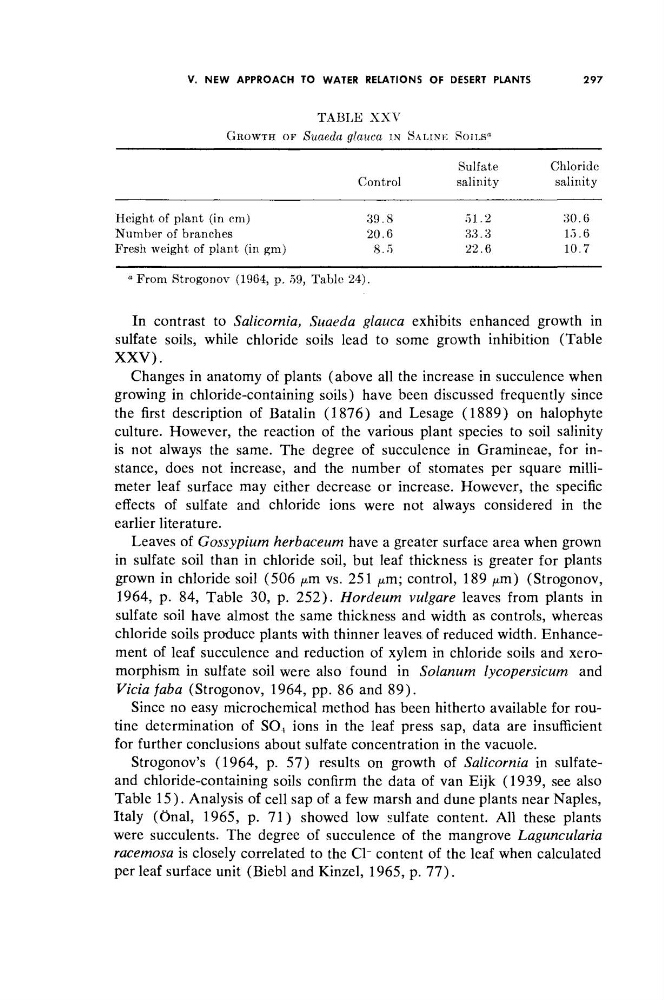
In contrast to Salicornia, Suaeda glauca exhibits enhanced growth in
sulfate soils, while chloride soils lead to some growth inhibition (Table
XXV).
Changes in anatomy of plants (above all the increase in succulence when
growing in chloride-containing soils) have been discussed frequently since
the first description of Batalin (1876) and Lesage (1889) on halophyte
culture. However, the reaction of the various plant species to soil salinity
is not always the same. The degree of succulence in Gramineae, for instance, does not increase, and the number of stomates per square millimeter leaf surface may either decrease or increase. However, the specific
effects of sulfate and chloride ions were not always considered in the
earlier literature.
Leaves of Gossypium herbaceum have a greater surface area when grown
in sulfate soil than in chloride soil, but leaf thickness is greater for plants
grown in chloride soil (506 μτη vs. 251 μπ\; control, 189 μτη) (Strogonov,
1964, p. 84, Table 30, p. 252). Hordeum vulgäre leaves from plants in
sulfate soil have almost the same thickness and width as controls, whereas
chloride soils produce plants with thinner leaves of reduced width. Enhancement of leaf succulence and reduction of xylem in chloride soils and xeromorphism in sulfate soil were also found in Solarium lycopersicum and
Vicia faba (Strogonov, 1964, pp. 86 and 89).
Since no easy microchemical method has been hitherto available for routine determination of S0 4 ions in the leaf press sap, data are insufficient
for further conclusions about sulfate concentration in the vacuole.
Strogonov's (1964, p. 57) results on growth of Salicornia in sulfateand chloride-containing soils confirm the data of van Eijk (1939, see also
Table 15). Analysis of cell sap of a few marsh and dune plants near Naples,
Italy (Önal, 1965, p. 71) showed low sulfate content. All these plants
were succulents. The degree of succulence of the mangrove Laguncularia
racemosa is closely correlated to the Cl
_
content of the leaf when calculated
per leaf surface unit (Biebl and Kinzel, 1965, p. 77).
297
TABLE ΧΧλ^
GROWTH OF Suaeda glauca IN SALINE SOILS'
1
Height of plant (in cm)
Number of branches
Fresh weight of plant (in gm)
Control
39.8
20.6
8.5
Sulfate
salinity
51.2
33.3
22.6
Chloride
salinity
30.6
15.6
10.7
From Strogonov (1964, p . 59, Table 24).
In contrast to Salicornia, Suaeda glauca exhibits enhanced growth in
sulfate soils, while chloride soils lead to some growth inhibition (Table
XXV).
Changes in anatomy of plants (above all the increase in succulence when
growing in chloride-containing soils) have been discussed frequently since
the first description of Batalin (1876) and Lesage (1889) on halophyte
culture. However, the reaction of the various plant species to soil salinity
is not always the same. The degree of succulence in Gramineae, for instance, does not increase, and the number of stomates per square millimeter leaf surface may either decrease or increase. However, the specific
effects of sulfate and chloride ions were not always considered in the
earlier literature.
Leaves of Gossypium herbaceum have a greater surface area when grown
in sulfate soil than in chloride soil, but leaf thickness is greater for plants
grown in chloride soil (506 μτη vs. 251 μπ\; control, 189 μτη) (Strogonov,
1964, p. 84, Table 30, p. 252). Hordeum vulgäre leaves from plants in
sulfate soil have almost the same thickness and width as controls, whereas
chloride soils produce plants with thinner leaves of reduced width. Enhancement of leaf succulence and reduction of xylem in chloride soils and xeromorphism in sulfate soil were also found in Solarium lycopersicum and
Vicia faba (Strogonov, 1964, pp. 86 and 89).
Since no easy microchemical method has been hitherto available for routine determination of S0 4 ions in the leaf press sap, data are insufficient
for further conclusions about sulfate concentration in the vacuole.
Strogonov's (1964, p. 57) results on growth of Salicornia in sulfateand chloride-containing soils confirm the data of van Eijk (1939, see also
Table 15). Analysis of cell sap of a few marsh and dune plants near Naples,
Italy (Önal, 1965, p. 71) showed low sulfate content. All these plants
were succulents. The degree of succulence of the mangrove Laguncularia
racemosa is closely correlated to the Cl
_
content of the leaf when calculated
per leaf surface unit (Biebl and Kinzel, 1965, p. 77).