

288
H. WALTER AND E. STADELMANN
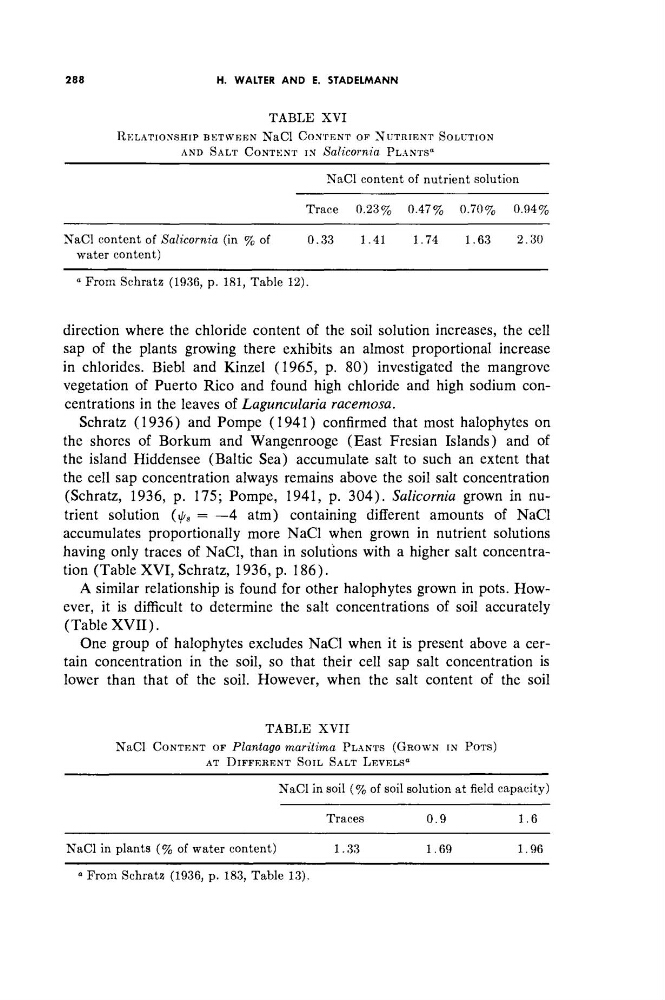
TABLE X V I
RELATIONSHIP BETWEEN NaCl CONTENT OF N U T R I E N T SOLUTION
AND SALT CONTENT IN SaHcornia P L A N T S
0
NaCl content of nutrient solution
Trace
0.23% 0.47% 0.70% 0.94%
NaCl content of SaHcornia (in % of
0 . 3 3
1.41
1.74
1.63
2. 30
water content)
« From Schratz (1936, p. 181, Table 12).
direction where the chloride content of the soil solution increases, the cell
sap of the plants growing there exhibits an almost proportional increase
in chlorides. Biebl and Kinzel (1965, p. 80) investigated the mangrove
vegetation of Puerto Rico and found high chloride and high sodium concentrations in the leaves of Laguncularia racemosa.
Schratz (1936) and Pompe (1941) confirmed that most halophytes on
the shores of Borkum and Wangenrooge (East Fresian Islands) and of
the island Hiddensee (Baltic Sea) accumulate salt to such an extent that
the cell sap concentration always remains above the soil salt concentration
(Schratz, 1936, p. 175; Pompe, 1941, p. 304). SaHcornia grown in nutrient solution (φ 8 = —4 atm) containing different amounts of NaCl
accumulates proportionally more NaCl when grown in nutrient solutions
having only traces of NaCl, than in solutions with a higher salt concentration (Table XVI, Schratz, 1936, p. 186).
A similar relationship is found for other halophytes grown in pots. However, it is difficult to determine the salt concentrations of soil accurately
(Table XVII).
One group of halophytes excludes NaCl when it is present above a certain concentration in the soil, so that their cell sap salt concentration is
lower than that of the soil. However, when the salt content of the soil
TABLE X V I I
NaCl CONTENT OF Plantago maritima PLANTS (GROWN IN P O T S )
AT D I F F E R E N T SOIL SALT L E V E L S
0
NaCl in plants (% of water content)
NaCl in soil (% of soil solution at field capacity)
Traces
1.33
0.9
1.69
1.6
1.96
• From Schratz (1936, p . 183, Table 13).
H. WALTER AND E. STADELMANN
TABLE X V I
RELATIONSHIP BETWEEN NaCl CONTENT OF N U T R I E N T SOLUTION
AND SALT CONTENT IN SaHcornia P L A N T S
0
NaCl content of nutrient solution
Trace
0.23% 0.47% 0.70% 0.94%
NaCl content of SaHcornia (in % of
0 . 3 3
1.41
1.74
1.63
2. 30
water content)
« From Schratz (1936, p. 181, Table 12).
direction where the chloride content of the soil solution increases, the cell
sap of the plants growing there exhibits an almost proportional increase
in chlorides. Biebl and Kinzel (1965, p. 80) investigated the mangrove
vegetation of Puerto Rico and found high chloride and high sodium concentrations in the leaves of Laguncularia racemosa.
Schratz (1936) and Pompe (1941) confirmed that most halophytes on
the shores of Borkum and Wangenrooge (East Fresian Islands) and of
the island Hiddensee (Baltic Sea) accumulate salt to such an extent that
the cell sap concentration always remains above the soil salt concentration
(Schratz, 1936, p. 175; Pompe, 1941, p. 304). SaHcornia grown in nutrient solution (φ 8 = —4 atm) containing different amounts of NaCl
accumulates proportionally more NaCl when grown in nutrient solutions
having only traces of NaCl, than in solutions with a higher salt concentration (Table XVI, Schratz, 1936, p. 186).
A similar relationship is found for other halophytes grown in pots. However, it is difficult to determine the salt concentrations of soil accurately
(Table XVII).
One group of halophytes excludes NaCl when it is present above a certain concentration in the soil, so that their cell sap salt concentration is
lower than that of the soil. However, when the salt content of the soil
TABLE X V I I
NaCl CONTENT OF Plantago maritima PLANTS (GROWN IN P O T S )
AT D I F F E R E N T SOIL SALT L E V E L S
0
NaCl in plants (% of water content)
NaCl in soil (% of soil solution at field capacity)
Traces
1.33
0.9
1.69
1.6
1.96
• From Schratz (1936, p . 183, Table 13).