

V. NEW APPROACH TO WATER RELATIONS OF DESERT PLANTS
289
TABLE X V I I I
NaCl CONTP:NT OF SOME P L A N T SPECIES AT D I F F E R E N T NaCl CONCENTRATIONS
OF THE SOIL SOLUTION
0 ·
6
Plant species
NaCl in soil (%)
c NaCl in plant (%)
d
Pucciniella
maritima
Aster tripolium
Malcolmia maritima
Lepidium sativum (Glycophyte)
0.32
1.06
1.4.5
1.75
0.07
0.60
2.18
2.48
0.20
0.67
1.61
2.65
0.07
1.20
1.47
2.85
0.79
1.15
1.46
1.52
0.45
1.19
1.38
1.89
0.37
0.63
0.76
1.26
traces
0.90
1.02
1.65
° Plants grown in pots.
b After Schratz (1936, p . 183, Table 14).
c In % of the soil solution a t field capacity.
d I n % of water content.
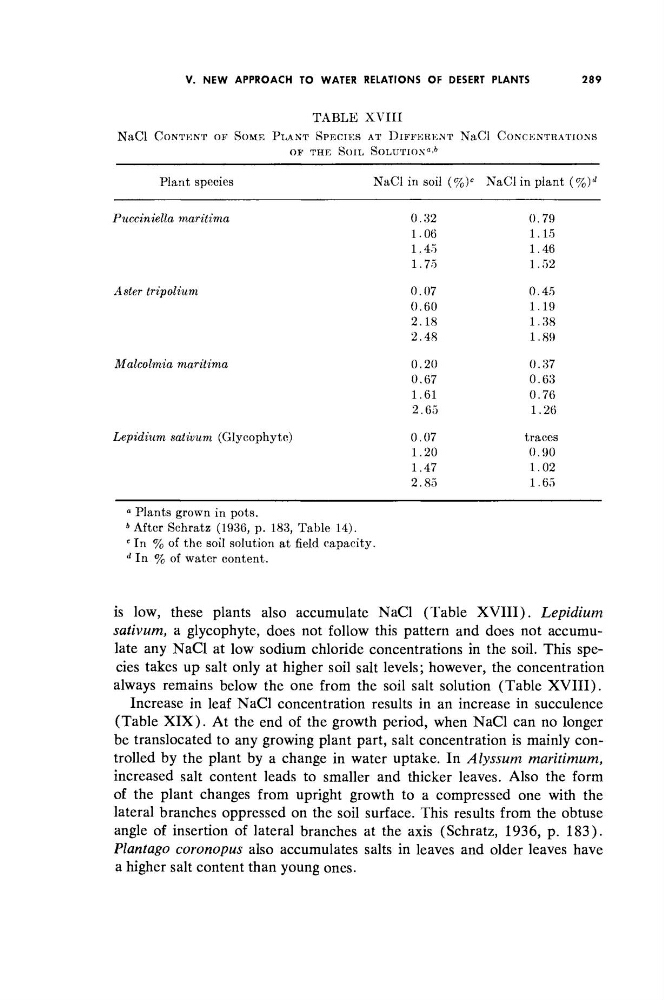
is low, these plants also accumulate NaCl (Table XVIII). Lepidium
sativum, a glycophyte, does not follow this pattern and does not accumulate any NaCl at low sodium chloride concentrations in the soil. This species takes up salt only at higher soil salt levels; however, the concentration
always remains, below the one from the soil salt solution (Table XVIII).
Increase in leaf NaCl concentration results in an increase in succulence
(Table XIX). At the end of the growth period, when NaCl can no longer
be translocated to any growing plant part, salt concentration is mainly controlled by the plant by a change in water uptake. In Alyssum maritimum,
increased salt content leads to smaller and thicker leaves. Also the form
of the plant changes from upright growth to a compressed one with the
lateral branches oppressed on the soil surface. This results from the obtuse
angle of insertion of lateral branches at the axis (Schratz, 1936, p. 183).
Plant ago coronopus also accumulates salts in leaves and older leaves have
a higher salt content than young ones.
289
TABLE X V I I I
NaCl CONTP:NT OF SOME P L A N T SPECIES AT D I F F E R E N T NaCl CONCENTRATIONS
OF THE SOIL SOLUTION
0 ·
6
Plant species
NaCl in soil (%)
c NaCl in plant (%)
d
Pucciniella
maritima
Aster tripolium
Malcolmia maritima
Lepidium sativum (Glycophyte)
0.32
1.06
1.4.5
1.75
0.07
0.60
2.18
2.48
0.20
0.67
1.61
2.65
0.07
1.20
1.47
2.85
0.79
1.15
1.46
1.52
0.45
1.19
1.38
1.89
0.37
0.63
0.76
1.26
traces
0.90
1.02
1.65
° Plants grown in pots.
b After Schratz (1936, p . 183, Table 14).
c In % of the soil solution a t field capacity.
d I n % of water content.
is low, these plants also accumulate NaCl (Table XVIII). Lepidium
sativum, a glycophyte, does not follow this pattern and does not accumulate any NaCl at low sodium chloride concentrations in the soil. This species takes up salt only at higher soil salt levels; however, the concentration
always remains, below the one from the soil salt solution (Table XVIII).
Increase in leaf NaCl concentration results in an increase in succulence
(Table XIX). At the end of the growth period, when NaCl can no longer
be translocated to any growing plant part, salt concentration is mainly controlled by the plant by a change in water uptake. In Alyssum maritimum,
increased salt content leads to smaller and thicker leaves. Also the form
of the plant changes from upright growth to a compressed one with the
lateral branches oppressed on the soil surface. This results from the obtuse
angle of insertion of lateral branches at the axis (Schratz, 1936, p. 183).
Plant ago coronopus also accumulates salts in leaves and older leaves have
a higher salt content than young ones.