

V. NEW APPROACH TO WATER RELATIONS OF DESERT PLANTS
287
tial (—30 to —35 atm) is on the average about 75-80% (i.e., —24
to —25 atm). The remaining portion of all the osmotically active material
of the cell sap only contributes —5 to —10 atm to the total osmotic potential of the cell sap. The concentration of the sodium ion in expressed
sap was always less than that of the chloride ion, with the exception of
A triplex hastata. Most likely, the excess chloride ions are neutralized by
potassium ions. The expressed sap of A triplex hastata has a higher concentration of sodium ions than of chloride ions. The excess sodium in this
case probably is neutralized by sufate ions or organic anions.
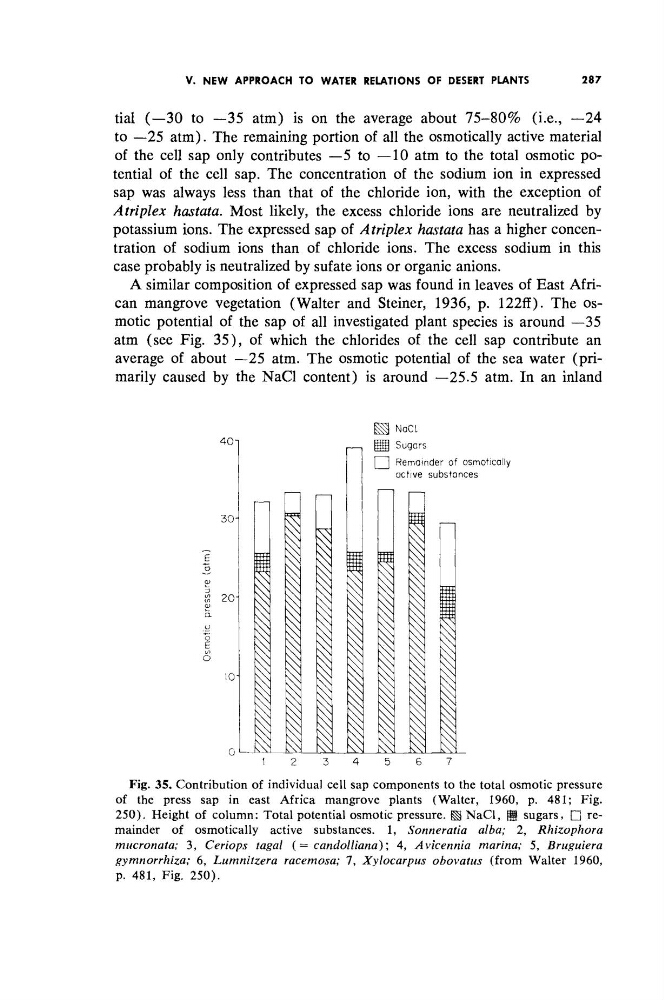
A similar composition of expressed sap was found in leaves of East African mangrove vegetation (Walter and Steiner, 1936, p. 122ff). The osmotic potential of the sap of all investigated plant species is around —35
atm (see Fig. 35), of which the chlorides of the cell sap contribute an
average of about —25 atm. The osmotic potential of the sea water (primarily caused by the NaCl content) is around —25.5 atm. In an inland
˧3 NaCl
| | Remainder of osmotically
active substances
Fig. 35. Contribution of individual cell sap components to the total osmotic pressure
of the press sap in east Africa mangrove plants (Walter, 1960, p. 481; Fig.
250). Height of column: Total potential osmotic pressure. ^ NaCl, H sugars, □ remainder of osmotically active substances. 1, Sonneratia
alba; 2,
Rhizophora
mucronata; 3, Ceriops tagal ( = candolliana) ; 4, Avicennia marina; 5, Bruguiera
gymnorrhiza; 6, Lumnitzera racemosa; 7, Xylocarpus obovatus (from Walter 1960,
p. 481, Fig. 250).
287
tial (—30 to —35 atm) is on the average about 75-80% (i.e., —24
to —25 atm). The remaining portion of all the osmotically active material
of the cell sap only contributes —5 to —10 atm to the total osmotic potential of the cell sap. The concentration of the sodium ion in expressed
sap was always less than that of the chloride ion, with the exception of
A triplex hastata. Most likely, the excess chloride ions are neutralized by
potassium ions. The expressed sap of A triplex hastata has a higher concentration of sodium ions than of chloride ions. The excess sodium in this
case probably is neutralized by sufate ions or organic anions.
A similar composition of expressed sap was found in leaves of East African mangrove vegetation (Walter and Steiner, 1936, p. 122ff). The osmotic potential of the sap of all investigated plant species is around —35
atm (see Fig. 35), of which the chlorides of the cell sap contribute an
average of about —25 atm. The osmotic potential of the sea water (primarily caused by the NaCl content) is around —25.5 atm. In an inland
˧3 NaCl
| | Remainder of osmotically
active substances
Fig. 35. Contribution of individual cell sap components to the total osmotic pressure
of the press sap in east Africa mangrove plants (Walter, 1960, p. 481; Fig.
250). Height of column: Total potential osmotic pressure. ^ NaCl, H sugars, □ remainder of osmotically active substances. 1, Sonneratia
alba; 2,
Rhizophora
mucronata; 3, Ceriops tagal ( = candolliana) ; 4, Avicennia marina; 5, Bruguiera
gymnorrhiza; 6, Lumnitzera racemosa; 7, Xylocarpus obovatus (from Walter 1960,
p. 481, Fig. 250).