

194
E. IMRE FRIEDMANN AND MARGALITH GALUN
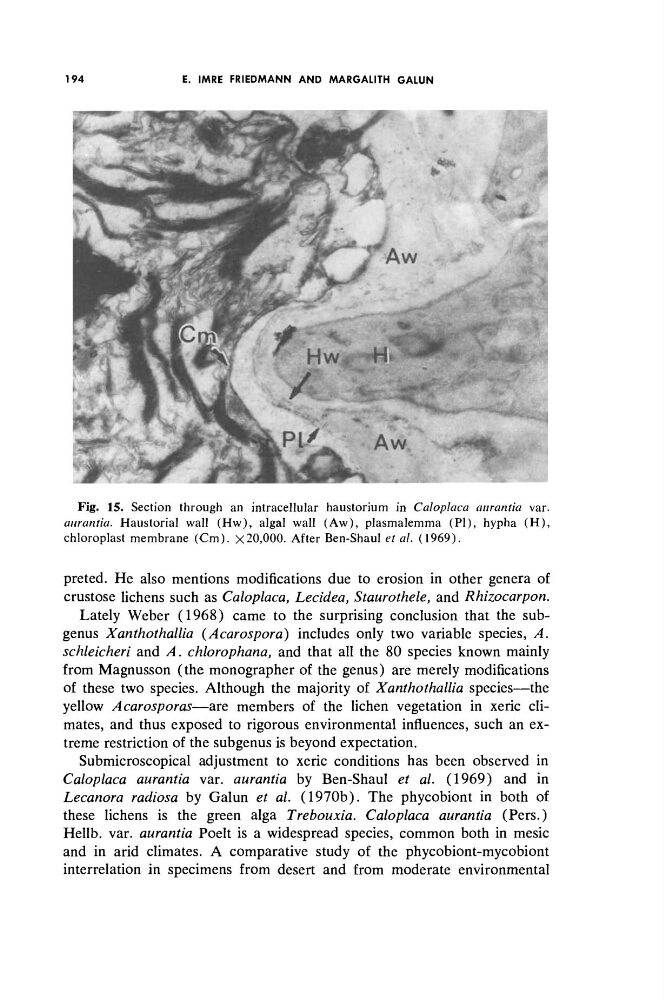
Fig. 15. Section through an intracellular haustorium in Caloplaca aurantia var.
aurantia. Haustorial wall (Hw), algal wall (Aw), plasmalemma (PI), hypha (H),
chloroplast membrane (Cm), χ20,000. After Ben-Shaul et al. (1969).
preted. He also mentions modifications due to erosion in other genera of
crustose lichens such as Caloplaca, Lecidea, Staurothele, and Rhizocarpon.
Lately Weber (1968) came to the surprising conclusion that the subgenus Xanthothallia (Acarospora) includes only two variable species, A.
schleichen and A. chlorophana, and that all the 80 species known mainly
from Magnusson (the monographer of the genus) are merely modifications
of these two species. Although the majority of Xanthothallia species—the
yellow Acarosporas—are members of the lichen vegetation in xeric climates, and thus exposed to rigorous environmental influences, such an extreme restriction of the subgenus is beyond expectation.
Submicroscopical adjustment to xeric conditions has been observed in
Caloplaca aurantia var. aurantia by Ben-Shaul et al. (1969) and in
Lecanora radiosa by Galun et al. (1970b). The phycobiont in both of
these lichens is the green alga Trebouxia. Caloplaca aurantia (Pers.)
Hellb. var. aurantia Poelt is a widespread species, common both in mesic
and in arid climates. A comparative study of the phycobiont-mycobiont
interrelation in specimens from desert and from moderate environmental
E. IMRE FRIEDMANN AND MARGALITH GALUN
Fig. 15. Section through an intracellular haustorium in Caloplaca aurantia var.
aurantia. Haustorial wall (Hw), algal wall (Aw), plasmalemma (PI), hypha (H),
chloroplast membrane (Cm), χ20,000. After Ben-Shaul et al. (1969).
preted. He also mentions modifications due to erosion in other genera of
crustose lichens such as Caloplaca, Lecidea, Staurothele, and Rhizocarpon.
Lately Weber (1968) came to the surprising conclusion that the subgenus Xanthothallia (Acarospora) includes only two variable species, A.
schleichen and A. chlorophana, and that all the 80 species known mainly
from Magnusson (the monographer of the genus) are merely modifications
of these two species. Although the majority of Xanthothallia species—the
yellow Acarosporas—are members of the lichen vegetation in xeric climates, and thus exposed to rigorous environmental influences, such an extreme restriction of the subgenus is beyond expectation.
Submicroscopical adjustment to xeric conditions has been observed in
Caloplaca aurantia var. aurantia by Ben-Shaul et al. (1969) and in
Lecanora radiosa by Galun et al. (1970b). The phycobiont in both of
these lichens is the green alga Trebouxia. Caloplaca aurantia (Pers.)
Hellb. var. aurantia Poelt is a widespread species, common both in mesic
and in arid climates. A comparative study of the phycobiont-mycobiont
interrelation in specimens from desert and from moderate environmental