

IV. DESERT ALGAE, LICHENS, AND FUNGI
193
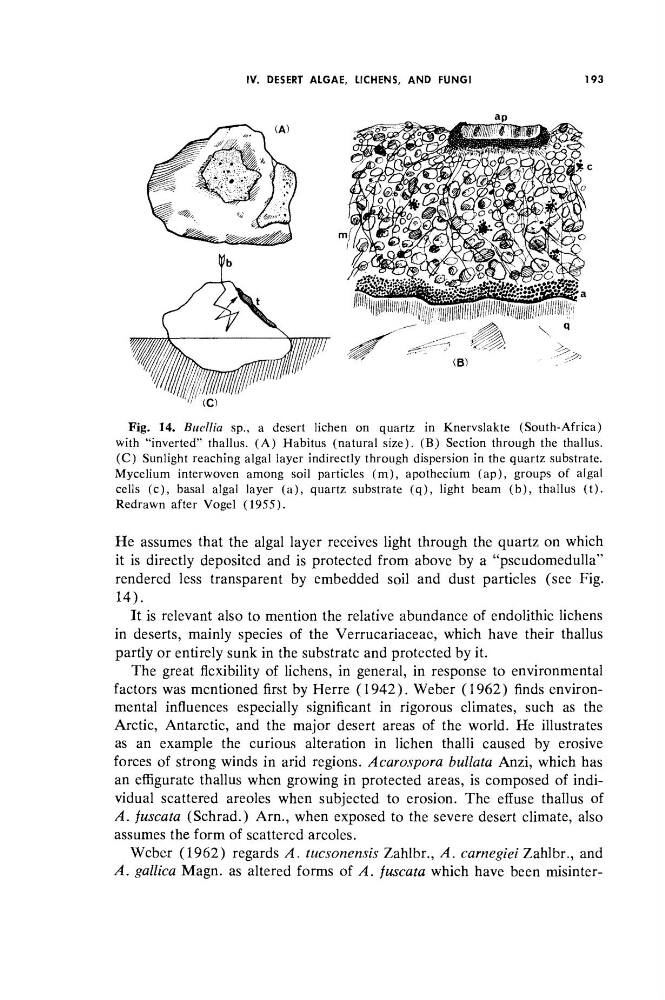
Fig. 14. Buellia sp., a desert lichen on quartz in Knervslakte (South-Africa)
with "inverted" thallus. (A) Habitus (natural size). (B) Section through the thallus.
(C) Sunlight reaching algal layer indirectly through dispersion in the quartz substrate.
Mycelium interwoven among soil particles (m), apothecium (ap), groups of algal
cells (c), basal algal layer (a), quartz substrate (q), light beam (b), thallus (t).
Redrawn after Vogel (1955).
He assumes that the algal layer receives light through the quartz on which
it is directly deposited and is protected from above by a "pseudomedulla"
rendered less transparent by embedded soil and dust particles (see Fig.
14).
It is relevant also to mention the relative abundance of endolithic lichens
in deserts, mainly species of the Verrucariaceae, which have their thallus
partly or entirely sunk in the substrate and protected by it.
The great flexibility of lichens, in general, in response to environmental
factors was mentioned first by Herre (1942). Weber (1962) finds environmental influences especially significant in rigorous climates, such as the
Arctic, Antarctic, and the major desert areas of the world. He illustrates
as an example the curious alteration in lichen thalli caused by erosive
forces of strong winds in arid regions. Acarospora bullata Anzi, which has
an effigurate thallus when growing in protected areas, is composed of individual scattered aréoles when subjected to erosion. The effuse thallus of
A. fuscata (Schrad.) Arn., when exposed to the severe desert climate, also
assumes the form of scattered aréoles.
Weber (1962) regards A. tucsonensis Zahlbr., A. carnegiei Zahlbr., and
A. gallica Magn. as altered forms of A. fuscata which have been misinter-
193
Fig. 14. Buellia sp., a desert lichen on quartz in Knervslakte (South-Africa)
with "inverted" thallus. (A) Habitus (natural size). (B) Section through the thallus.
(C) Sunlight reaching algal layer indirectly through dispersion in the quartz substrate.
Mycelium interwoven among soil particles (m), apothecium (ap), groups of algal
cells (c), basal algal layer (a), quartz substrate (q), light beam (b), thallus (t).
Redrawn after Vogel (1955).
He assumes that the algal layer receives light through the quartz on which
it is directly deposited and is protected from above by a "pseudomedulla"
rendered less transparent by embedded soil and dust particles (see Fig.
14).
It is relevant also to mention the relative abundance of endolithic lichens
in deserts, mainly species of the Verrucariaceae, which have their thallus
partly or entirely sunk in the substrate and protected by it.
The great flexibility of lichens, in general, in response to environmental
factors was mentioned first by Herre (1942). Weber (1962) finds environmental influences especially significant in rigorous climates, such as the
Arctic, Antarctic, and the major desert areas of the world. He illustrates
as an example the curious alteration in lichen thalli caused by erosive
forces of strong winds in arid regions. Acarospora bullata Anzi, which has
an effigurate thallus when growing in protected areas, is composed of individual scattered aréoles when subjected to erosion. The effuse thallus of
A. fuscata (Schrad.) Arn., when exposed to the severe desert climate, also
assumes the form of scattered aréoles.
Weber (1962) regards A. tucsonensis Zahlbr., A. carnegiei Zahlbr., and
A. gallica Magn. as altered forms of A. fuscata which have been misinter-