

Β. C 2 7 Sterols
conjecture was fully confirmed only two years later when Tsuda and coworkers (1960) isolated the sterol from the red alga Hypnea japonica. A
further isolation was reported by the Canadian group (Tamura et al, 1964)
from the scallop Placopecten magellanicus. The Canadian workers checked
the homogeneity of their sterol by glc and compared it directly with the
algal compound (Tsuda et al, 1960), which had been purified by the earlier
technique of column chromatography of the azobenzoyl ester (Idler and
Baumann, 1952).
4. CHOLESTA-5,24-DIEN-3£-OL (24-DEHYDROCHOLESTEROL, DESMOSTEROL)
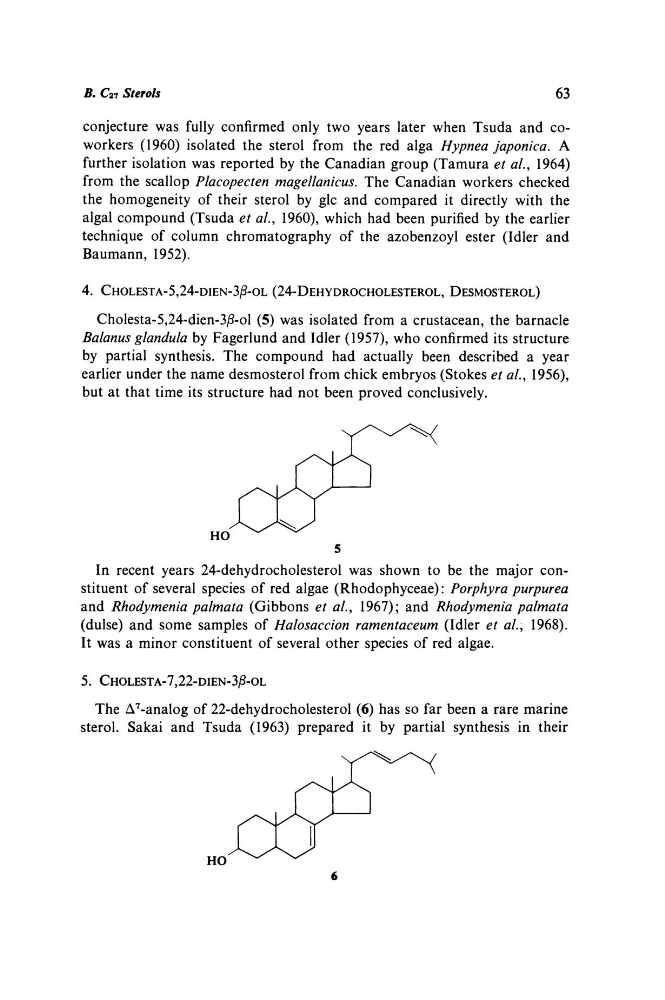
Cholesta-5,24-dien-3ß-ol (5) was isolated from a crustacean, the barnacle
Balanus glandula by Fagerlund and Idler (1957), who confirmed its structure
by partial synthesis. The compound had actually been described a year
earlier under the name desmosterol from chick embryos (Stokes et al, 1956),
but at that time its structure had not been proved conclusively.
5
In recent years 24-dehydrocholesterol was shown to be the major constituent of several species of red algae (Rhodophyceae) : Porphyra purpurea
and Rhodymenia palmata (Gibbons et al, 1967); and Rhodymenia
palmata
(dulse) and some samples of Halosaccion ramentaceum (Idler et al.; 1968).
It was a minor constituent of several other species of red algae.
5. CHOLESTA-7,22-DIEN-3/?-OL
The A
7 -analog of 22-dehydrocholesterol (6) has so far been a rare marine
sterol. Sakai and Tsuda (1963) prepared it by partial synthesis in their
6
conjecture was fully confirmed only two years later when Tsuda and coworkers (1960) isolated the sterol from the red alga Hypnea japonica. A
further isolation was reported by the Canadian group (Tamura et al, 1964)
from the scallop Placopecten magellanicus. The Canadian workers checked
the homogeneity of their sterol by glc and compared it directly with the
algal compound (Tsuda et al, 1960), which had been purified by the earlier
technique of column chromatography of the azobenzoyl ester (Idler and
Baumann, 1952).
4. CHOLESTA-5,24-DIEN-3£-OL (24-DEHYDROCHOLESTEROL, DESMOSTEROL)
Cholesta-5,24-dien-3ß-ol (5) was isolated from a crustacean, the barnacle
Balanus glandula by Fagerlund and Idler (1957), who confirmed its structure
by partial synthesis. The compound had actually been described a year
earlier under the name desmosterol from chick embryos (Stokes et al, 1956),
but at that time its structure had not been proved conclusively.
5
In recent years 24-dehydrocholesterol was shown to be the major constituent of several species of red algae (Rhodophyceae) : Porphyra purpurea
and Rhodymenia palmata (Gibbons et al, 1967); and Rhodymenia
palmata
(dulse) and some samples of Halosaccion ramentaceum (Idler et al.; 1968).
It was a minor constituent of several other species of red algae.
5. CHOLESTA-7,22-DIEN-3/?-OL
The A
7 -analog of 22-dehydrocholesterol (6) has so far been a rare marine
sterol. Sakai and Tsuda (1963) prepared it by partial synthesis in their
6