

62
2. Sterols
4
2. CHOLEST-7-EN-3/?-OL (A
7 -CHOLESTENOL, LATHOSTEROL)
A
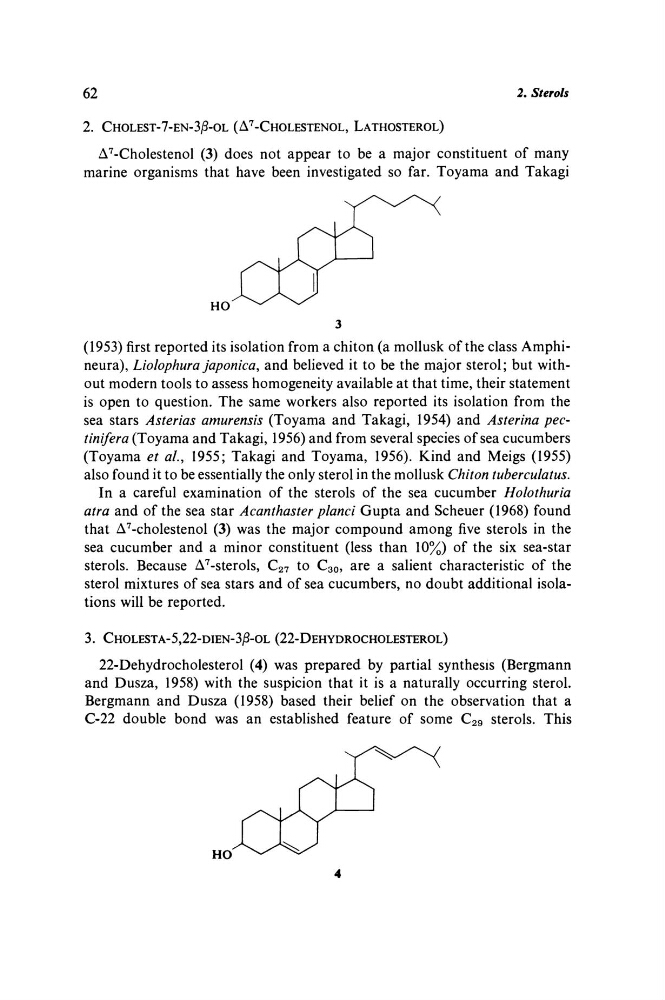
7 -Cholestenol (3) does not appear to be a major constituent of many
marine organisms that have been investigated so far. Toyama and Takagi
3
(1953) first reported its isolation from a chiton (a mollusk of the class Amphineura), Liolophura japonica, and believed it to be the major sterol; but without modern tools to assess homogeneity available at that time, their statement
is open to question. The same workers also reported its isolation from the
sea stars Asterias amurensis (Toyama and Takagi, 1954) and Asterina pectinifera (Toyama and Takagi, 1956) and from several species of sea cucumbers
(Toyama et al, 1955; Takagi and Toyama, 1956). Kind and Meigs (1955)
also found it to be essentially the only sterol in the mollusk Chiton tuberculatus.
In a careful examination of the sterols of the sea cucumber Holothuria
atra and of the sea star Acanthaster planci Gupta and Scheuer (1968) found
that A
7 -cholestenol (3) was the major compound among five sterols in the
sea cucumber and a minor constituent (less than 10%) of the six sea-star
sterols. Because A
7 -sterols, C 27 to C 3 0 , are a salient characteristic of the
sterol mixtures of sea stars and of sea cucumbers, no doubt additional isolations will be reported.
3. CHOLESTA-5,22-DIEN-3J8-OL (22-DEHYDROCHOLESTEROL)
22-Dehydrocholesterol (4) was prepared by partial synthesis (Bergmann
and Dusza, 1958) with the suspicion that it is a naturally occurring sterol.
Bergmann and Dusza (1958) based their belief on the observation that a
C-22 double bond was an established feature of some C 29 sterols. This
2. Sterols
4
2. CHOLEST-7-EN-3/?-OL (A
7 -CHOLESTENOL, LATHOSTEROL)
A
7 -Cholestenol (3) does not appear to be a major constituent of many
marine organisms that have been investigated so far. Toyama and Takagi
3
(1953) first reported its isolation from a chiton (a mollusk of the class Amphineura), Liolophura japonica, and believed it to be the major sterol; but without modern tools to assess homogeneity available at that time, their statement
is open to question. The same workers also reported its isolation from the
sea stars Asterias amurensis (Toyama and Takagi, 1954) and Asterina pectinifera (Toyama and Takagi, 1956) and from several species of sea cucumbers
(Toyama et al, 1955; Takagi and Toyama, 1956). Kind and Meigs (1955)
also found it to be essentially the only sterol in the mollusk Chiton tuberculatus.
In a careful examination of the sterols of the sea cucumber Holothuria
atra and of the sea star Acanthaster planci Gupta and Scheuer (1968) found
that A
7 -cholestenol (3) was the major compound among five sterols in the
sea cucumber and a minor constituent (less than 10%) of the six sea-star
sterols. Because A
7 -sterols, C 27 to C 3 0 , are a salient characteristic of the
sterol mixtures of sea stars and of sea cucumbers, no doubt additional isolations will be reported.
3. CHOLESTA-5,22-DIEN-3J8-OL (22-DEHYDROCHOLESTEROL)
22-Dehydrocholesterol (4) was prepared by partial synthesis (Bergmann
and Dusza, 1958) with the suspicion that it is a naturally occurring sterol.
Bergmann and Dusza (1958) based their belief on the observation that a
C-22 double bond was an established feature of some C 29 sterols. This