

64
2. Sterols
program of establishing a reference collection of marine sterols. Apparently
only Gupta and Scheuer (1968) have identified it in natural sources as a
minor sterol of an asteroid (1%) and of a holothurian (about 4%). They
established the identity of this sterol by mass spectral comparison with
Tsuda's synthetic sample.
6. 20-HYDROXYECDYSONE (CRUSTECDYSONE)
Organic chemists who attempt to isolate steroids or for that matter any
given class of compounds from natural sources generally do this by a welldesigned procedure that insures isolation of the sought-after substances
within a narrow polar range. Such a procedure then excludes members of the
class that possess unusual functionality and therefore fall outside the normal
polarity range. If, on the other hand, a chemist searches for a natural product
that possesses a desired physiological activity, he is guided by a bioassay
and he will isolate the active substance or substances without regard to their
functionality or polarity.
The account of the isolation of the principal moulting hormone of crustaceans, crustecdysone, provides a good illustration of this point. It had been
known for some time that moulting of insects was governed by a hormone
(ecdysone) when Karlson (1956) disclosed that an extract of the shrimp
Crangon vulgaris, which had been prepared in analogy with insect extracts
that yielded ecdysone, was active in one of the standard bioassays that employs larvae of the blowfly (Calliphora erythrocephala). A subsequent attempt
by Karlson and Schmialek (1959) to isolate the crustacean moulting hormone
from 3000 kg of shrimp was unsuccessful. Subsequently Hampshire and Horn
(1966) devised a new isolation procedure, and guided by the Calliphora
bioassay, succeeded in isolating 2 mg of "substantially pure, but noncrystalline hormone" from 1000 kg of frozen marine crayfish waste, Jasus lalandei.
Whereas the hormone was highly active in the bioassay, it was only about
one-third as active as the insect hormone ecdysone. The Australian workers
(Hampshire and Horn, 1966) named the crustacean hormone crustecdysone.
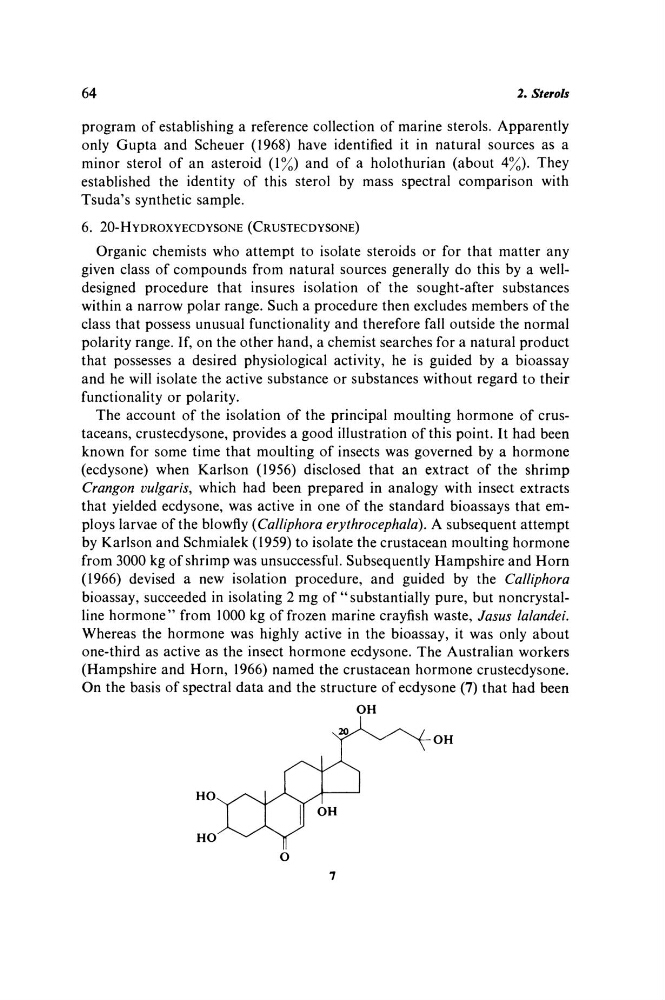
On the basis of spectral data and the structure of ecdysone (7) that had been
OH
Τ II
ΟΗ
HO^^^Nf
Ο
7
2. Sterols
program of establishing a reference collection of marine sterols. Apparently
only Gupta and Scheuer (1968) have identified it in natural sources as a
minor sterol of an asteroid (1%) and of a holothurian (about 4%). They
established the identity of this sterol by mass spectral comparison with
Tsuda's synthetic sample.
6. 20-HYDROXYECDYSONE (CRUSTECDYSONE)
Organic chemists who attempt to isolate steroids or for that matter any
given class of compounds from natural sources generally do this by a welldesigned procedure that insures isolation of the sought-after substances
within a narrow polar range. Such a procedure then excludes members of the
class that possess unusual functionality and therefore fall outside the normal
polarity range. If, on the other hand, a chemist searches for a natural product
that possesses a desired physiological activity, he is guided by a bioassay
and he will isolate the active substance or substances without regard to their
functionality or polarity.
The account of the isolation of the principal moulting hormone of crustaceans, crustecdysone, provides a good illustration of this point. It had been
known for some time that moulting of insects was governed by a hormone
(ecdysone) when Karlson (1956) disclosed that an extract of the shrimp
Crangon vulgaris, which had been prepared in analogy with insect extracts
that yielded ecdysone, was active in one of the standard bioassays that employs larvae of the blowfly (Calliphora erythrocephala). A subsequent attempt
by Karlson and Schmialek (1959) to isolate the crustacean moulting hormone
from 3000 kg of shrimp was unsuccessful. Subsequently Hampshire and Horn
(1966) devised a new isolation procedure, and guided by the Calliphora
bioassay, succeeded in isolating 2 mg of "substantially pure, but noncrystalline hormone" from 1000 kg of frozen marine crayfish waste, Jasus lalandei.
Whereas the hormone was highly active in the bioassay, it was only about
one-third as active as the insect hormone ecdysone. The Australian workers
(Hampshire and Horn, 1966) named the crustacean hormone crustecdysone.
On the basis of spectral data and the structure of ecdysone (7) that had been
OH
Τ II
ΟΗ
HO^^^Nf
Ο
7