

50
i. Isoprenoids
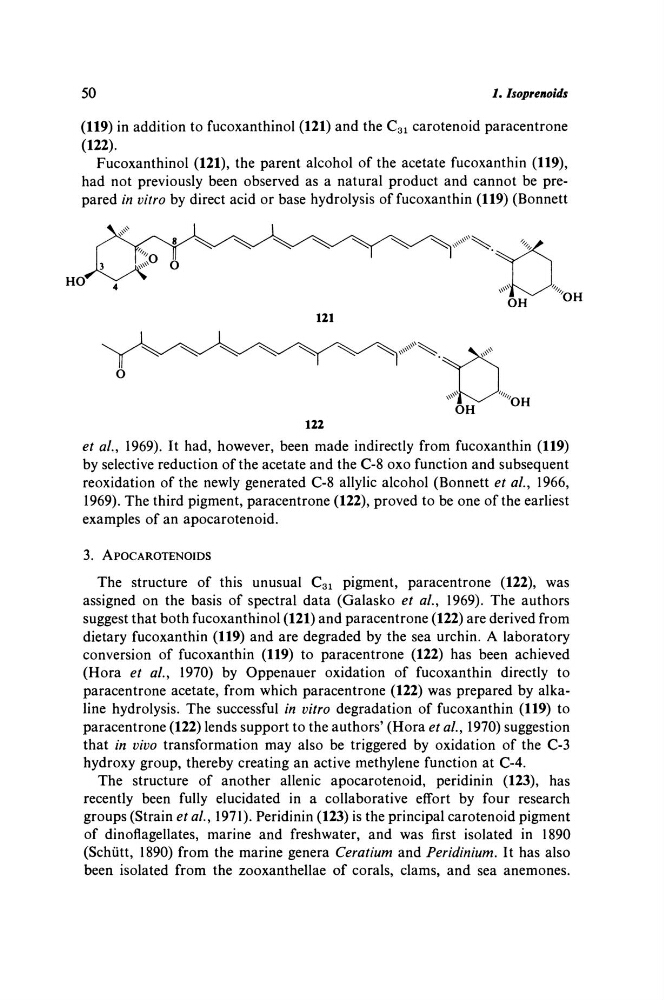
(119) in addition to fucoxanthinol (121) and the C 31 carotenoid paracentrone
(122).
Fucoxanthinol (121), the parent alcohol of the acetate fucoxanthin (119),
had not previously been observed as a natural product and cannot be prepared in vitro by direct acid or base hydrolysis of fucoxanthin (119) (Bonnett
ÔH
O
H
121
OH
°
H
122
et al., 1969). It had, however, been made indirectly from fucoxanthin (119)
by selective reduction of the acetate and the C-8 oxo function and subsequent
reoxidation of the newly generated C-8 allylic alcohol (Bonnett et al., 1966,
1969). The third pigment, paracentrone (122), proved to be one of the earliest
examples of an apocarotenoid.
3.
APOCAROTENOIDS
The structure of this unusual C 31 pigment, paracentrone (122), was
assigned on the basis of spectral data (Galasko et al., 1969). The authors
suggest that both fucoxanthinol (121) and paracentrone (122) are derived from
dietary fucoxanthin (119) and are degraded by the sea urchin. A laboratory
conversion of fucoxanthin (119) to paracentrone (122) has been achieved
(Hora et al., 1970) by Oppenauer oxidation of fucoxanthin directly to
paracentrone acetate, from which paracentrone (122) was prepared by alkaline hydrolysis. The successful in vitro degradation of fucoxanthin (119) to
paracentrone (122) lends support to the authors' (Hora et al., 1970) suggestion
that in vivo transformation may also be triggered by oxidation of the C-3
hydroxy group, thereby creating an active methylene function at C-4.
The structure of another allenic apocarotenoid, peridinin (123), has
recently been fully elucidated in a collaborative effort by four research
groups (Strain et al., 1971). Peridinin (123) is the principal carotenoid pigment
of dinoflagellates, marine and freshwater, and was first isolated in 1890
(Schutt, 1890) from the marine genera Ceratium and Peridinium. It has also
been isolated from the zooxanthellae of corals, clams, and sea anemones.
i. Isoprenoids
(119) in addition to fucoxanthinol (121) and the C 31 carotenoid paracentrone
(122).
Fucoxanthinol (121), the parent alcohol of the acetate fucoxanthin (119),
had not previously been observed as a natural product and cannot be prepared in vitro by direct acid or base hydrolysis of fucoxanthin (119) (Bonnett
ÔH
O
H
121
OH
°
H
122
et al., 1969). It had, however, been made indirectly from fucoxanthin (119)
by selective reduction of the acetate and the C-8 oxo function and subsequent
reoxidation of the newly generated C-8 allylic alcohol (Bonnett et al., 1966,
1969). The third pigment, paracentrone (122), proved to be one of the earliest
examples of an apocarotenoid.
3.
APOCAROTENOIDS
The structure of this unusual C 31 pigment, paracentrone (122), was
assigned on the basis of spectral data (Galasko et al., 1969). The authors
suggest that both fucoxanthinol (121) and paracentrone (122) are derived from
dietary fucoxanthin (119) and are degraded by the sea urchin. A laboratory
conversion of fucoxanthin (119) to paracentrone (122) has been achieved
(Hora et al., 1970) by Oppenauer oxidation of fucoxanthin directly to
paracentrone acetate, from which paracentrone (122) was prepared by alkaline hydrolysis. The successful in vitro degradation of fucoxanthin (119) to
paracentrone (122) lends support to the authors' (Hora et al., 1970) suggestion
that in vivo transformation may also be triggered by oxidation of the C-3
hydroxy group, thereby creating an active methylene function at C-4.
The structure of another allenic apocarotenoid, peridinin (123), has
recently been fully elucidated in a collaborative effort by four research
groups (Strain et al., 1971). Peridinin (123) is the principal carotenoid pigment
of dinoflagellates, marine and freshwater, and was first isolated in 1890
(Schutt, 1890) from the marine genera Ceratium and Peridinium. It has also
been isolated from the zooxanthellae of corals, clams, and sea anemones.