

D. Carotenoids
51
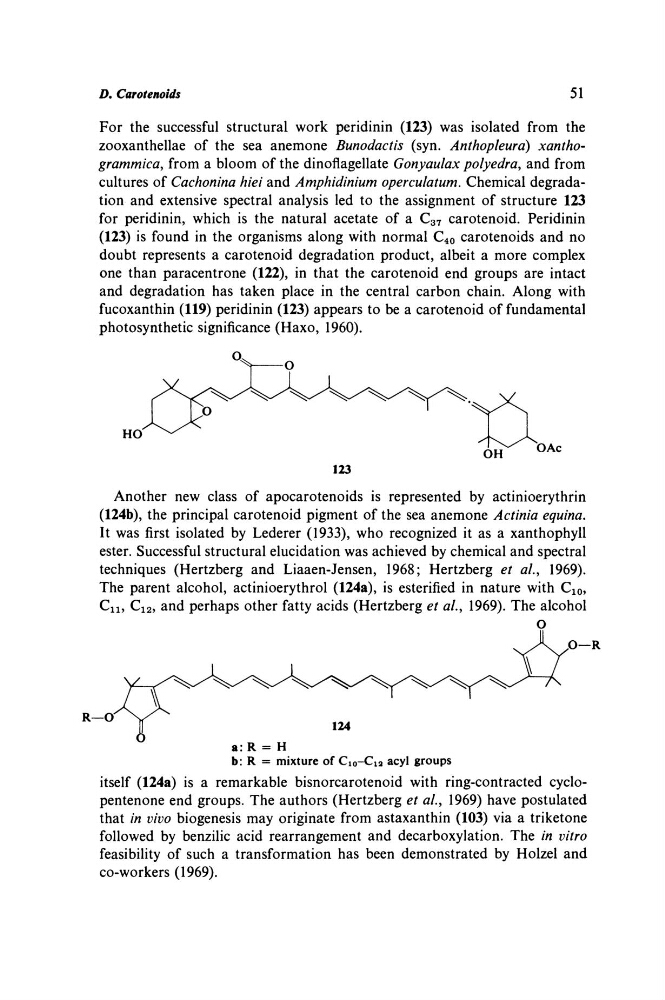
For the successful structural work peridinin (123) was isolated from the
zooxanthellae of the sea anemone Bunodactis (syn. Anthopleura)
xanthogrammica, from a bloom of the dinoflagellate Gonyaulax polyedra, and from
cultures of Cachonina hiei and Amphidinium operculatum. Chemical degradation and extensive spectral analysis led to the assignment of structure 123
for peridinin, which is the natural acetate of a C 37 carotenoid. Peridinin
(123) is found in the organisms along with normal C 40 carotenoids and no
doubt represents a carotenoid degradation product, albeit a more complex
one than paracentrone (122), in that the carotenoid end groups are intact
and degradation has taken place in the central carbon chain. Along with
fucoxanthin (119) peridinin (123) appears to be a carotenoid of fundamental
photosynthetic significance (Haxo, 1960).
Another new class of apocarotenoids is represented by actinioerythrin
(124b), the principal carotenoid pigment of the sea anemone Actinia equina.
It was first isolated by Lederer (1933), who recognized it as a xanthophyll
ester. Successful structural elucidation was achieved by chemical and spectral
techniques (Hertzberg and Liaaen-Jensen, 1968; Hertzberg et al, 1969).
The parent alcohol, actinioerythrol (124a), is esterified in nature with C 10 ,
Cn, C 12 , and perhaps other fatty acids (Hertzberg et al, 1969). The alcohol
b: R = mixture of Ci 0 -C l2 acyl groups
itself (124a) is a remarkable bisnorcarotenoid with ring-contracted cyclopentenone end groups. The authors (Hertzberg et al, 1969) have postulated
that in vivo biogenesis may originate from astaxanthin (103) via a triketone
followed by benzilic acid rearrangement and decarboxylation. The in vitro
feasibility of such a transformation has been demonstrated by Holzel and
co-workers (1969).
51
For the successful structural work peridinin (123) was isolated from the
zooxanthellae of the sea anemone Bunodactis (syn. Anthopleura)
xanthogrammica, from a bloom of the dinoflagellate Gonyaulax polyedra, and from
cultures of Cachonina hiei and Amphidinium operculatum. Chemical degradation and extensive spectral analysis led to the assignment of structure 123
for peridinin, which is the natural acetate of a C 37 carotenoid. Peridinin
(123) is found in the organisms along with normal C 40 carotenoids and no
doubt represents a carotenoid degradation product, albeit a more complex
one than paracentrone (122), in that the carotenoid end groups are intact
and degradation has taken place in the central carbon chain. Along with
fucoxanthin (119) peridinin (123) appears to be a carotenoid of fundamental
photosynthetic significance (Haxo, 1960).
Another new class of apocarotenoids is represented by actinioerythrin
(124b), the principal carotenoid pigment of the sea anemone Actinia equina.
It was first isolated by Lederer (1933), who recognized it as a xanthophyll
ester. Successful structural elucidation was achieved by chemical and spectral
techniques (Hertzberg and Liaaen-Jensen, 1968; Hertzberg et al, 1969).
The parent alcohol, actinioerythrol (124a), is esterified in nature with C 10 ,
Cn, C 12 , and perhaps other fatty acids (Hertzberg et al, 1969). The alcohol
b: R = mixture of Ci 0 -C l2 acyl groups
itself (124a) is a remarkable bisnorcarotenoid with ring-contracted cyclopentenone end groups. The authors (Hertzberg et al, 1969) have postulated
that in vivo biogenesis may originate from astaxanthin (103) via a triketone
followed by benzilic acid rearrangement and decarboxylation. The in vitro
feasibility of such a transformation has been demonstrated by Holzel and
co-workers (1969).