

D. Carotenoids
49
carotenoid (Allen et al, 1960; Bonnett et al, 1964, 1969), fucoxanthin (119) is
a representative of this exclusive class of natural products. Not surprisingly,
however, the structure of fucoxanthin, an investigation dating back to 1914,
has been a difficult problem that was recently solved by the Weedon group
(Bonnett et al, 1964), who have also provided the historical background and
full experimental details in what doubtless is a classic paper in the carotenoid
field (Bonnett et al, 1969). Among the outstanding features of this investigation was the recognition of the 1927 cm
-1 ir band as that of an aliène. The
acetate, novel in a carotenoid, was unambiguously identified by the properties
of perhydrofucoxanthin—appropriate ir absorption, O-acetyl analysis, and
hydrolysis yielding acetic acid. High-resolution mass spectrometry provided
an unambiguous molecular formula of C 4 2 H 5 8 0 6 for fucoxanthin, thereby
confirming its nature as an acetate. Many of the structural details were pieced
together by the use of zinc rather than the conventional potassium permanganate as a principal oxidizing agent. The zinc salt reacted faster than the
potassium analog and caused fewer side reactions, because of its weakly basic
nature. It allowed the isolation and structural elucidation of, inter alia,
authentic allenic degradation products. Needless to say, the monumental
task of solving the fucoxanthin structure could not have been accomplished
without the extensive and imaginative use of nuclear magnetic resonance and
high resolution mass spectrometric techniques.
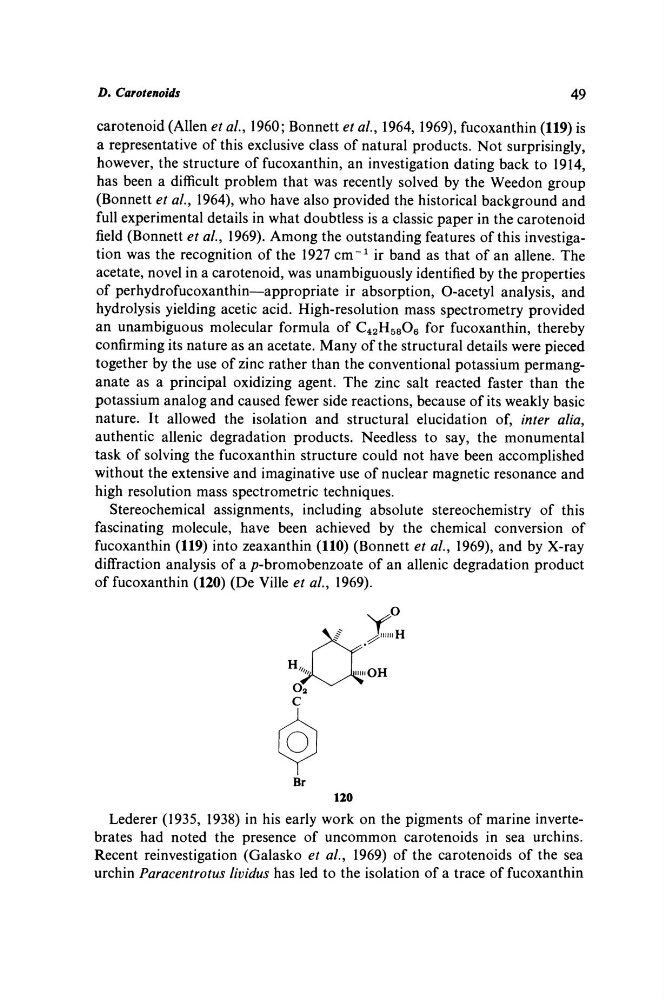
Stereochemical assignments, including absolute stereochemistry of this
fascinating molecule, have been achieved by the chemical conversion of
fucoxanthin (119) into zeaxanthin (110) (Bonnett et al, 1969), and by X-ray
diffraction analysis of a /?-bromobenzoate of an allenic degradation product
of fucoxanthin (120) (De Ville et al, 1969).
^ιιιιιιΗ
Η
imiiOH
c
Br
120
Lederer (1935, 1938) in his early work on the pigments of marine invertebrates had noted the presence of uncommon carotenoids in sea urchins.
Recent reinvestigation (Galasko et al, 1969) of the carotenoids of the sea
urchin Paracentrotus lividus has led to the isolation of a trace of fucoxanthin
49
carotenoid (Allen et al, 1960; Bonnett et al, 1964, 1969), fucoxanthin (119) is
a representative of this exclusive class of natural products. Not surprisingly,
however, the structure of fucoxanthin, an investigation dating back to 1914,
has been a difficult problem that was recently solved by the Weedon group
(Bonnett et al, 1964), who have also provided the historical background and
full experimental details in what doubtless is a classic paper in the carotenoid
field (Bonnett et al, 1969). Among the outstanding features of this investigation was the recognition of the 1927 cm
-1 ir band as that of an aliène. The
acetate, novel in a carotenoid, was unambiguously identified by the properties
of perhydrofucoxanthin—appropriate ir absorption, O-acetyl analysis, and
hydrolysis yielding acetic acid. High-resolution mass spectrometry provided
an unambiguous molecular formula of C 4 2 H 5 8 0 6 for fucoxanthin, thereby
confirming its nature as an acetate. Many of the structural details were pieced
together by the use of zinc rather than the conventional potassium permanganate as a principal oxidizing agent. The zinc salt reacted faster than the
potassium analog and caused fewer side reactions, because of its weakly basic
nature. It allowed the isolation and structural elucidation of, inter alia,
authentic allenic degradation products. Needless to say, the monumental
task of solving the fucoxanthin structure could not have been accomplished
without the extensive and imaginative use of nuclear magnetic resonance and
high resolution mass spectrometric techniques.
Stereochemical assignments, including absolute stereochemistry of this
fascinating molecule, have been achieved by the chemical conversion of
fucoxanthin (119) into zeaxanthin (110) (Bonnett et al, 1969), and by X-ray
diffraction analysis of a /?-bromobenzoate of an allenic degradation product
of fucoxanthin (120) (De Ville et al, 1969).
^ιιιιιιΗ
Η
imiiOH
c
Br
120
Lederer (1935, 1938) in his early work on the pigments of marine invertebrates had noted the presence of uncommon carotenoids in sea urchins.
Recent reinvestigation (Galasko et al, 1969) of the carotenoids of the sea
urchin Paracentrotus lividus has led to the isolation of a trace of fucoxanthin