

20
/. Isoprenoids
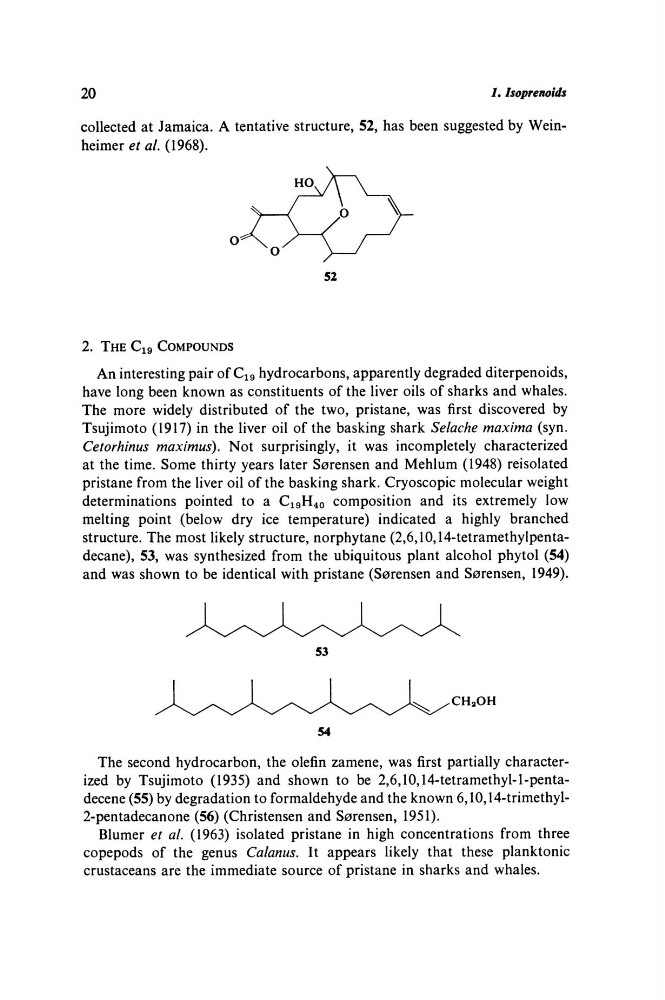
collected at Jamaica. A tentative structure, 52, has been suggested by Weinheimer et al (1968).
ΗΟ
\λ~~~λ\^
s—(
Ρ ^"Yο
)—/
52
2. THE C 19 COMPOUNDS
An interesting pair of Qg hydrocarbons, apparently degraded diterpenoids,
have long been known as constituents of the liver oils of sharks and whales.
The more widely distributed of the two, pristane, was first discovered by
Tsujimoto (1917) in the liver oil of the basking shark Selache maxima (syn.
Cetorhinus maximus). Not surprisingly, it was incompletely characterized
at the time. Some thirty years later S0rensen and Mehlum (1948) reisolated
pristane from the liver oil of the basking shark. Cryoscopic molecular weight
determinations pointed to a Ci 9 H 40 composition and its extremely low
melting point (below dry ice temperature) indicated a highly branched
structure. The most likely structure, norphytane (2,6,10,14-tetramethylpentadecane), 53, was synthesized from the ubiquitous plant alcohol phytol (54)
and was shown to be identical with pristane (Sörensen and Sorensen, 1949).
53
^JL^/\^
CH 2 OH
54
The second hydrocarbon, the olefin zamene, was first partially characterized by Tsujimoto (1935) and shown to be 2,6,10,14-tetramethyl-l-pentadecene (55) by degradation to formaldehyde and the known 6,10,14-trimethyl2-pentadecanone (56) (Christensen and Sorensen, 1951).
Blumer et al (1963) isolated pristane in high concentrations from three
copepods of the genus Calanus. It appears likely that these planktonic
crustaceans are the immediate source of pristane in sharks and whales.
/. Isoprenoids
collected at Jamaica. A tentative structure, 52, has been suggested by Weinheimer et al (1968).
ΗΟ
\λ~~~λ\^
s—(
Ρ ^"Yο
)—/
52
2. THE C 19 COMPOUNDS
An interesting pair of Qg hydrocarbons, apparently degraded diterpenoids,
have long been known as constituents of the liver oils of sharks and whales.
The more widely distributed of the two, pristane, was first discovered by
Tsujimoto (1917) in the liver oil of the basking shark Selache maxima (syn.
Cetorhinus maximus). Not surprisingly, it was incompletely characterized
at the time. Some thirty years later S0rensen and Mehlum (1948) reisolated
pristane from the liver oil of the basking shark. Cryoscopic molecular weight
determinations pointed to a Ci 9 H 40 composition and its extremely low
melting point (below dry ice temperature) indicated a highly branched
structure. The most likely structure, norphytane (2,6,10,14-tetramethylpentadecane), 53, was synthesized from the ubiquitous plant alcohol phytol (54)
and was shown to be identical with pristane (Sörensen and Sorensen, 1949).
53
^JL^/\^
CH 2 OH
54
The second hydrocarbon, the olefin zamene, was first partially characterized by Tsujimoto (1935) and shown to be 2,6,10,14-tetramethyl-l-pentadecene (55) by degradation to formaldehyde and the known 6,10,14-trimethyl2-pentadecanone (56) (Christensen and Sorensen, 1951).
Blumer et al (1963) isolated pristane in high concentrations from three
copepods of the genus Calanus. It appears likely that these planktonic
crustaceans are the immediate source of pristane in sharks and whales.