

Β. Diterpenoids
21
55
56
3. THE C 21
COMPOUNDS
Two related terpenoids, each possessing twenty-one carbon atoms, have
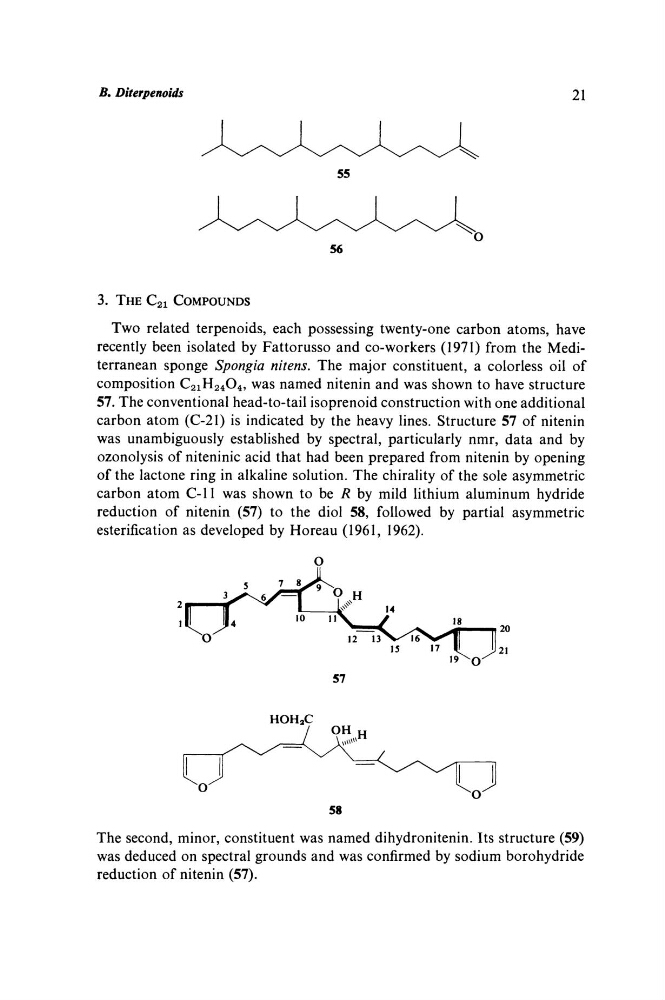
recently been isolated by Fattorusso and co-workers (1971) from the Mediterranean sponge Spongia nit ens. The major constituent, a colorless oil of
composition C21H24O4, was named nitenin and was shown to have structure
57. The conventional head-to-tail isoprenoid construction with one additional
carbon atom (C-21) is indicated by the heavy lines. Structure 57 of nitenin
was unambiguously established by spectral, particularly nmr, data and by
ozonolysis of niteninic acid that had been prepared from nitenin by opening
of the lactone ring in alkaline solution. The chirality of the sole asymmetric
carbon atom C-ll was shown to be R by mild lithium aluminum hydride
reduction of nitenin (57) to the diol 58, followed by partial asymmetric
esterification as developed by Horeau (1961, 1962).
Ο
3 l^/=Ç^O
η
57
HOH 2 C
/
OH IT
58
The second, minor, constituent was named dihydronitenin. Its structure (59)
was deduced on spectral grounds and was confirmed by sodium borohydride
reduction of nitenin (57).
21
55
56
3. THE C 21
COMPOUNDS
Two related terpenoids, each possessing twenty-one carbon atoms, have
recently been isolated by Fattorusso and co-workers (1971) from the Mediterranean sponge Spongia nit ens. The major constituent, a colorless oil of
composition C21H24O4, was named nitenin and was shown to have structure
57. The conventional head-to-tail isoprenoid construction with one additional
carbon atom (C-21) is indicated by the heavy lines. Structure 57 of nitenin
was unambiguously established by spectral, particularly nmr, data and by
ozonolysis of niteninic acid that had been prepared from nitenin by opening
of the lactone ring in alkaline solution. The chirality of the sole asymmetric
carbon atom C-ll was shown to be R by mild lithium aluminum hydride
reduction of nitenin (57) to the diol 58, followed by partial asymmetric
esterification as developed by Horeau (1961, 1962).
Ο
3 l^/=Ç^O
η
57
HOH 2 C
/
OH IT
58
The second, minor, constituent was named dihydronitenin. Its structure (59)
was deduced on spectral grounds and was confirmed by sodium borohydride
reduction of nitenin (57).