

Β. Diterpenoids
19
Perhaps the first mention in the literature of a marine-derived diterpenoid—
although unrecognized as such at the time—may be found in a paper of the
Oklahoma group (Ciereszko et al, 1960). During pentane or ether extraction
of the gorgonian Plexaura crassa a substance crystallized out, mp 144°-144.5°,
[oc]f>
5
° +70.7°, which was called crassin acetate. A summary of the chemical
work (Weinheimer et al, 1968) and the details of the X-ray determination of
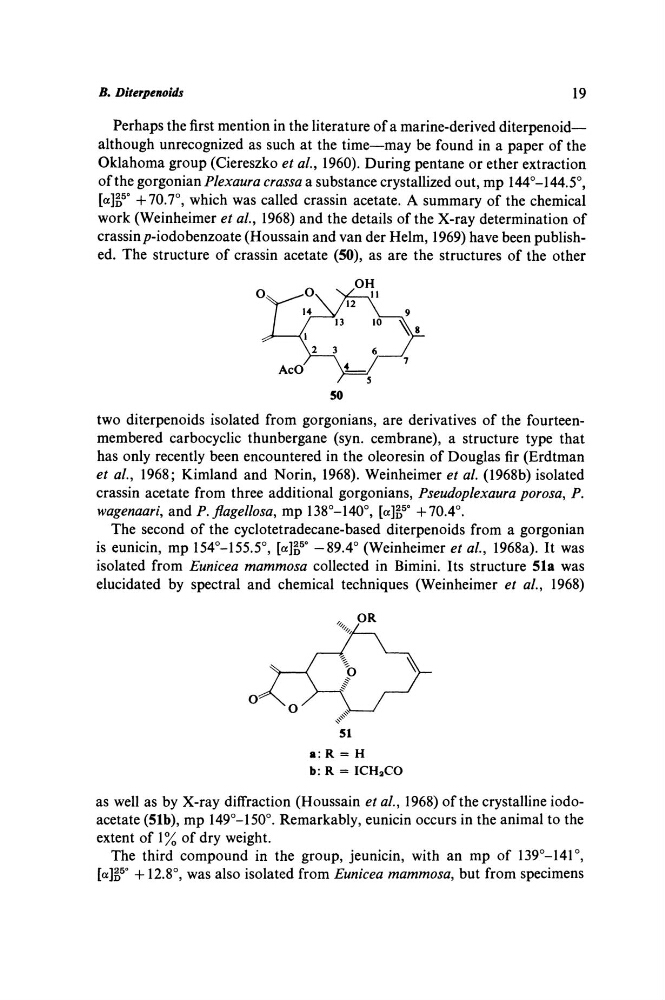
crassin/7-iodobenzoate (Houssain and van der Helm, 1969) have been published. The structure of crassin acetate (50), as are the structures of the other
OH
1/
13
10
y 3 6 /
Aco)S=/
7
50
two diterpenoids isolated from gorgonians, are derivatives of the fourteenmembered carbocyclic thunbergane (syn. cembrane), a structure type that
has only recently been encountered in the oleoresin of Douglas fir (Erdtman
et al, 1968; Kimland and Norin, 1968). Weinheimer et al (1968b) isolated
crassin acetate from three additional gorgonians, Pseudoplexaura porosa, P.
wagenaarU and P. flagellosa, mp 138°-140°,
+70.4°.
The second of the cyclotetradecane-based diterpenoids from a gorgonian
is eunicin, mp 154°-155.5°, Mj f
5
-89.4° (Weinheimer et al, 1968a). It was
isolated from Eunicea mammosa collected in Bimini. Its structure 51a was
elucidated by spectral and chemical techniques (Weinheimer et al, 1968)
51
a: R = Η
b: R = ICHaCO
as well as by X-ray diffraction (Houssain et al, 1968) of the crystalline iodoacetate (51b), mp 149°-150°. Remarkably, eunicin occurs in the animal to the
extent of 1% of dry weight.
The third compound in the group, jeunicin, with an mp of 139°-141°,
[a]f +12.8°, was also isolated from Eunicea mammosa, but from specimens
19
Perhaps the first mention in the literature of a marine-derived diterpenoid—
although unrecognized as such at the time—may be found in a paper of the
Oklahoma group (Ciereszko et al, 1960). During pentane or ether extraction
of the gorgonian Plexaura crassa a substance crystallized out, mp 144°-144.5°,
[oc]f>
5
° +70.7°, which was called crassin acetate. A summary of the chemical
work (Weinheimer et al, 1968) and the details of the X-ray determination of
crassin/7-iodobenzoate (Houssain and van der Helm, 1969) have been published. The structure of crassin acetate (50), as are the structures of the other
OH
1/
13
10
y 3 6 /
Aco)S=/
7
50
two diterpenoids isolated from gorgonians, are derivatives of the fourteenmembered carbocyclic thunbergane (syn. cembrane), a structure type that
has only recently been encountered in the oleoresin of Douglas fir (Erdtman
et al, 1968; Kimland and Norin, 1968). Weinheimer et al (1968b) isolated
crassin acetate from three additional gorgonians, Pseudoplexaura porosa, P.
wagenaarU and P. flagellosa, mp 138°-140°,
+70.4°.
The second of the cyclotetradecane-based diterpenoids from a gorgonian
is eunicin, mp 154°-155.5°, Mj f
5
-89.4° (Weinheimer et al, 1968a). It was
isolated from Eunicea mammosa collected in Bimini. Its structure 51a was
elucidated by spectral and chemical techniques (Weinheimer et al, 1968)
51
a: R = Η
b: R = ICHaCO
as well as by X-ray diffraction (Houssain et al, 1968) of the crystalline iodoacetate (51b), mp 149°-150°. Remarkably, eunicin occurs in the animal to the
extent of 1% of dry weight.
The third compound in the group, jeunicin, with an mp of 139°-141°,
[a]f +12.8°, was also isolated from Eunicea mammosa, but from specimens