

18
/. Isoprenoids
49
HO
o^uY Cl
Br
48
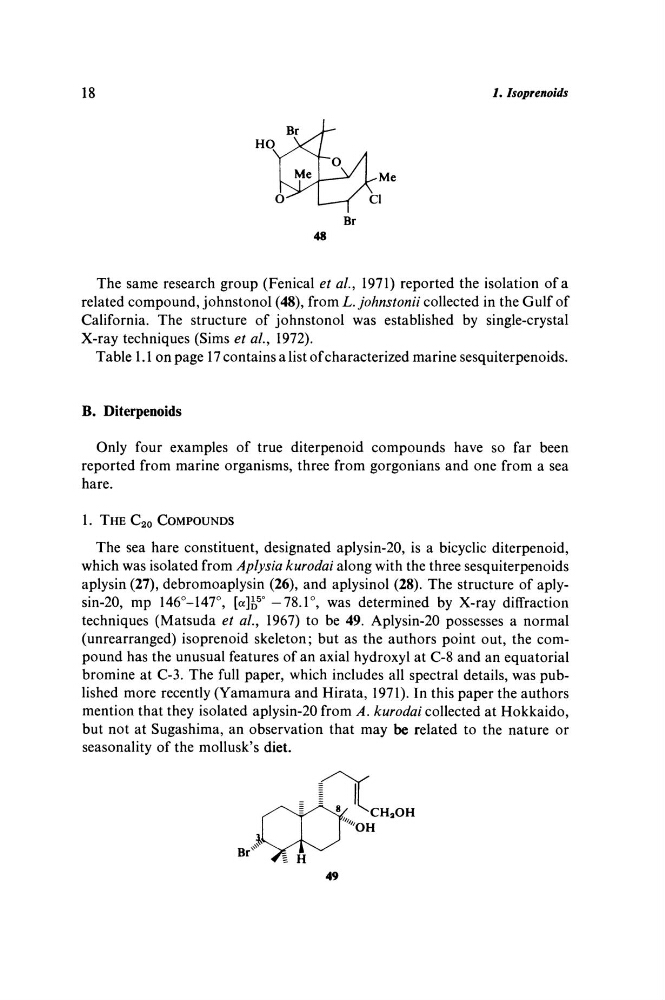
The same research group (Fenical et al, 1971) reported the isolation of a
related compound, johnstonol (48), from L. johnstonii collected in the Gulf of
California. The structure of johnstonol was established by single-crystal
X-ray techniques (Sims et al, 1972).
Table 1.1 on page 17 contains a list of characterized marine sesquiterpenoids.
B. Diterpenoids
Only four examples of true diterpenoid compounds have so far been
reported from marine organisms, three from gorgonians and one from a sea
hare.
1. THE C 20 COMPOUNDS
The sea hare constituent, designated aplysin-20, is a bicyclic diterpenoid,
which was isolated from Aplysia kurodai along with the three sesquiterpenoids
aplysin (27), debromoaplysin (26), and aplysinol (28). The structure of aplysin-20, mp 146°-147°, [αβ
5 ° -78.1°, was determined by X-ray diffraction
techniques (Matsuda et al, 1967) to be 49. Aplysin-20 possesses a normal
(unrearranged) isoprenoid skeleton; but as the authors point out, the compound has the unusual features of an axial hydroxyl at C-8 and an equatorial
bromine at C-3. The full paper, which includes all spectral details, was published more recently (Yamamura and Hirata, 1971). In this paper the authors
mention that they isolated aplysin-20 from A. kurodai collected at Hokkaido,
but not at Sugashima, an observation that may be related to the nature or
seasonality of the mollusk's diet.
• (
/Nj/^
CH a OH
Γ Τ J "'"OH
/. Isoprenoids
49
HO
o^uY Cl
Br
48
The same research group (Fenical et al, 1971) reported the isolation of a
related compound, johnstonol (48), from L. johnstonii collected in the Gulf of
California. The structure of johnstonol was established by single-crystal
X-ray techniques (Sims et al, 1972).
Table 1.1 on page 17 contains a list of characterized marine sesquiterpenoids.
B. Diterpenoids
Only four examples of true diterpenoid compounds have so far been
reported from marine organisms, three from gorgonians and one from a sea
hare.
1. THE C 20 COMPOUNDS
The sea hare constituent, designated aplysin-20, is a bicyclic diterpenoid,
which was isolated from Aplysia kurodai along with the three sesquiterpenoids
aplysin (27), debromoaplysin (26), and aplysinol (28). The structure of aplysin-20, mp 146°-147°, [αβ
5 ° -78.1°, was determined by X-ray diffraction
techniques (Matsuda et al, 1967) to be 49. Aplysin-20 possesses a normal
(unrearranged) isoprenoid skeleton; but as the authors point out, the compound has the unusual features of an axial hydroxyl at C-8 and an equatorial
bromine at C-3. The full paper, which includes all spectral details, was published more recently (Yamamura and Hirata, 1971). In this paper the authors
mention that they isolated aplysin-20 from A. kurodai collected at Hokkaido,
but not at Sugashima, an observation that may be related to the nature or
seasonality of the mollusk's diet.
• (
/Nj/^
CH a OH
Γ Τ J "'"OH