

A. Sesquiterpenoids
9
et al. (1968) from the gorgonian Pseudopterogorgia
americana. It is the
predominant sesquiterpene and occurs along with maaliene (11) and the
aristolenes (9, 10). ß-Gorgonene, [αβ
5 ° +13.9°, was isolated as its crystalline
silver nitrate, mp 132.5°-133.5°. The structure of this complex was determined by X-ray diffraction techniques (Houssain and Van der Helm, 1968). It
has an interesting nonisoprenoid skeleton that may well have arisen from a
common precursor with maaliene (11). As the authors (Weinheimer et al,
1968c) point out, such a rearranged skeleton is analogous to the monoterpene
sylvestrene (3-isopropenyl-l-methylcyclohexene), which is presumed to arise
from carenes during isolation (Pollock and Stevens, 1965).
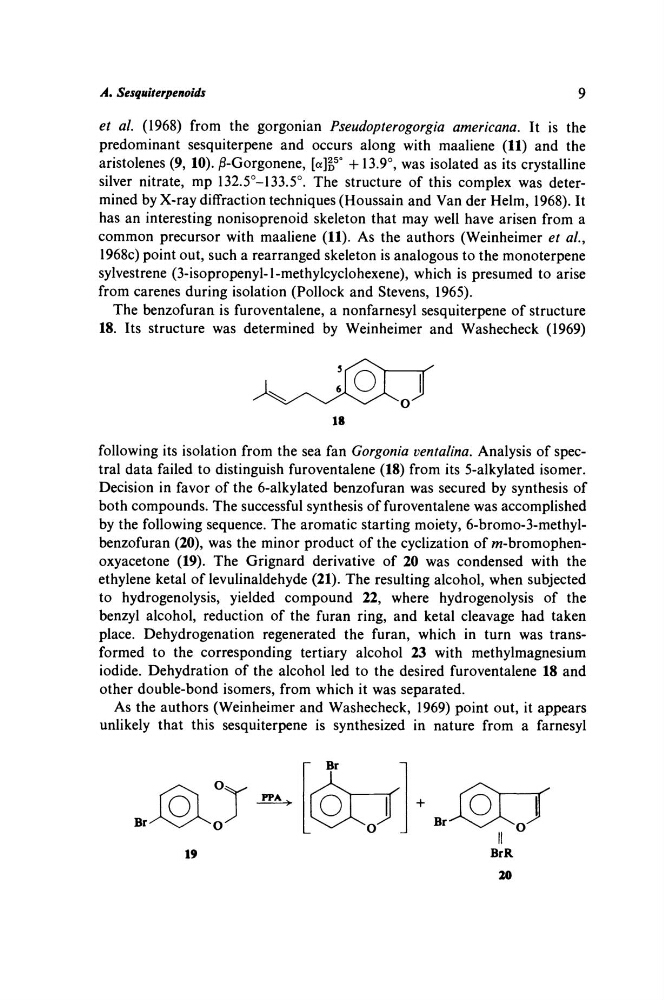
The benzofuran is furoventalene, a nonfarnesyl sesquiterpene of structure
18. Its structure was determined by Weinheimer and Washecheck (1969)
18
following its isolation from the sea fan Gorgonia ventalina. Analysis of spectral data failed to distinguish furoventalene (18) from its 5-alkylated isomer.
Decision in favor of the 6-alkylated benzofuran was secured by synthesis of
both compounds. The successful synthesis of furoventalene was accomplished
by the following sequence. The aromatic starting moiety, 6-bromo-3-methylbenzofuran (20), was the minor product of the cyclization of m-bromophenoxyacetone (19). The Grignard derivative of 20 was condensed with the
ethylene ketal of levulinaldehyde (21). The resulting alcohol, when subjected
to hydrogenolysis, yielded compound 22, where hydrogenolysis of the
benzyl alcohol, reduction of the furan ring, and ketal cleavage had taken
place. Dehydrogenation regenerated the furan, which in turn was transformed to the corresponding tertiary alcohol 23 with methylmagnesium
iodide. Dehydration of the alcohol led to the desired furoventalene 18 and
other double-bond isomers, from which it was separated.
As the authors (Weinheimer and Washecheck, 1969) point out, it appears
unlikely that this sesquiterpene is synthesized in nature from a farnesyl
19
BrR
20
9
et al. (1968) from the gorgonian Pseudopterogorgia
americana. It is the
predominant sesquiterpene and occurs along with maaliene (11) and the
aristolenes (9, 10). ß-Gorgonene, [αβ
5 ° +13.9°, was isolated as its crystalline
silver nitrate, mp 132.5°-133.5°. The structure of this complex was determined by X-ray diffraction techniques (Houssain and Van der Helm, 1968). It
has an interesting nonisoprenoid skeleton that may well have arisen from a
common precursor with maaliene (11). As the authors (Weinheimer et al,
1968c) point out, such a rearranged skeleton is analogous to the monoterpene
sylvestrene (3-isopropenyl-l-methylcyclohexene), which is presumed to arise
from carenes during isolation (Pollock and Stevens, 1965).
The benzofuran is furoventalene, a nonfarnesyl sesquiterpene of structure
18. Its structure was determined by Weinheimer and Washecheck (1969)
18
following its isolation from the sea fan Gorgonia ventalina. Analysis of spectral data failed to distinguish furoventalene (18) from its 5-alkylated isomer.
Decision in favor of the 6-alkylated benzofuran was secured by synthesis of
both compounds. The successful synthesis of furoventalene was accomplished
by the following sequence. The aromatic starting moiety, 6-bromo-3-methylbenzofuran (20), was the minor product of the cyclization of m-bromophenoxyacetone (19). The Grignard derivative of 20 was condensed with the
ethylene ketal of levulinaldehyde (21). The resulting alcohol, when subjected
to hydrogenolysis, yielded compound 22, where hydrogenolysis of the
benzyl alcohol, reduction of the furan ring, and ketal cleavage had taken
place. Dehydrogenation regenerated the furan, which in turn was transformed to the corresponding tertiary alcohol 23 with methylmagnesium
iodide. Dehydration of the alcohol led to the desired furoventalene 18 and
other double-bond isomers, from which it was separated.
As the authors (Weinheimer and Washecheck, 1969) point out, it appears
unlikely that this sesquiterpene is synthesized in nature from a farnesyl
19
BrR
20