

8
Ζ. Isoprenoids
report a rotation of [<χ] Ό -19°, close to the rotation of a-copaene,
[«]D
3 ° -26.Γ, isolated from the brown alga (Irie et al, 1964).
2. NEW COMPOUNDS
The sesquiterpenoids of novel structure fall into four well-defined categories. By far the most numerous group, based on a rearranged farnesyl skeleton,
which so far encompasses about a dozen compounds, has been isolated by
two Japanese and an American group from sea hares and from red algae
of a single genus. Many of these compounds contain bromine, and two
contain chlorine as well. Two other categories have only one representative
each: one a benzofuran derivative and the other a rearranged maaliene (11),
both isolated from gorgonians. The fourth group consists of two oxygenated
derivatives of known skeletal type. These groups of compounds will be
discussed in reverse order, beginning with those that are most closely related
to known sesquiterpenoids.
Two functionalized derivatives, an alcohol and a ketone, of the wellknown ß-selinene (8) were isolated by Irie's group (Kurosawa et al. 9 1966)
from the essential oil of the brown alga Dictyopteris divaricata. The alcohol
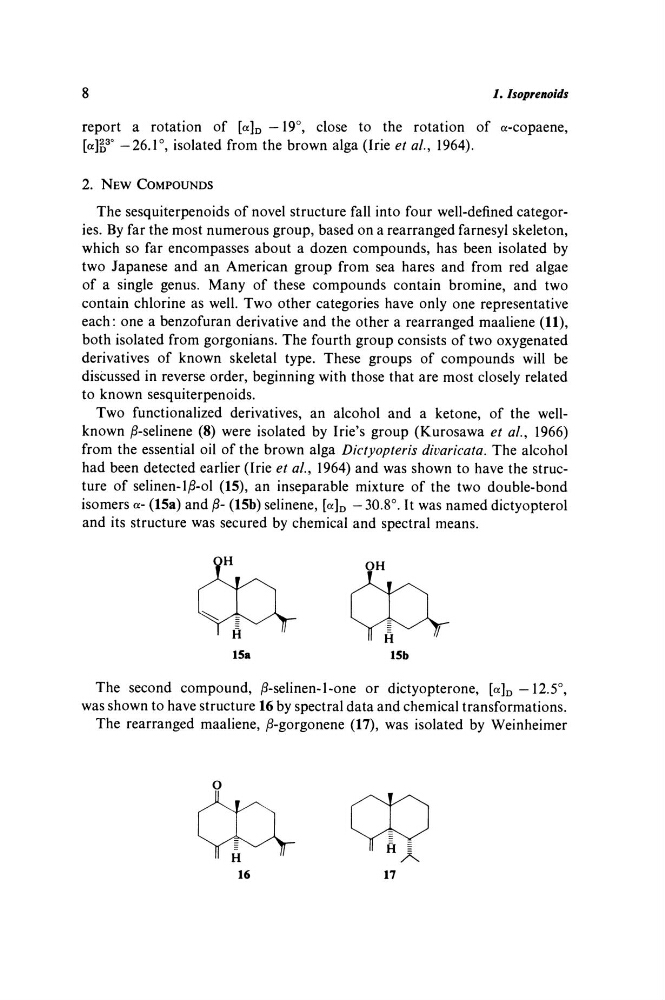
had been detected earlier (Irie et al, 1964) and was shown to have the structure of selinen-lß-ol (15), an inseparable mixture of the two double-bond
isomers a- (15a) and β- (15b) selinene, [a] D — 30.8°. It was named dictyopterol
and its structure was secured by chemical and spectral means.
9
H
OH
15a
15b
The second compound, ß-selinen-1-one or dictyopterone, [a] D —12.5°,
was shown to have structure 16 by spectral data and chemical transformations.
The rearranged maaliene, ß-gorgonene (17), was isolated by Weinheimer
Ο
16
17
Ζ. Isoprenoids
report a rotation of [<χ] Ό -19°, close to the rotation of a-copaene,
[«]D
3 ° -26.Γ, isolated from the brown alga (Irie et al, 1964).
2. NEW COMPOUNDS
The sesquiterpenoids of novel structure fall into four well-defined categories. By far the most numerous group, based on a rearranged farnesyl skeleton,
which so far encompasses about a dozen compounds, has been isolated by
two Japanese and an American group from sea hares and from red algae
of a single genus. Many of these compounds contain bromine, and two
contain chlorine as well. Two other categories have only one representative
each: one a benzofuran derivative and the other a rearranged maaliene (11),
both isolated from gorgonians. The fourth group consists of two oxygenated
derivatives of known skeletal type. These groups of compounds will be
discussed in reverse order, beginning with those that are most closely related
to known sesquiterpenoids.
Two functionalized derivatives, an alcohol and a ketone, of the wellknown ß-selinene (8) were isolated by Irie's group (Kurosawa et al. 9 1966)
from the essential oil of the brown alga Dictyopteris divaricata. The alcohol
had been detected earlier (Irie et al, 1964) and was shown to have the structure of selinen-lß-ol (15), an inseparable mixture of the two double-bond
isomers a- (15a) and β- (15b) selinene, [a] D — 30.8°. It was named dictyopterol
and its structure was secured by chemical and spectral means.
9
H
OH
15a
15b
The second compound, ß-selinen-1-one or dictyopterone, [a] D —12.5°,
was shown to have structure 16 by spectral data and chemical transformations.
The rearranged maaliene, ß-gorgonene (17), was isolated by Weinheimer
Ο
16
17