

A. Sesquiterpenoids
7
occurring enantiomer is dextrorotatory (Streith et al, 1963; Vrkoc et al,
1964), while the marine-derived compound (10) has [a]f>
5
° —78.5°. Compound 11, y-maaliene, [αβ
5 ° +10.9°, had not been isolated from another
natural source, but was known as a member of a mixture of olefinic isomers, intermediate in the synthesis of maaliol by Bates and co-workers
(1960).
1
9
ι
Ç^^^
^^^^ ^Tfi
9
10
11
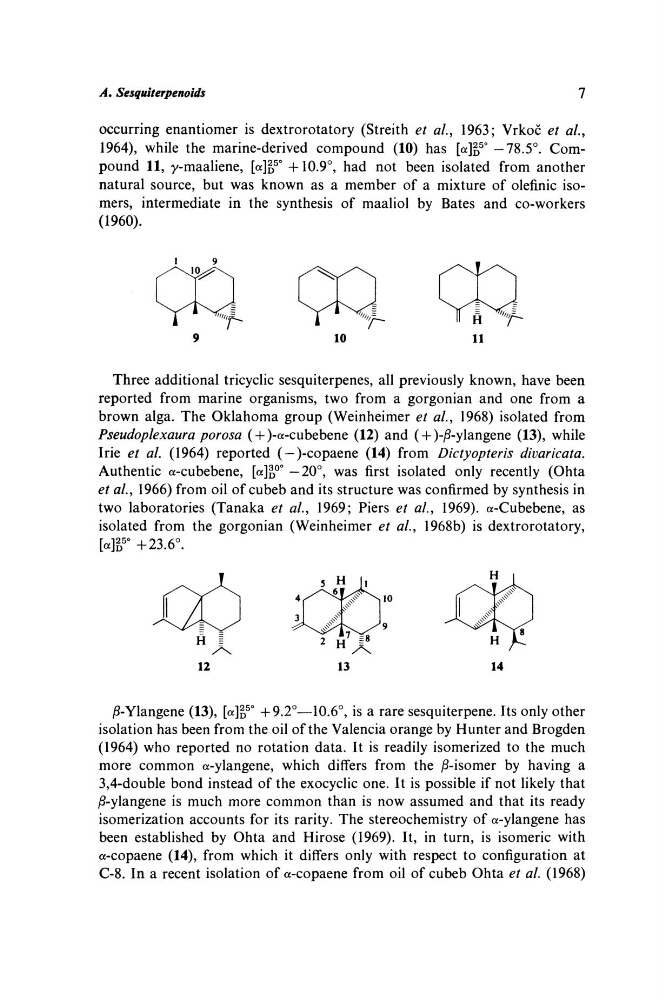
Three additional tricyclic sesquiterpenes, all previously known, have been
reported from marine organisms, two from a gorgonian and one from a
brown alga. The Oklahoma group (Weinheimer et al, 1968) isolated from
Pseudoplexaura porosa (-h)-a-cubebene (12) and ( + )-ß-ylangene (13), while
Irie et al. (1964) reported ( —)-copaene (14) from Dictyopteris
divaricata.
Authentic α-cubebene, [αβ°° —20°, was first isolated only recently (Ohta
et al, 1966) from oil of cubeb and its structure was confirmed by synthesis in
two laboratories (Tanaka et al, 1969; Piers et al, 1969). α-Cubebene, as
isolated from the gorgonian (Weinheimer et al, 1968b) is dextrorotatory,
[αβ
5β +23.6°.
12
13
14
ß-Ylangene (13), [a]f +9.2°—10.6°, is a rare sesquiterpene. Its only other
isolation has been from the oil of the Valencia orange by Hunter and Brogden
(1964) who reported no rotation data. It is readily isomerized to the much
more common a-ylangene, which differs from the ß-isomer by having a
3,4-double bond instead of the exocyclic one. It is possible if not likely that
ß-ylangene is much more common than is now assumed and that its ready
isomerization accounts for its rarity. The stereochemistry of a-ylangene has
been established by Ohta and Hirose (1969). It, in turn, is isomeric with
a-copaene (14), from which it differs only with respect to configuration at
C-8. In a recent isolation of a-copaene from oil of cubeb Ohta et al. (1968)
7
occurring enantiomer is dextrorotatory (Streith et al, 1963; Vrkoc et al,
1964), while the marine-derived compound (10) has [a]f>
5
° —78.5°. Compound 11, y-maaliene, [αβ
5 ° +10.9°, had not been isolated from another
natural source, but was known as a member of a mixture of olefinic isomers, intermediate in the synthesis of maaliol by Bates and co-workers
(1960).
1
9
ι
Ç^^^
^^^^ ^Tfi
9
10
11
Three additional tricyclic sesquiterpenes, all previously known, have been
reported from marine organisms, two from a gorgonian and one from a
brown alga. The Oklahoma group (Weinheimer et al, 1968) isolated from
Pseudoplexaura porosa (-h)-a-cubebene (12) and ( + )-ß-ylangene (13), while
Irie et al. (1964) reported ( —)-copaene (14) from Dictyopteris
divaricata.
Authentic α-cubebene, [αβ°° —20°, was first isolated only recently (Ohta
et al, 1966) from oil of cubeb and its structure was confirmed by synthesis in
two laboratories (Tanaka et al, 1969; Piers et al, 1969). α-Cubebene, as
isolated from the gorgonian (Weinheimer et al, 1968b) is dextrorotatory,
[αβ
5β +23.6°.
12
13
14
ß-Ylangene (13), [a]f +9.2°—10.6°, is a rare sesquiterpene. Its only other
isolation has been from the oil of the Valencia orange by Hunter and Brogden
(1964) who reported no rotation data. It is readily isomerized to the much
more common a-ylangene, which differs from the ß-isomer by having a
3,4-double bond instead of the exocyclic one. It is possible if not likely that
ß-ylangene is much more common than is now assumed and that its ready
isomerization accounts for its rarity. The stereochemistry of a-ylangene has
been established by Ohta and Hirose (1969). It, in turn, is isomeric with
a-copaene (14), from which it differs only with respect to configuration at
C-8. In a recent isolation of a-copaene from oil of cubeb Ohta et al. (1968)