

6
1, Isoprenoids
et al. (1964) from the brown alga Dictyopteris divaricata (HD
3
° +12.8°).
Another dextrorotatory ß-elemene, HD°° +14.2°, has been reported from a
terrestrial source by Pigulovskii and Borokov (1962). However, material
that constituted two original isolations from sweet flag (Sorm et al, 1953) and
juniper oils (Sykora et al, 1956) by the Czech terpene group was levorotatory,
— 20° and [«] D —16.9°, respectively. Unfortunately, no rotation is
reported by Patil and Rao (1967) for a sample of ß-elemene synthesized from
an optically active bicyclic precursor. Since the natural precursor of ß-elemene,
germacrene-A (7), has one center of chirality (starred carbon atom), which is
unaffected by the rearrangement, much of the observed optical activity of the
various elemenes may be due to that carbon. Germacrene-A, [ce]r>
5
° — 3°, has
not been isolated from another source so far and assessment of its optical
purity is not possible.
çPv
8
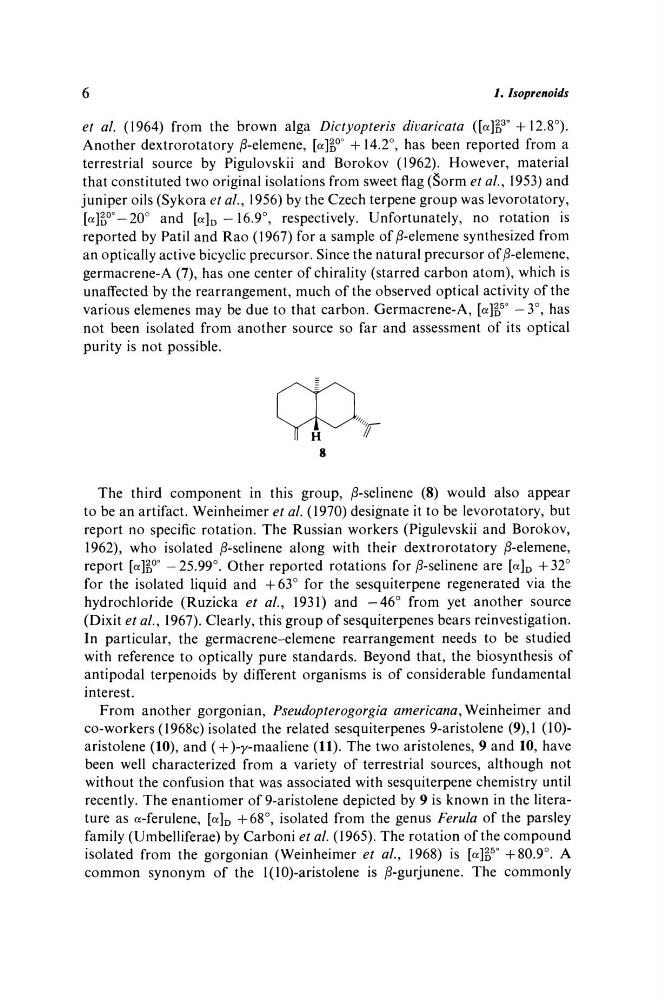
The third component in this group, ß-selinene (8) would also appear
to be an artifact. Weinheimer et al. (1970) designate it to be levorotatory, but
report no specific rotation. The Russian workers (Pigulevskii and Borokov,
1962), who isolated ß-selinene along with their dextrorotatory ß-elemene,
report [a]%°° -25.99°. Other reported rotations for ß-selinene are [a] D +32°
for the isolated liquid and +63° for the sesquiterpene regenerated via the
hydrochloride (Ruzicka et al, 1931) and —46° from yet another source
(Dixit et al, 1967). Clearly, this group of sesquiterpenes bears reinvestigation.
In particular, the germacrene-elemene rearrangement needs to be studied
with reference to optically pure standards. Beyond that, the biosynthesis of
antipodal terpenoids by different organisms is of considerable fundamental
interest.
From another gorgonian, Pseudopterogorgia americana, Weinheimer and
co-workers (1968c) isolated the related sesquiterpenes 9-aristolene (9),1 (10)aristolene (10), and ( + )-y-maaliene (11). The two aristolenes, 9 and 10, have
been well characterized from a variety of terrestrial sources, although not
without the confusion that was associated with sesquiterpene chemistry until
recently. The enantiomer of 9-aristolene depicted by 9 is known in the literature as a-ferulene, [a] D +68°, isolated from the genus Ferula of the parsley
family (Umbelliferae) by Carboni et al. (1965). The rotation of the compound
isolated from the gorgonian (Weinheimer et ai, 1968) is [αβ
5 ° +80.9°. A
common synonym of the l(10)-aristolene is ß-gurjunene. The commonly
1, Isoprenoids
et al. (1964) from the brown alga Dictyopteris divaricata (HD
3
° +12.8°).
Another dextrorotatory ß-elemene, HD°° +14.2°, has been reported from a
terrestrial source by Pigulovskii and Borokov (1962). However, material
that constituted two original isolations from sweet flag (Sorm et al, 1953) and
juniper oils (Sykora et al, 1956) by the Czech terpene group was levorotatory,
— 20° and [«] D —16.9°, respectively. Unfortunately, no rotation is
reported by Patil and Rao (1967) for a sample of ß-elemene synthesized from
an optically active bicyclic precursor. Since the natural precursor of ß-elemene,
germacrene-A (7), has one center of chirality (starred carbon atom), which is
unaffected by the rearrangement, much of the observed optical activity of the
various elemenes may be due to that carbon. Germacrene-A, [ce]r>
5
° — 3°, has
not been isolated from another source so far and assessment of its optical
purity is not possible.
çPv
8
The third component in this group, ß-selinene (8) would also appear
to be an artifact. Weinheimer et al. (1970) designate it to be levorotatory, but
report no specific rotation. The Russian workers (Pigulevskii and Borokov,
1962), who isolated ß-selinene along with their dextrorotatory ß-elemene,
report [a]%°° -25.99°. Other reported rotations for ß-selinene are [a] D +32°
for the isolated liquid and +63° for the sesquiterpene regenerated via the
hydrochloride (Ruzicka et al, 1931) and —46° from yet another source
(Dixit et al, 1967). Clearly, this group of sesquiterpenes bears reinvestigation.
In particular, the germacrene-elemene rearrangement needs to be studied
with reference to optically pure standards. Beyond that, the biosynthesis of
antipodal terpenoids by different organisms is of considerable fundamental
interest.
From another gorgonian, Pseudopterogorgia americana, Weinheimer and
co-workers (1968c) isolated the related sesquiterpenes 9-aristolene (9),1 (10)aristolene (10), and ( + )-y-maaliene (11). The two aristolenes, 9 and 10, have
been well characterized from a variety of terrestrial sources, although not
without the confusion that was associated with sesquiterpene chemistry until
recently. The enantiomer of 9-aristolene depicted by 9 is known in the literature as a-ferulene, [a] D +68°, isolated from the genus Ferula of the parsley
family (Umbelliferae) by Carboni et al. (1965). The rotation of the compound
isolated from the gorgonian (Weinheimer et ai, 1968) is [αβ
5 ° +80.9°. A
common synonym of the l(10)-aristolene is ß-gurjunene. The commonly