

10
/. Isoprenoids
RBr
> RMgBr + ΓΠ
> ΓΠ
^>
>0^γΗ
>O^R
Ο
OH
21
Γ^λΊ
pd—C
O
MeMgl
22
OH
>L
18 + isomers
23
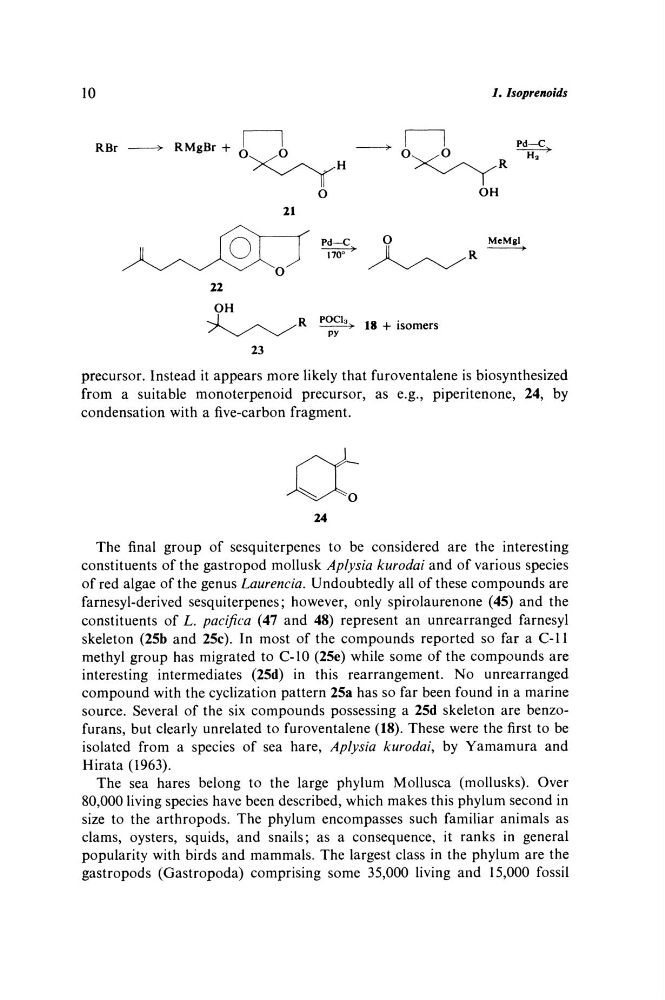
precursor. Instead it appears more likely that furoventalene is biosynthesized
from a suitable monoterpenoid precursor, as e.g., piperitenone, 24, by
condensation with a five-carbon fragment.
24
The final group of sesquiterpenes to be considered are the interesting
constituents of the gastropod mollusk Aplysia kurodai and of various species
of red algae of the genus Laurencia. Undoubtedly all of these compounds are
farnesyl-derived sesquiterpenes; however, only spirolaurenone (45) and the
constituents of L. pacifica (47 and 48) represent an unrearranged farnesyl
skeleton (25b and 25c). In most of the compounds reported so far a C-ll
methyl group has migrated to C-10 (25e) while some of the compounds are
interesting intermediates (25d) in this rearrangement. No unrearranged
compound with the cyclization pattern 25a has so far been found in a marine
source. Several of the six compounds possessing a 25d skeleton are benzofurans, but clearly unrelated to furoventalene (18). These were the first to be
isolated from a species of sea hare, Aplysia kurodai, by Yamamura and
Hirata (1963).
The sea hares belong to the large phylum Mollusca (mollusks). Over
80,000 living species have been described, which makes this phylum second in
size to the arthropods. The phylum encompasses such familiar animals as
clams, oysters, squids, and snails; as a consequence, it ranks in general
popularity with birds and mammals. The largest class in the phylum are the
gastropods (Gastropoda) comprising some 35,000 living and 15,000 fossil
/. Isoprenoids
RBr
> RMgBr + ΓΠ
> ΓΠ
^>
>0^γΗ
>O^R
Ο
OH
21
Γ^λΊ
pd—C
O
MeMgl
22
OH
>L
18 + isomers
23
precursor. Instead it appears more likely that furoventalene is biosynthesized
from a suitable monoterpenoid precursor, as e.g., piperitenone, 24, by
condensation with a five-carbon fragment.
24
The final group of sesquiterpenes to be considered are the interesting
constituents of the gastropod mollusk Aplysia kurodai and of various species
of red algae of the genus Laurencia. Undoubtedly all of these compounds are
farnesyl-derived sesquiterpenes; however, only spirolaurenone (45) and the
constituents of L. pacifica (47 and 48) represent an unrearranged farnesyl
skeleton (25b and 25c). In most of the compounds reported so far a C-ll
methyl group has migrated to C-10 (25e) while some of the compounds are
interesting intermediates (25d) in this rearrangement. No unrearranged
compound with the cyclization pattern 25a has so far been found in a marine
source. Several of the six compounds possessing a 25d skeleton are benzofurans, but clearly unrelated to furoventalene (18). These were the first to be
isolated from a species of sea hare, Aplysia kurodai, by Yamamura and
Hirata (1963).
The sea hares belong to the large phylum Mollusca (mollusks). Over
80,000 living species have been described, which makes this phylum second in
size to the arthropods. The phylum encompasses such familiar animals as
clams, oysters, squids, and snails; as a consequence, it ranks in general
popularity with birds and mammals. The largest class in the phylum are the
gastropods (Gastropoda) comprising some 35,000 living and 15,000 fossil