

C. Miscellaneous Functions
111
be hexadeca-4,7,10,13-tetraenoic acid (Irie et al, 1970). The acid-catalyzed
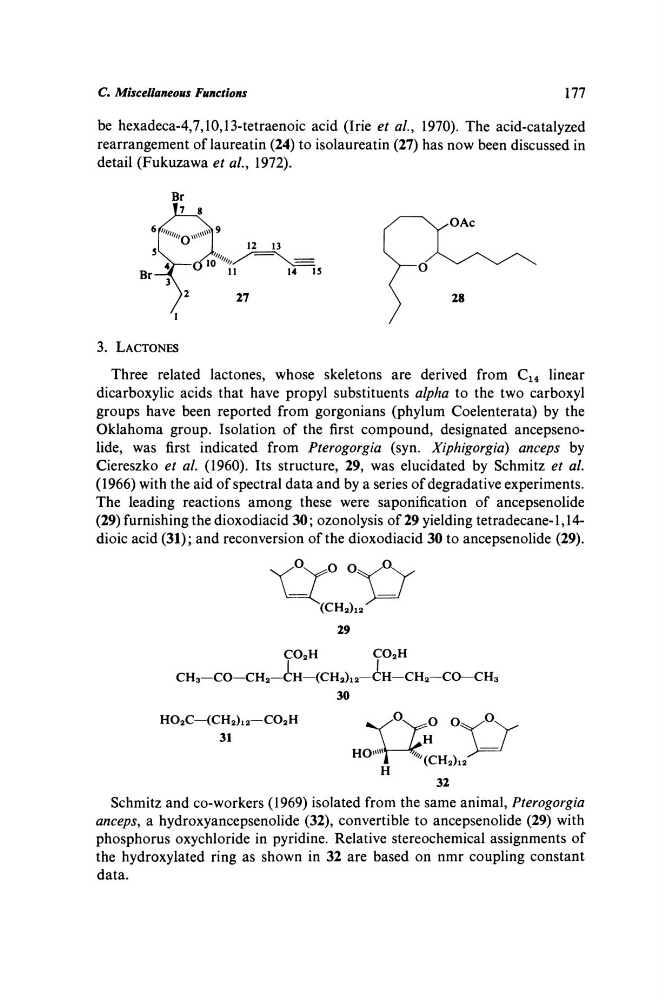
rearrangement of laureatin (24) to isolaureatin (27) has now been discussed in
detail (Fukuzawa et al, 1972).
Br
?7
8
J
U
I
12
13
I
I
)
2
27
\
28
3. LACTONES
Three related lactones, whose skeletons are derived from C 14 linear
dicarboxylic acids that have propyl substituents alpha to the two carboxyl
groups have been reported from gorgonians (phylum Coelenterata) by the
Oklahoma group. Isolation of the first compound, designated ancepsenolide, was first indicated from Pterogorgia (syn. Xiphigorgia) anceps by
Ciereszko et al. (1960). Its structure, 29, was elucidated by Schmitz et al.
(1966) with the aid of spectral data and by a series of degradative experiments.
The leading reactions among these were saponification of ancepsenolide
(29) furnishing the dioxodiacid 30; ozonolysis of 29 yielding tetradecane-1,14dioic acid (31); and reconversion of the dioxodiacid 30 to ancepsenolide (29).
( C H 2 ) l 2
29
C0 2 H
C0 2 H
C H 3 — C O — C H 2 — ( ^ H — ( C H 2 ) i 2 — C H — C H 2 — C O — C H 3
30
H 0 2 C - ( C H 2 ) 1 2 - C 0 2 H
Ο
0
ο . O .
Η
32
Schmitz and co-workers (1969) isolated from the same animal, Pterogorgia
anceps, a hydroxyancepsenolide (32), convertible to ancepsenolide (29) with
phosphorus oxychloride in pyridine. Relative stereochemical assignments of
the hydroxylated ring as shown in 32 are based on nmr coupling constant
data.
111
be hexadeca-4,7,10,13-tetraenoic acid (Irie et al, 1970). The acid-catalyzed
rearrangement of laureatin (24) to isolaureatin (27) has now been discussed in
detail (Fukuzawa et al, 1972).
Br
?7
8
J
U
I
12
13
I
I
)
2
27
\
28
3. LACTONES
Three related lactones, whose skeletons are derived from C 14 linear
dicarboxylic acids that have propyl substituents alpha to the two carboxyl
groups have been reported from gorgonians (phylum Coelenterata) by the
Oklahoma group. Isolation of the first compound, designated ancepsenolide, was first indicated from Pterogorgia (syn. Xiphigorgia) anceps by
Ciereszko et al. (1960). Its structure, 29, was elucidated by Schmitz et al.
(1966) with the aid of spectral data and by a series of degradative experiments.
The leading reactions among these were saponification of ancepsenolide
(29) furnishing the dioxodiacid 30; ozonolysis of 29 yielding tetradecane-1,14dioic acid (31); and reconversion of the dioxodiacid 30 to ancepsenolide (29).
( C H 2 ) l 2
29
C0 2 H
C0 2 H
C H 3 — C O — C H 2 — ( ^ H — ( C H 2 ) i 2 — C H — C H 2 — C O — C H 3
30
H 0 2 C - ( C H 2 ) 1 2 - C 0 2 H
Ο
0
ο . O .
Η
32
Schmitz and co-workers (1969) isolated from the same animal, Pterogorgia
anceps, a hydroxyancepsenolide (32), convertible to ancepsenolide (29) with
phosphorus oxychloride in pyridine. Relative stereochemical assignments of
the hydroxylated ring as shown in 32 are based on nmr coupling constant
data.