

176
5. Nonaromatic Compounds
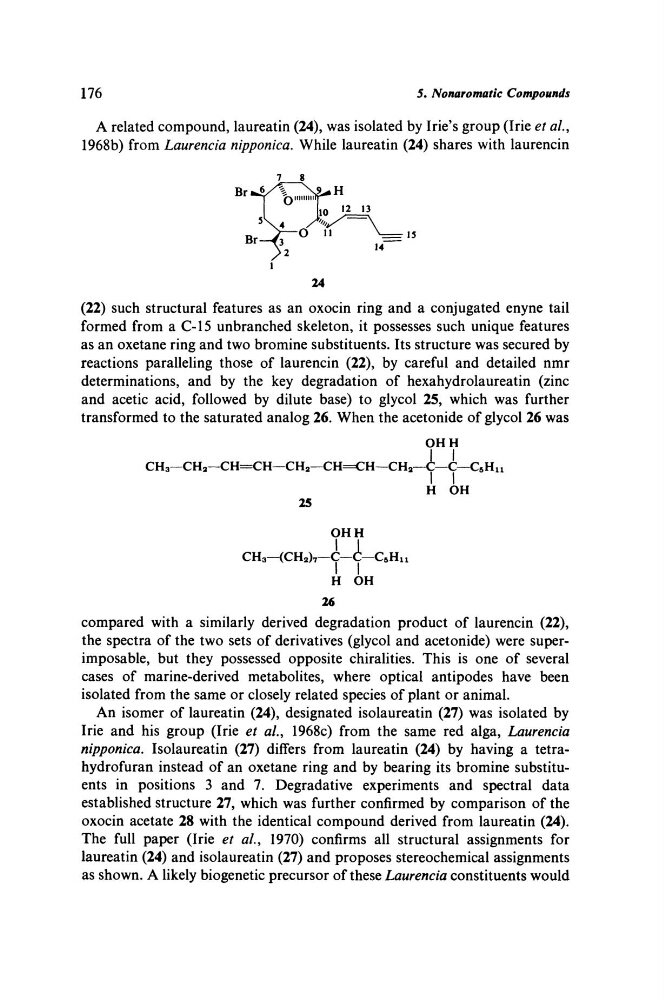
A related compound, laureatin (24), was isolated by Irie's group (Irie et al,
1968b) from Laurencia nipponica. While laureatin (24) shares with laurencin
7
8
1
24
(22) such structural features as an oxocin ring and a conjugated enyne tail
formed from a C-15 unbranched skeleton, it possesses such unique features
as an oxetane ring and two bromine substituents. Its structure was secured by
reactions paralleling those of laurencin (22), by careful and detailed nmr
determinations, and by the key degradation of hexahydrolaureatin (zinc
and acetic acid, followed by dilute base) to glycol 25, which was further
transformed to the saturated analog 26. When the acetonide of glycol 26 was
OH Η
_
Τ I
CH3—CH2—CH—CH—CH2—CH=CH—CHa—C—C—C5H11
Η
OH
25
OH Η
ι I
CH3—(CHa)?—Ç—C—C5H11
Η
OH
26
compared with a similarly derived degradation product of laurencin (22),
the spectra of the two sets of derivatives (glycol and acetonide) were superimposable, but they possessed opposite chiralities. This is one of several
cases of marine-derived metabolites, where optical antipodes have been
isolated from the same or closely related species of plant or animal.
An isomer of laureatin (24), designated isolaureatin (27) was isolated by
Irie and his group (Irie et al., 1968c) from the same red alga, Laurencia
nipponica. Isolaureatin (27) differs from laureatin (24) by having a tetrahydrofuran instead of an oxetane ring and by bearing its bromine substituents in positions 3 and 7. Degradative experiments and spectral data
established structure 27, which was further confirmed by comparison of the
oxocin acetate 28 with the identical compound derived from laureatin (24).
The full paper (Irie et al., 1970) confirms all structural assignments for
laureatin (24) and isolaureatin (27) and proposes stereochemical assignments
as shown. A likely biogenetic precursor of these Laurencia constituents would
176
5. Nonaromatic Compounds
A related compound, laureatin (24), was isolated by Irie's group (Irie et al.,
1968b) from Laurencia nipponica. While laureatin (24) shares with laurencin
24
(22) such structural features as an oxocin ring and a conjugated enyne tail
formed from a C-15 unbranched skeleton, it possesses such unique features
as an oxetane ring and two bromine substituents. Its structure was secured by
reactions paralleling those of laurencin (22), by careful and detailed nmr
determinations, and by the key degradation of hexahydrolaureatin (zinc
and acetic acid, followed by dilute base) to glycol 25, which was further
transformed to the saturated analog 26. When the acetonide of glycol 26 was
OHH
CHa-CH2-CH-CH-CH2-CH=CH-CH2-t-t-CsHll
I ,
H OH
OHH
CHa--(CH2h-t-t-CsHll
I I
H OH
26
compared with a similarly derived degradation product of laurencin (22),
the spectra of the two sets of derivatives (glycol and acetonide) were superimposable, but they possessed opposite chiralities. This is one of several
cases of marine-derived metabolites, where optical antipodes have been
isolated from the same or closely related species of plant or animal.
An isomer of laureatin (24), designated isolaureatin (27) was isolated by
Irie and his group (Irie et al., 1968c) from the same red alga, Laurencia
nipponica. Isolaureatin (27) differs from laureatin (24) by having a tetrahydrofuran instead of an oxetane ring and by bearing its bromine substituents in positions 3 and 7. Degradative experiments and spectral data
established structure 27, which was further confirmed by comparison of the
oxocin acetate 28 with the identical compound derived from laureatin (24).
The full paper (Irie et al., 1970) confirms all structural assignments for
laureatin (24) and isolaureatin (27) and proposes stereochemical assignments
as shown. A likely biogenetic precursor of these Laurencia constituents would
5. Nonaromatic Compounds
A related compound, laureatin (24), was isolated by Irie's group (Irie et al,
1968b) from Laurencia nipponica. While laureatin (24) shares with laurencin
7
8
1
24
(22) such structural features as an oxocin ring and a conjugated enyne tail
formed from a C-15 unbranched skeleton, it possesses such unique features
as an oxetane ring and two bromine substituents. Its structure was secured by
reactions paralleling those of laurencin (22), by careful and detailed nmr
determinations, and by the key degradation of hexahydrolaureatin (zinc
and acetic acid, followed by dilute base) to glycol 25, which was further
transformed to the saturated analog 26. When the acetonide of glycol 26 was
OH Η
_
Τ I
CH3—CH2—CH—CH—CH2—CH=CH—CHa—C—C—C5H11
Η
OH
25
OH Η
ι I
CH3—(CHa)?—Ç—C—C5H11
Η
OH
26
compared with a similarly derived degradation product of laurencin (22),
the spectra of the two sets of derivatives (glycol and acetonide) were superimposable, but they possessed opposite chiralities. This is one of several
cases of marine-derived metabolites, where optical antipodes have been
isolated from the same or closely related species of plant or animal.
An isomer of laureatin (24), designated isolaureatin (27) was isolated by
Irie and his group (Irie et al., 1968c) from the same red alga, Laurencia
nipponica. Isolaureatin (27) differs from laureatin (24) by having a tetrahydrofuran instead of an oxetane ring and by bearing its bromine substituents in positions 3 and 7. Degradative experiments and spectral data
established structure 27, which was further confirmed by comparison of the
oxocin acetate 28 with the identical compound derived from laureatin (24).
The full paper (Irie et al., 1970) confirms all structural assignments for
laureatin (24) and isolaureatin (27) and proposes stereochemical assignments
as shown. A likely biogenetic precursor of these Laurencia constituents would
176
5. Nonaromatic Compounds
A related compound, laureatin (24), was isolated by Irie's group (Irie et al.,
1968b) from Laurencia nipponica. While laureatin (24) shares with laurencin
24
(22) such structural features as an oxocin ring and a conjugated enyne tail
formed from a C-15 unbranched skeleton, it possesses such unique features
as an oxetane ring and two bromine substituents. Its structure was secured by
reactions paralleling those of laurencin (22), by careful and detailed nmr
determinations, and by the key degradation of hexahydrolaureatin (zinc
and acetic acid, followed by dilute base) to glycol 25, which was further
transformed to the saturated analog 26. When the acetonide of glycol 26 was
OHH
CHa-CH2-CH-CH-CH2-CH=CH-CH2-t-t-CsHll
I ,
H OH
OHH
CHa--(CH2h-t-t-CsHll
I I
H OH
26
compared with a similarly derived degradation product of laurencin (22),
the spectra of the two sets of derivatives (glycol and acetonide) were superimposable, but they possessed opposite chiralities. This is one of several
cases of marine-derived metabolites, where optical antipodes have been
isolated from the same or closely related species of plant or animal.
An isomer of laureatin (24), designated isolaureatin (27) was isolated by
Irie and his group (Irie et al., 1968c) from the same red alga, Laurencia
nipponica. Isolaureatin (27) differs from laureatin (24) by having a tetrahydrofuran instead of an oxetane ring and by bearing its bromine substituents in positions 3 and 7. Degradative experiments and spectral data
established structure 27, which was further confirmed by comparison of the
oxocin acetate 28 with the identical compound derived from laureatin (24).
The full paper (Irie et al., 1970) confirms all structural assignments for
laureatin (24) and isolaureatin (27) and proposes stereochemical assignments
as shown. A likely biogenetic precursor of these Laurencia constituents would