

C. Miscellaneous Functions
175
and TLC. Compound 17 could be regenerated from 19 by treatment of 19
with neutral alumina in hexane. Compound 19 additionally is a natural
constituent of Dictyopteris algae.
In another publication in this series Moore (1971) reported the isolation and
structural identification of polysulfides 20 and 21 from the same two species
of Dictyopteris. The structures of 20, bis(3-oxoundecyl) trisulfide, and of 21,
bis(3-oxoundecyl)tetrasulfide, were secured by spectral data and by their
relationship to the other sulfur-containing Dictyopteris constituents. Moore
(1971) suggests that the polysulfides may be biogenetic precursors of the
dictyopterenes.
[CH 3 —(CH 2 ) 7 —CO—(C] 2)2—S—H 2 S
[CH 3 —(CH 2 ) 7 —CO(CH 2 ) 2 —S—] 2 S 2
20
21
2. CYCLIC ETHERS
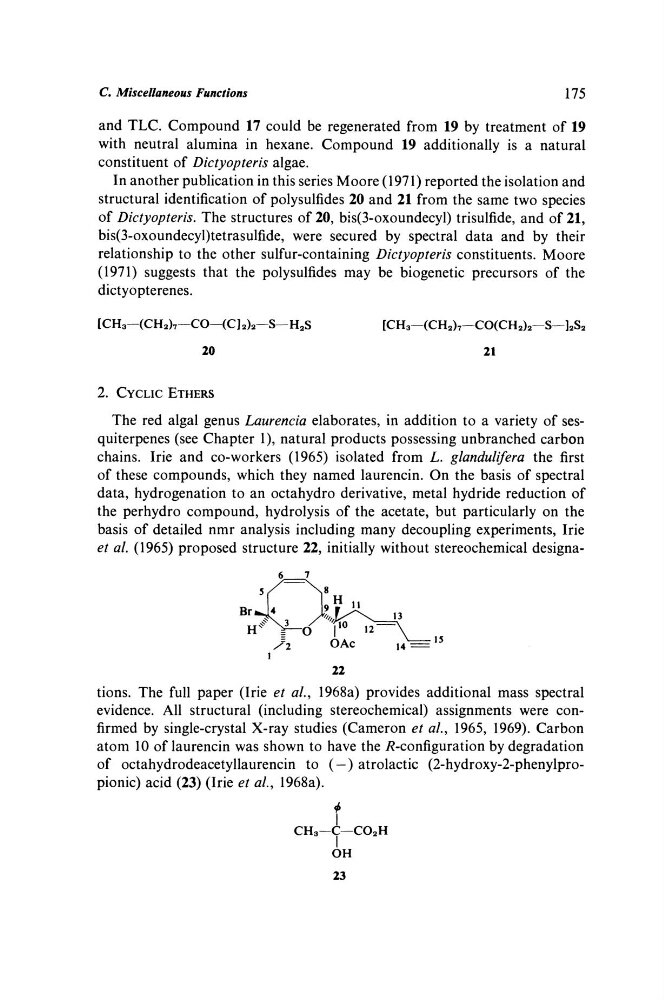
The red algal genus Laurencia elaborates, in addition to a variety of sesquiterpenes (see Chapter 1), natural products possessing unbranched carbon
chains. Irie and co-workers (1965) isolated from L. glandulifera the first
of these compounds, which they named laurencin. On the basis of spectral
data, hydrogénation to an octahydro derivative, metal hydride reduction of
the perhydro compound, hydrolysis of the acetate, but particularly on the
basis of detailed nmr analysis including many decoupling experiments, Irie
et al. (1965) proposed structure 22, initially without stereochemical designa67
^ 2
OAc
1 4 =
1
5
22
tions. The full paper (Irie et al., 1968a) provides additional mass spectral
evidence. All structural (including stereochemical) assignments were confirmed by single-crystal X-ray studies (Cameron et al., 1965, 1969). Carbon
atom 10 of laurencin was shown to have the ^-configuration by degradation
of octahydrodeacetyllaurencin to ( —) atrolactic (2-hydroxy-2-phenylpropionic) acid (23) (Irie et al., 1968a).
Φ
I
CH 3 —C—C0 2 H
OH
23
175
and TLC. Compound 17 could be regenerated from 19 by treatment of 19
with neutral alumina in hexane. Compound 19 additionally is a natural
constituent of Dictyopteris algae.
In another publication in this series Moore (1971) reported the isolation and
structural identification of polysulfides 20 and 21 from the same two species
of Dictyopteris. The structures of 20, bis(3-oxoundecyl) trisulfide, and of 21,
bis(3-oxoundecyl)tetrasulfide, were secured by spectral data and by their
relationship to the other sulfur-containing Dictyopteris constituents. Moore
(1971) suggests that the polysulfides may be biogenetic precursors of the
dictyopterenes.
[CH 3 —(CH 2 ) 7 —CO—(C] 2)2—S—H 2 S
[CH 3 —(CH 2 ) 7 —CO(CH 2 ) 2 —S—] 2 S 2
20
21
2. CYCLIC ETHERS
The red algal genus Laurencia elaborates, in addition to a variety of sesquiterpenes (see Chapter 1), natural products possessing unbranched carbon
chains. Irie and co-workers (1965) isolated from L. glandulifera the first
of these compounds, which they named laurencin. On the basis of spectral
data, hydrogénation to an octahydro derivative, metal hydride reduction of
the perhydro compound, hydrolysis of the acetate, but particularly on the
basis of detailed nmr analysis including many decoupling experiments, Irie
et al. (1965) proposed structure 22, initially without stereochemical designa67
^ 2
OAc
1 4 =
1
5
22
tions. The full paper (Irie et al., 1968a) provides additional mass spectral
evidence. All structural (including stereochemical) assignments were confirmed by single-crystal X-ray studies (Cameron et al., 1965, 1969). Carbon
atom 10 of laurencin was shown to have the ^-configuration by degradation
of octahydrodeacetyllaurencin to ( —) atrolactic (2-hydroxy-2-phenylpropionic) acid (23) (Irie et al., 1968a).
Φ
I
CH 3 —C—C0 2 H
OH
23