

178
5. Nonaromatic Compounds
A third compound in this series was isolated by Schmitz and Lorance
(1971) from the sea fan Pterogorgia quadalupensis. This animal yielded
ancepsenolide (29) in 3.1% yield and the new lactone in 1% yield. The new
lactone was shown to be 2-(13'-carboxy-14',15
, -diacetoxyhexadecanyl)-2penten-4-olide (33) by spectral data and by conversion to the known
ancepsenolide (29) by acidic methanolysis followed by treatment with phosphorus oxychloride in pyridine. Relative stereochemistry as shown in 33 was
deduced on coupling constant data.
Examination of a third species of Pterogorgia, P. citrina, surprisingly
showed the absence of these or related lactones (Schmitz et al., 1970).
V = /
1 À 1 4 /
3
^(CH 2 ) 12 /r|VoAc
33
4. KETO ACIDS
Isolation of an epimer of a known substance is by itself not very remarkable
and ordinarily would not receive much attention in a context that emphasizes
structural chemistry. However, the recent isolation of two prostaglandins
by Weinheimer and Spraggins (1969, 1970) is rather remarkable from several
viewpoints. The prostaglandins are a group of fatty acid-derived substances
that were first isolated from seminal fluid and genital glands of man and sheep,
where they occur in trace concentrations. The compounds are characterized
by dramatic physiological activity, particularly lowering of blood pressure
and stimulating of smooth muscle. Much academic and industrial research
effort has been devoted to the biological evaluation and to total synthesis of
these compounds. In the light of this background it is indeed fascinating to
learn of Weinheimer and Spraggins' (1969, 1970) isolation of two new
prostaglandins from a primitive animal, the gorgonian Plexaura
homomalla,
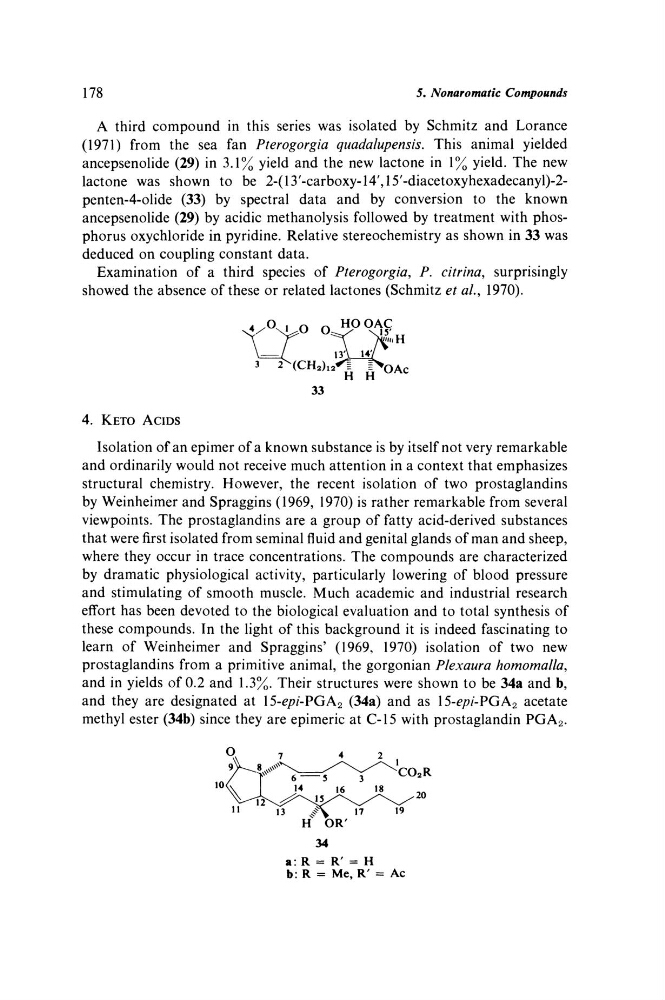
and in yields of 0.2 and 1.3%. Their structures were shown to be 34a and b,
and they are designated at 15-e/?/-PGA 2 (34a) and as 15-e/?/-PGA 2 acetate
methyl ester (34b) since they are epimeric at C-15 with prostaglandin PGA 2 .
Ο
7
4
2
»
13
/\
17
19
H OR'
34
a: R = R' = H
b: R = Me, R' = Ac
5. Nonaromatic Compounds
A third compound in this series was isolated by Schmitz and Lorance
(1971) from the sea fan Pterogorgia quadalupensis. This animal yielded
ancepsenolide (29) in 3.1% yield and the new lactone in 1% yield. The new
lactone was shown to be 2-(13'-carboxy-14',15
, -diacetoxyhexadecanyl)-2penten-4-olide (33) by spectral data and by conversion to the known
ancepsenolide (29) by acidic methanolysis followed by treatment with phosphorus oxychloride in pyridine. Relative stereochemistry as shown in 33 was
deduced on coupling constant data.
Examination of a third species of Pterogorgia, P. citrina, surprisingly
showed the absence of these or related lactones (Schmitz et al., 1970).
V = /
1 À 1 4 /
3
^(CH 2 ) 12 /r|VoAc
33
4. KETO ACIDS
Isolation of an epimer of a known substance is by itself not very remarkable
and ordinarily would not receive much attention in a context that emphasizes
structural chemistry. However, the recent isolation of two prostaglandins
by Weinheimer and Spraggins (1969, 1970) is rather remarkable from several
viewpoints. The prostaglandins are a group of fatty acid-derived substances
that were first isolated from seminal fluid and genital glands of man and sheep,
where they occur in trace concentrations. The compounds are characterized
by dramatic physiological activity, particularly lowering of blood pressure
and stimulating of smooth muscle. Much academic and industrial research
effort has been devoted to the biological evaluation and to total synthesis of
these compounds. In the light of this background it is indeed fascinating to
learn of Weinheimer and Spraggins' (1969, 1970) isolation of two new
prostaglandins from a primitive animal, the gorgonian Plexaura
homomalla,
and in yields of 0.2 and 1.3%. Their structures were shown to be 34a and b,
and they are designated at 15-e/?/-PGA 2 (34a) and as 15-e/?/-PGA 2 acetate
methyl ester (34b) since they are epimeric at C-15 with prostaglandin PGA 2 .
Ο
7
4
2
»
13
/\
17
19
H OR'
34
a: R = R' = H
b: R = Me, R' = Ac