

D. Complex Polycyclic Compounds
159
/
Nv^N
H
Ι
H
Γ
N^(CH 2 ) 3 -N-C=NH
~
H
136
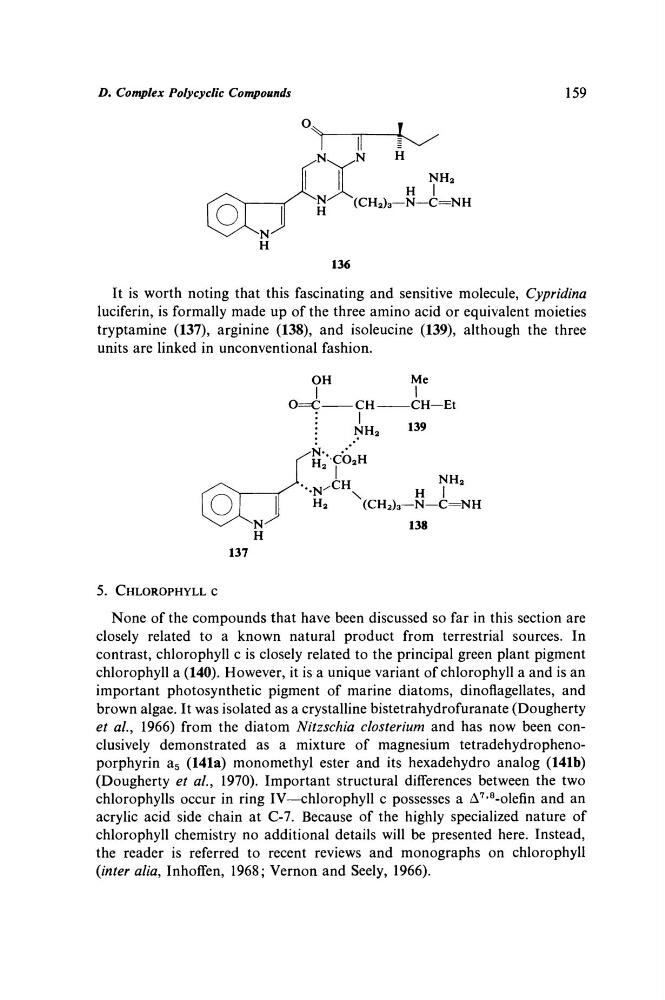
It is worth noting that this fascinating and sensitive molecule, Cypridina
luciferin, is formally made up of the three amino acid or equivalent moieties
tryptamine (137), arginine (138), and isoleucine (139), although the three
units are linked in unconventional fashion.
OH
Me
I
I
0=C
CH
CH—Et
J
NH 2
139
^
A'^
C
\
Η Τ"
Ι Ο Ι
1
H
z
(CH 2 ) 3 —N—C=NH
\/^N^
138
Η
137
5. CHLOROPHYLL C
None of the compounds that have been discussed so far in this section are
closely related to a known natural product from terrestrial sources. In
contrast, chlorophyll c is closely related to the principal green plant pigment
chlorophyll a (140). However, it is a unique variant of chlorophyll a and is an
important photosynthetic pigment of marine diatoms, dinoflagellates, and
brown algae. It was isolated as a crystalline bistetrahydrofuranate (Dougherty
et al, 1966) from the diatom Nitzschia closterium and has now been conclusively demonstrated as a mixture of magnesium tetradehydrophenoporphyrin a 5 (141a) monomethyl ester and its hexadehydro analog (141b)
(Dougherty et al, 1970). Important structural differences between the two
chlorophylls occur in ring IV—chlorophyll c possesses a A
7 '
8 -olefin and an
acrylic acid side chain at C-7. Because of the highly specialized nature of
chlorophyll chemistry no additional details will be presented here. Instead,
the reader is referred to recent reviews and monographs on chlorophyll
{inter alia, Inhoffen, 1968; Vernon and Seely, 1966).
159
/
Nv^N
H
Ι
H
Γ
N^(CH 2 ) 3 -N-C=NH
~
H
136
It is worth noting that this fascinating and sensitive molecule, Cypridina
luciferin, is formally made up of the three amino acid or equivalent moieties
tryptamine (137), arginine (138), and isoleucine (139), although the three
units are linked in unconventional fashion.
OH
Me
I
I
0=C
CH
CH—Et
J
NH 2
139
^
A'^
C
\
Η Τ"
Ι Ο Ι
1
H
z
(CH 2 ) 3 —N—C=NH
\/^N^
138
Η
137
5. CHLOROPHYLL C
None of the compounds that have been discussed so far in this section are
closely related to a known natural product from terrestrial sources. In
contrast, chlorophyll c is closely related to the principal green plant pigment
chlorophyll a (140). However, it is a unique variant of chlorophyll a and is an
important photosynthetic pigment of marine diatoms, dinoflagellates, and
brown algae. It was isolated as a crystalline bistetrahydrofuranate (Dougherty
et al, 1966) from the diatom Nitzschia closterium and has now been conclusively demonstrated as a mixture of magnesium tetradehydrophenoporphyrin a 5 (141a) monomethyl ester and its hexadehydro analog (141b)
(Dougherty et al, 1970). Important structural differences between the two
chlorophylls occur in ring IV—chlorophyll c possesses a A
7 '
8 -olefin and an
acrylic acid side chain at C-7. Because of the highly specialized nature of
chlorophyll chemistry no additional details will be presented here. Instead,
the reader is referred to recent reviews and monographs on chlorophyll
{inter alia, Inhoffen, 1968; Vernon and Seely, 1966).