

160
4. Nitrogenous Compounds
142
\
Ι
Ι
/
\
v=N
Ν—(/
\
·· \
/
/
N
N
\
* J | |
ι ~ V
^ ^ J O ^
F
D
H
I
\
C0 2 Me°
C0 2 R
C0 2 Me
C0 2 H
140
141
R = phytyl
a: R = —CH 2 —CH 3
b: R = — CH=CH 2
6. SURUGATOXIN
In 1967 Hashimoto and co-workers (Hashimoto et ah, 1967b) followed up
earlier reports of human intoxications that had been caused by ingestion of a
gastropod mollusk Babylonia japonica (Japanese ivory shell) and isolated a
toxin from the midgut gland of the mollusk. Hashimoto et ah (1967) developed a bioassay based on mydriasis in mice since optical disturbances
including mydriasis had been reported among the human symptoms of
intoxication. Shibota and Hashimoto (1970, 1971) further purified and
characterized the toxin.
Another group of Japanese workers (Kosuge et ah, 1972) reisolated the
toxin they call surugatoxin (after Suruga Bay, where toxic outbreaks had
occurred), and determined its structure by X-ray crystallographic techniques.
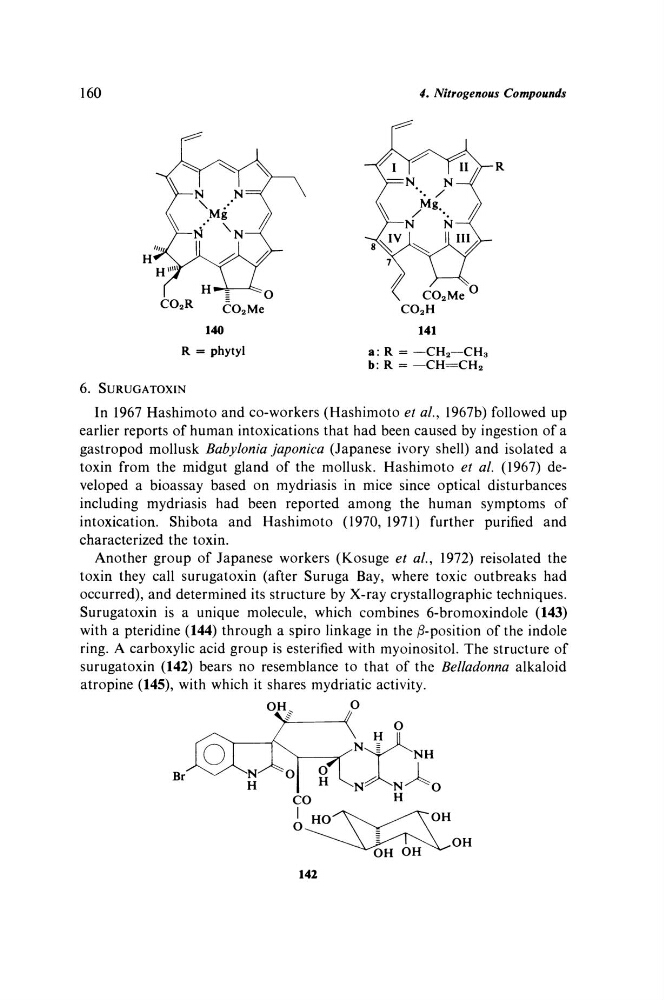
Surugatoxin is a unique molecule, which combines 6-bromoxindole (143)
with a pteridine (144) through a spiro linkage in the ß-position of the indole
ring. A carboxylic acid group is esterified with myoinositol. The structure of
surugatoxin (142) bears no resemblance to that of the Belladonna alkaloid
atropine (145), with which it shares mydriatic activity.
OH.
Ο
CO
Η
^ HO^V^^TOH
^OH OH
^
4. Nitrogenous Compounds
142
\
Ι
Ι
/
\
v=N
Ν—(/
\
·· \
/
/
N
N
\
* J | |
ι ~ V
^ ^ J O ^
F
D
H
I
\
C0 2 Me°
C0 2 R
C0 2 Me
C0 2 H
140
141
R = phytyl
a: R = —CH 2 —CH 3
b: R = — CH=CH 2
6. SURUGATOXIN
In 1967 Hashimoto and co-workers (Hashimoto et ah, 1967b) followed up
earlier reports of human intoxications that had been caused by ingestion of a
gastropod mollusk Babylonia japonica (Japanese ivory shell) and isolated a
toxin from the midgut gland of the mollusk. Hashimoto et ah (1967) developed a bioassay based on mydriasis in mice since optical disturbances
including mydriasis had been reported among the human symptoms of
intoxication. Shibota and Hashimoto (1970, 1971) further purified and
characterized the toxin.
Another group of Japanese workers (Kosuge et ah, 1972) reisolated the
toxin they call surugatoxin (after Suruga Bay, where toxic outbreaks had
occurred), and determined its structure by X-ray crystallographic techniques.
Surugatoxin is a unique molecule, which combines 6-bromoxindole (143)
with a pteridine (144) through a spiro linkage in the ß-position of the indole
ring. A carboxylic acid group is esterified with myoinositol. The structure of
surugatoxin (142) bears no resemblance to that of the Belladonna alkaloid
atropine (145), with which it shares mydriatic activity.
OH.
Ο
CO
Η
^ HO^V^^TOH
^OH OH
^