

158
4. Nitrogenous Compounds
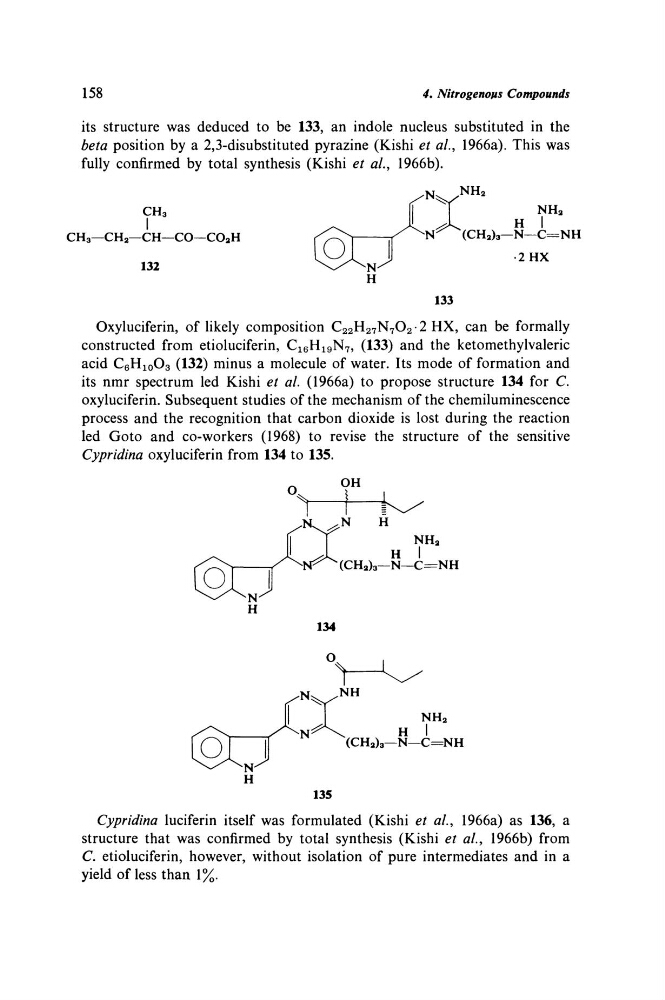
its structure was deduced to be 133, an indole nucleus substituted in the
beta position by a 2,3-disubstituted pyrazine (Kishi et al, 1966a). This was
fully confirmed by total synthesis (Kishi et al., 1966b).
CH 3
\\
Τ
NH a
CH 3 -CH 2 -CH-CO-C0 2 H
/^N^fCH^-N^NH
Η
133
Oxyluciferin, of likely composition C22H 2 7N 7 0 2 · 2 HX, can be formally
constructed from etioluciferin, C 1 6 H 1 9 N 7 , (133) and the ketomethylvaleric
acid C 6 H 1 0 O 3 (132) minus a molecule of water. Its mode of formation and
its nmr spectrum led Kishi et al. (1966a) to propose structure 134 for C.
oxyluciferin. Subsequent studies of the mechanism of the chemiluminescence
process and the recognition that carbon dioxide is lost during the reaction
led Goto and co-workers (1968) to revise the structure of the sensitive
Cypridina oxyluciferin from 134 to 135.
1 Τ
T
H2
j^Qj^~~~j^N^(CH 2 ) 3 -N-C=NH
Η
134
[ I J NH 2
/ V _ A N ^
Η I
| Q
J
J]
(CH 2 ) 3 —Ν—C=NH
Η
135
Cypridina luciferin itself was formulated (Kishi et al, 1966a) as 136, a
structure that was confirmed by total synthesis (Kishi et al, 1966b) from
C. etioluciferin, however, without isolation of pure intermediates and in a
yield of less than 1%.
158
4. Nitrogenous Compounds
its structure was deduced to be 133, an indole nucleus substituted in the
beta position by a 2,3-disubstituted pyrazine (Kishi et al., 1966a). This was
fully confirmed by total synthesis (Kishi et al., 1966b).
132
N
H
133
Oxyluciferin, of likely composition C22H27N702· 2 HX, can be formally
constructed from etioluciferin, C16H19N7, (133) and the ketomethylvaleric
acid C 6 H100S (132) minus a molecule of water. Its mode of formation and
its nmr spectrum led Kishi et al. (1966a) to propose structure 134 for C.
oxyluciferin. Subsequent studies of the mechanism of the chemiluminescence
process and the recognition that carbon dioxide is lost during the reaction
led Goto and co-workers (1968) to revise the structure of the sensitive
Cypridina oxyluciferin from 134 to 135.
o
OH
~ N ~N H
I X H~H2
~ (CH2)3-N-C=NH
N
H
134
N
H
135
Cypridina luciferin itself was formulated (Kishi et al., 1966a) as 136, a
structure that was confirmed by total synthesis (Kishi et al., 1966b) from
C. etioluciferin, however, without isolation of pure intermediates and in a
yield of less than 1%.
4. Nitrogenous Compounds
its structure was deduced to be 133, an indole nucleus substituted in the
beta position by a 2,3-disubstituted pyrazine (Kishi et al, 1966a). This was
fully confirmed by total synthesis (Kishi et al., 1966b).
CH 3
\\
Τ
NH a
CH 3 -CH 2 -CH-CO-C0 2 H
/^N^fCH^-N^NH
Η
133
Oxyluciferin, of likely composition C22H 2 7N 7 0 2 · 2 HX, can be formally
constructed from etioluciferin, C 1 6 H 1 9 N 7 , (133) and the ketomethylvaleric
acid C 6 H 1 0 O 3 (132) minus a molecule of water. Its mode of formation and
its nmr spectrum led Kishi et al. (1966a) to propose structure 134 for C.
oxyluciferin. Subsequent studies of the mechanism of the chemiluminescence
process and the recognition that carbon dioxide is lost during the reaction
led Goto and co-workers (1968) to revise the structure of the sensitive
Cypridina oxyluciferin from 134 to 135.
1 Τ
T
H2
j^Qj^~~~j^N^(CH 2 ) 3 -N-C=NH
Η
134
[ I J NH 2
/ V _ A N ^
Η I
| Q
J
J]
(CH 2 ) 3 —Ν—C=NH
Η
135
Cypridina luciferin itself was formulated (Kishi et al, 1966a) as 136, a
structure that was confirmed by total synthesis (Kishi et al, 1966b) from
C. etioluciferin, however, without isolation of pure intermediates and in a
yield of less than 1%.
158
4. Nitrogenous Compounds
its structure was deduced to be 133, an indole nucleus substituted in the
beta position by a 2,3-disubstituted pyrazine (Kishi et al., 1966a). This was
fully confirmed by total synthesis (Kishi et al., 1966b).
132
N
H
133
Oxyluciferin, of likely composition C22H27N702· 2 HX, can be formally
constructed from etioluciferin, C16H19N7, (133) and the ketomethylvaleric
acid C 6 H100S (132) minus a molecule of water. Its mode of formation and
its nmr spectrum led Kishi et al. (1966a) to propose structure 134 for C.
oxyluciferin. Subsequent studies of the mechanism of the chemiluminescence
process and the recognition that carbon dioxide is lost during the reaction
led Goto and co-workers (1968) to revise the structure of the sensitive
Cypridina oxyluciferin from 134 to 135.
o
OH
~ N ~N H
I X H~H2
~ (CH2)3-N-C=NH
N
H
134
N
H
135
Cypridina luciferin itself was formulated (Kishi et al., 1966a) as 136, a
structure that was confirmed by total synthesis (Kishi et al., 1966b) from
C. etioluciferin, however, without isolation of pure intermediates and in a
yield of less than 1%.