

D. Complex Poly cyclic Compounds
143
data, degradation, and synthesis to be 3,4-dihydroxyquinoline-2-carboxylic
acid (89). Like anabaseine (87), this quinoline derivative also was not previously known as a natural product.
OH
^^N^C0 2 H
89
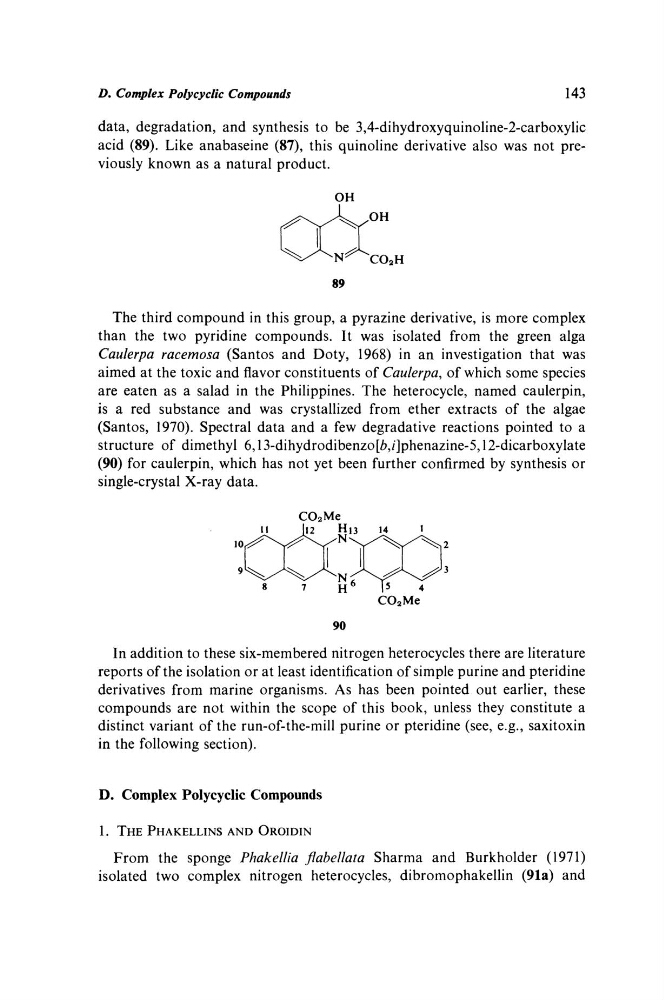
The third compound in this group, a pyrazine derivative, is more complex
than the two pyridine compounds. It was isolated from the green alga
Caulerpa racemosa (Santos and Doty, 1968) in an investigation that was
aimed at the toxic and flavor constituents of Caulerpa, of which some species
are eaten as a salad in the Philippines. The heterocycle, named caulerpin,
is a red substance and was crystallized from ether extracts of the algae
(Santos, 1970). Spectral data and a few degradative reactions pointed to a
structure of dimethyl 6,13-dihydrodibenzo[Z?,/]phenazine-5,12-dicarboxylate
(90) for caulerpin, which has not yet been further confirmed by synthesis or
single-crystal X-ray data.
C0 2 Me
Π
Jl2
Hi3
14
1
8
7
HP
4
C0 2 Me
90
In addition to these six-membered nitrogen heterocycles there are literature
reports of the isolation or at least identification of simple purine and pteridine
derivatives from marine organisms. As has been pointed out earlier, these
compounds are not within the scope of this book, unless they constitute a
distinct variant of the run-of-the-mill purine or pteridine (see, e.g., saxitoxin
in the following section).
D. Complex Polycyclic Compounds
1. THE PHAKELLINS AND OROIDIN
From the sponge Phakellia flabellata Sharma and Burkholder (1971)
isolated two complex nitrogen heterocycles, dibromophakellin (91a) and
D. Complex Polycyclic Compounds
143
data, degradation, and synthesis to be 3,4-dihydroxyquinoline-2-carboxylic
acid (89). Like anabaseine (87), this quinoline derivative also was not previously known as a natural product.
OH
~OH
UNAc02H
89
The third compound in this group, a pyrazine derivative, is more complex
than the two pyridine compounds. It was isolated from the green alga
Caulerpa racemosa (Santos and Doty, 1968) in an investigation that was
aimed at the toxic and flavor constituents of Caulerpa, of which some species
are eaten as a salad in the Philippines. The heterocycle, named caulerpin,
is a red substance and was crystallized from ether extracts of the algae
(Santos, 1970). Spectral data and a few degradative reactions pointed to a
structure of dimethyl 6, 13-dihydrodibenzo[b,i]phenazine-5, 12-dicarboxylate
(90) for caulerpin, which has not yet been further confirmed by synthesis or
single-crystal X-ray data.
90
In addition to these six-membered nitrogen heterocycles there are literature
reports of the isolation or at least identification of simple purine and pteridine
derivatives from marine organisms. As has been pointed out earlier, these
compounds are not within the scope of this book, unless they constitute a
distinct variant of the run-of-the-mill purine or pteridine (see, e.g., saxitoxin
in the following section).
D. Complex Polycyclic Compounds
1. THE PHAKELLINS AND OROIDIN
From the sponge Phakellia flabellata Sharma and Burkholder (1971)
isolated two complex nitrogen heterocycles, dibromophakellin (91a) and
143
data, degradation, and synthesis to be 3,4-dihydroxyquinoline-2-carboxylic
acid (89). Like anabaseine (87), this quinoline derivative also was not previously known as a natural product.
OH
^^N^C0 2 H
89
The third compound in this group, a pyrazine derivative, is more complex
than the two pyridine compounds. It was isolated from the green alga
Caulerpa racemosa (Santos and Doty, 1968) in an investigation that was
aimed at the toxic and flavor constituents of Caulerpa, of which some species
are eaten as a salad in the Philippines. The heterocycle, named caulerpin,
is a red substance and was crystallized from ether extracts of the algae
(Santos, 1970). Spectral data and a few degradative reactions pointed to a
structure of dimethyl 6,13-dihydrodibenzo[Z?,/]phenazine-5,12-dicarboxylate
(90) for caulerpin, which has not yet been further confirmed by synthesis or
single-crystal X-ray data.
C0 2 Me
Π
Jl2
Hi3
14
1
8
7
HP
4
C0 2 Me
90
In addition to these six-membered nitrogen heterocycles there are literature
reports of the isolation or at least identification of simple purine and pteridine
derivatives from marine organisms. As has been pointed out earlier, these
compounds are not within the scope of this book, unless they constitute a
distinct variant of the run-of-the-mill purine or pteridine (see, e.g., saxitoxin
in the following section).
D. Complex Polycyclic Compounds
1. THE PHAKELLINS AND OROIDIN
From the sponge Phakellia flabellata Sharma and Burkholder (1971)
isolated two complex nitrogen heterocycles, dibromophakellin (91a) and
D. Complex Polycyclic Compounds
143
data, degradation, and synthesis to be 3,4-dihydroxyquinoline-2-carboxylic
acid (89). Like anabaseine (87), this quinoline derivative also was not previously known as a natural product.
OH
~OH
UNAc02H
89
The third compound in this group, a pyrazine derivative, is more complex
than the two pyridine compounds. It was isolated from the green alga
Caulerpa racemosa (Santos and Doty, 1968) in an investigation that was
aimed at the toxic and flavor constituents of Caulerpa, of which some species
are eaten as a salad in the Philippines. The heterocycle, named caulerpin,
is a red substance and was crystallized from ether extracts of the algae
(Santos, 1970). Spectral data and a few degradative reactions pointed to a
structure of dimethyl 6, 13-dihydrodibenzo[b,i]phenazine-5, 12-dicarboxylate
(90) for caulerpin, which has not yet been further confirmed by synthesis or
single-crystal X-ray data.
90
In addition to these six-membered nitrogen heterocycles there are literature
reports of the isolation or at least identification of simple purine and pteridine
derivatives from marine organisms. As has been pointed out earlier, these
compounds are not within the scope of this book, unless they constitute a
distinct variant of the run-of-the-mill purine or pteridine (see, e.g., saxitoxin
in the following section).
D. Complex Polycyclic Compounds
1. THE PHAKELLINS AND OROIDIN
From the sponge Phakellia flabellata Sharma and Burkholder (1971)
isolated two complex nitrogen heterocycles, dibromophakellin (91a) and