

144
4. Nitrogenous Compounds
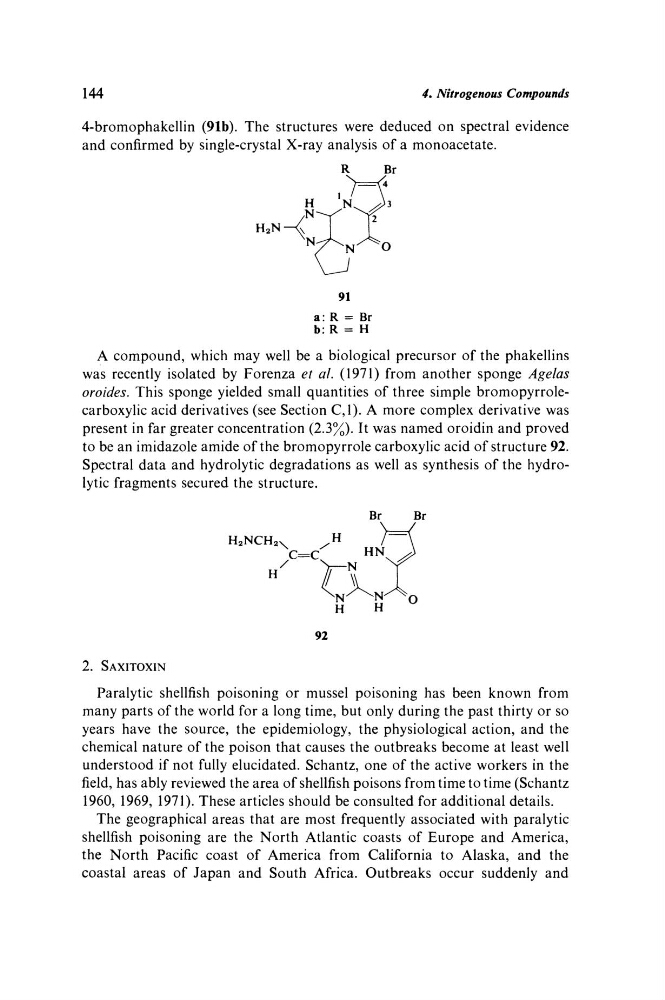
4-bromophakellin (91b). The structures were deduced on spectral evidence
and confirmed by single-crystal X-ray analysis of a monoacetate.
R
Br
H
V J>3
H 2 N^1
I
ν
ΛΝ
Λ
Ο
91
a: R = Br
b: R = Η
A compound, which may well be a biological precursor of the phakellins
was recently isolated by Forenza et al. (1971) from another sponge Agelas
oroides. This sponge yielded small quantities of three simple bromopyrrolecarboxylic acid derivatives (see Section C,l). A more complex derivative was
present in far greater concentration (2.3%). It was named oroidin and proved
to be an imidazole amide of the bromopyrrole carboxylic acid of structure 92.
Spectral data and hydrolytic degradations as well as synthesis of the hydrolytic fragments secured the structure.
Br
Br
H 2 NCH 2V
H
/
\
ni
H
H
92
2. SAXITOXIN
Paralytic shellfish poisoning or mussel poisoning has been known from
many parts of the world for a long time, but only during the past thirty or so
years have the source, the epidemiology, the physiological action, and the
chemical nature of the poison that causes the outbreaks become at least well
understood if not fully elucidated. Schantz, one of the active workers in the
field, has ably reviewed the area of shellfish poisons from time to time (Schantz
1960, 1969, 1971). These articles should be consulted for additional details.
The geographical areas that are most frequently associated with paralytic
shellfish poisoning are the North Atlantic coasts of Europe and America,
the North Pacific coast of America from California to Alaska, and the
coastal areas of Japan and South Africa. Outbreaks occur suddenly and
4. Nitrogenous Compounds
4-bromophakellin (91b). The structures were deduced on spectral evidence
and confirmed by single-crystal X-ray analysis of a monoacetate.
R
Br
H
V J>3
H 2 N^1
I
ν
ΛΝ
Λ
Ο
91
a: R = Br
b: R = Η
A compound, which may well be a biological precursor of the phakellins
was recently isolated by Forenza et al. (1971) from another sponge Agelas
oroides. This sponge yielded small quantities of three simple bromopyrrolecarboxylic acid derivatives (see Section C,l). A more complex derivative was
present in far greater concentration (2.3%). It was named oroidin and proved
to be an imidazole amide of the bromopyrrole carboxylic acid of structure 92.
Spectral data and hydrolytic degradations as well as synthesis of the hydrolytic fragments secured the structure.
Br
Br
H 2 NCH 2V
H
/
\
ni
H
H
92
2. SAXITOXIN
Paralytic shellfish poisoning or mussel poisoning has been known from
many parts of the world for a long time, but only during the past thirty or so
years have the source, the epidemiology, the physiological action, and the
chemical nature of the poison that causes the outbreaks become at least well
understood if not fully elucidated. Schantz, one of the active workers in the
field, has ably reviewed the area of shellfish poisons from time to time (Schantz
1960, 1969, 1971). These articles should be consulted for additional details.
The geographical areas that are most frequently associated with paralytic
shellfish poisoning are the North Atlantic coasts of Europe and America,
the North Pacific coast of America from California to Alaska, and the
coastal areas of Japan and South Africa. Outbreaks occur suddenly and