

142
4. Nitrogenous Compounds
nemertine worms when injected into crabs produced convulsions, paralysis,
and death. Bacq (1936) coined the trivial names amphiporine and nemertine
for these toxins.
Solution of this problem was not forthcoming until 1969 in a preliminary
announcement by Kern et al, followed by the full paper in 1971. Kern et al.
(1971) collected and processed about ten thousand (3-4 kg) specimens of
the hoplonemertine Paranemertes peregrina. The toxin was purified by solvent
partition, chromatography, and preparation of the crystalline picrate.
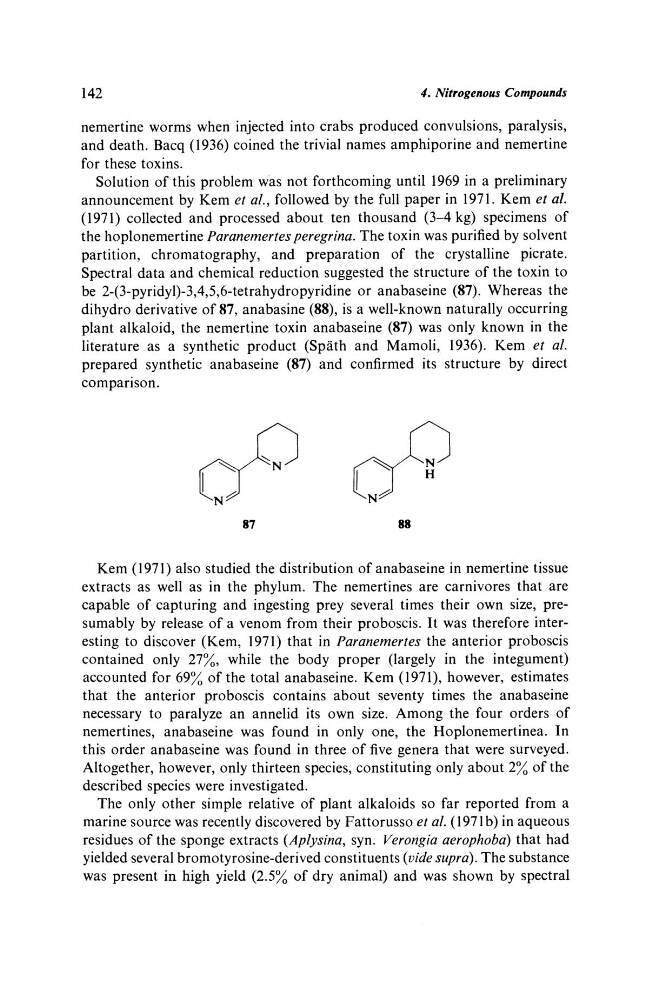
Spectral data and chemical reduction suggested the structure of the toxin to
be 2-(3-pyridyl)-3,4,5,6-tetrahydropyridine or anabaseine (87). Whereas the
dihydro derivative of 87, anabasine (88), is a well-known naturally occurring
plant alkaloid, the nemertine toxin anabaseine (87) was only known in the
literature as a synthetic product (Späth and Mamoli, 1936). Kern et al.
prepared synthetic anabaseine (87) and confirmed its structure by direct
comparison.
(Τ
on
87
88
Kern (1971) also studied the distribution of anabaseine in nemertine tissue
extracts as well as in the phylum. The nemertines are carnivores that are
capable of capturing and ingesting prey several times their own size, presumably by release of a venom from their proboscis. It was therefore interesting to discover (Kern, 1971) that in Paranemertes the anterior proboscis
contained only 27%, while the body proper (largely in the integument)
accounted for 69% of the total anabaseine. Kern (1971), however, estimates
that the anterior proboscis contains about seventy times the anabaseine
necessary to paralyze an annelid its own size. Among the four orders of
nemertines, anabaseine was found in only one, the Hoplonemertinea. In
this order anabaseine was found in three of five genera that were surveyed.
Altogether, however, only thirteen species, constituting only about 2% of the
described species were investigated.
The only other simple relative of plant alkaloids so far reported from a
marine source was recently discovered by Fattorusso et al. (1971b) in aqueous
residues of the sponge extracts {Aplysina, syn. Verongia aerophoba) that had
yielded several bromotyrosine-derived constituents (vide supra). The substance
was present in high yield (2.5% of dry animal) and was shown by spectral
4. Nitrogenous Compounds
nemertine worms when injected into crabs produced convulsions, paralysis,
and death. Bacq (1936) coined the trivial names amphiporine and nemertine
for these toxins.
Solution of this problem was not forthcoming until 1969 in a preliminary
announcement by Kern et al, followed by the full paper in 1971. Kern et al.
(1971) collected and processed about ten thousand (3-4 kg) specimens of
the hoplonemertine Paranemertes peregrina. The toxin was purified by solvent
partition, chromatography, and preparation of the crystalline picrate.
Spectral data and chemical reduction suggested the structure of the toxin to
be 2-(3-pyridyl)-3,4,5,6-tetrahydropyridine or anabaseine (87). Whereas the
dihydro derivative of 87, anabasine (88), is a well-known naturally occurring
plant alkaloid, the nemertine toxin anabaseine (87) was only known in the
literature as a synthetic product (Späth and Mamoli, 1936). Kern et al.
prepared synthetic anabaseine (87) and confirmed its structure by direct
comparison.
(Τ
on
87
88
Kern (1971) also studied the distribution of anabaseine in nemertine tissue
extracts as well as in the phylum. The nemertines are carnivores that are
capable of capturing and ingesting prey several times their own size, presumably by release of a venom from their proboscis. It was therefore interesting to discover (Kern, 1971) that in Paranemertes the anterior proboscis
contained only 27%, while the body proper (largely in the integument)
accounted for 69% of the total anabaseine. Kern (1971), however, estimates
that the anterior proboscis contains about seventy times the anabaseine
necessary to paralyze an annelid its own size. Among the four orders of
nemertines, anabaseine was found in only one, the Hoplonemertinea. In
this order anabaseine was found in three of five genera that were surveyed.
Altogether, however, only thirteen species, constituting only about 2% of the
described species were investigated.
The only other simple relative of plant alkaloids so far reported from a
marine source was recently discovered by Fattorusso et al. (1971b) in aqueous
residues of the sponge extracts {Aplysina, syn. Verongia aerophoba) that had
yielded several bromotyrosine-derived constituents (vide supra). The substance
was present in high yield (2.5% of dry animal) and was shown by spectral