

C. Compounds Containing Nitrogen in a Cycle
141
C0 2 H C0 2 H
H
H
H
H
85
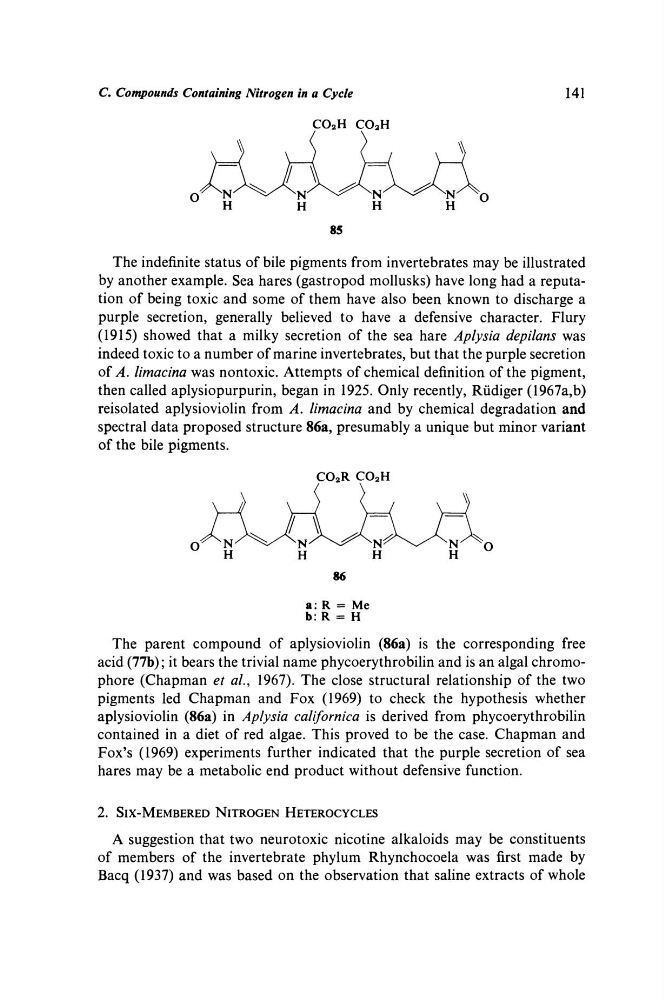
The indefinite status of bile pigments from invertebrates may be illustrated
by another example. Sea hares (gastropod mollusks) have long had a reputation of being toxic and some of them have also been known to discharge a
purple secretion, generally believed to have a defensive character. Flury
(1915) showed that a milky secretion of the sea hare Aplysia depilans was
indeed toxic to a number of marine invertebrates, but that the purple secretion
of A. limacina was nontoxic. Attempts of chemical definition of the pigment,
then called aplysiopurpurin, began in 1925. Only recently, Rüdiger (1967a,b)
reisolated aplysioviolin from A. limacina and by chemical degradation and
spectral data proposed structure 86a, presumably a unique but minor variant
of the bile pigments.
C0 2 R C0 2 H
H
H
H
H
86
a: R = Me
b: R = H
The parent compound of aplysioviolin (86a) is the corresponding free
acid (77b) ; it bears the trivial name phycoerythrobilin and is an algal chromophore (Chapman et al, 1967). The close structural relationship of the two
pigments led Chapman and Fox (1969) to check the hypothesis whether
aplysioviolin (86a) in Aplysia californica is derived from phycoerythrobilin
contained in a diet of red algae. This proved to be the case. Chapman and
Fox's (1969) experiments further indicated that the purple secretion of sea
hares may be a metabolic end product without defensive function.
2. SIX-MEMBERED NITROGEN HETEROCYCLES
A suggestion that two neurotoxic nicotine alkaloids may be constituents
of members of the invertebrate phylum Rhynchocoela was first made by
Bacq (1937) and was based on the observation that saline extracts of whole
141
C0 2 H C0 2 H
H
H
H
H
85
The indefinite status of bile pigments from invertebrates may be illustrated
by another example. Sea hares (gastropod mollusks) have long had a reputation of being toxic and some of them have also been known to discharge a
purple secretion, generally believed to have a defensive character. Flury
(1915) showed that a milky secretion of the sea hare Aplysia depilans was
indeed toxic to a number of marine invertebrates, but that the purple secretion
of A. limacina was nontoxic. Attempts of chemical definition of the pigment,
then called aplysiopurpurin, began in 1925. Only recently, Rüdiger (1967a,b)
reisolated aplysioviolin from A. limacina and by chemical degradation and
spectral data proposed structure 86a, presumably a unique but minor variant
of the bile pigments.
C0 2 R C0 2 H
H
H
H
H
86
a: R = Me
b: R = H
The parent compound of aplysioviolin (86a) is the corresponding free
acid (77b) ; it bears the trivial name phycoerythrobilin and is an algal chromophore (Chapman et al, 1967). The close structural relationship of the two
pigments led Chapman and Fox (1969) to check the hypothesis whether
aplysioviolin (86a) in Aplysia californica is derived from phycoerythrobilin
contained in a diet of red algae. This proved to be the case. Chapman and
Fox's (1969) experiments further indicated that the purple secretion of sea
hares may be a metabolic end product without defensive function.
2. SIX-MEMBERED NITROGEN HETEROCYCLES
A suggestion that two neurotoxic nicotine alkaloids may be constituents
of members of the invertebrate phylum Rhynchocoela was first made by
Bacq (1937) and was based on the observation that saline extracts of whole