

140
4. Nitrogenous Compounds
A third isolate, designated kainic lactone and assigned structure 83, is
considered an artifact.
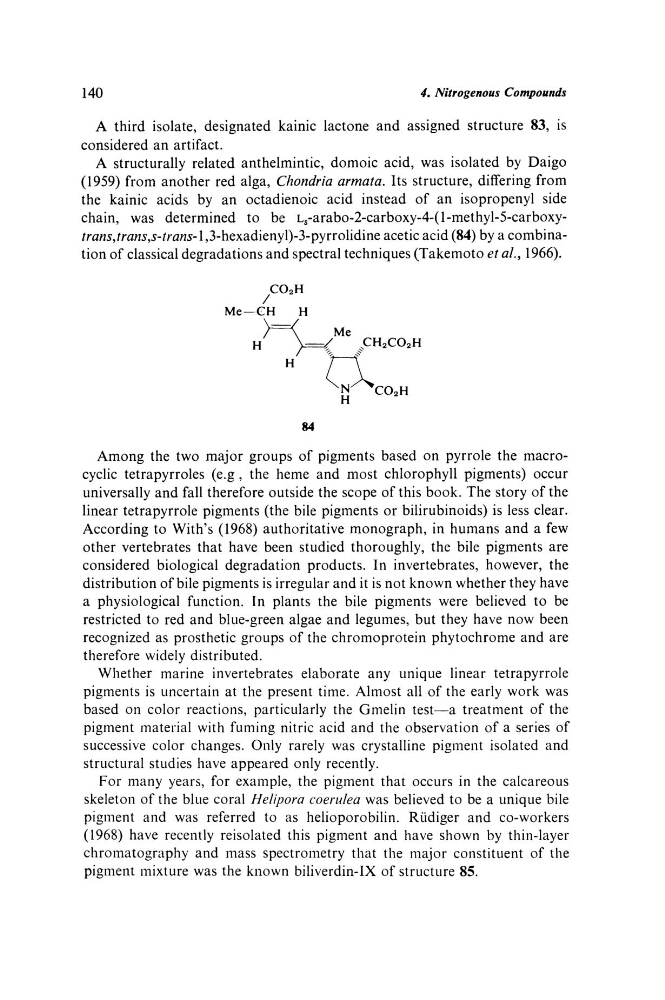
A structurally related anthelmintic, domoic acid, was isolated by Daigo
(1959) from another red alga, Chondria armata. Its structure, differing from
the kainic acids by an octadienoic acid instead of an isopropenyl side
chain, was determined to be L s -arabo-2-carboxy-4-(l-methyl-5-carboxytransJrans,s-transA,3-hcx&dienyi)-3-pyno\idim
acetic acid (84) by a combination of classical degradations and spectral techniques (Takemoto et al, 1966).
Among the two major groups of pigments based on pyrrole the macrocyclic tetrapyrroles (e.g, the heme and most chlorophyll pigments) occur
universally and fall therefore outside the scope of this book. The story of the
linear tetrapyrrole pigments (the bile pigments or bilirubinoids) is less clear.
According to With's (1968) authoritative monograph, in humans and a few
other vertebrates that have been studied thoroughly, the bile pigments are
considered biological degradation products. In invertebrates, however, the
distribution of bile pigments is irregular and it is not known whether they have
a physiological function. In plants the bile pigments were believed to be
restricted to red and blue-green algae and legumes, but they have now been
recognized as prosthetic groups of the chromoprotein phytochrome and are
therefore widely distributed.
Whether marine invertebrates elaborate any unique linear tetrapyrrole
pigments is uncertain at the present time. Almost all of the early work was
based on color reactions, particularly the Gmelin test—a treatment of the
pigment material with fuming nitric acid and the observation of a series of
successive color changes. Only rarely was crystalline pigment isolated and
structural studies have appeared only recently.
For many years, for example, the pigment that occurs in the calcareous
skeleton of the blue coral Helipora coerulea was believed to be a unique bile
pigment and was referred to as helioporobilin. Rüdiger and co-workers
(1968) have recently reisolated this pigment and have shown by thin-layer
chromatography and mass spectrometry that the major constituent of the
pigment mixture was the known biliverdin-IX of structure 85.
/
Me—GH
C0 2 H
H
84
4. Nitrogenous Compounds
A third isolate, designated kainic lactone and assigned structure 83, is
considered an artifact.
A structurally related anthelmintic, domoic acid, was isolated by Daigo
(1959) from another red alga, Chondria armata. Its structure, differing from
the kainic acids by an octadienoic acid instead of an isopropenyl side
chain, was determined to be L s -arabo-2-carboxy-4-(l-methyl-5-carboxytransJrans,s-transA,3-hcx&dienyi)-3-pyno\idim
acetic acid (84) by a combination of classical degradations and spectral techniques (Takemoto et al, 1966).
Among the two major groups of pigments based on pyrrole the macrocyclic tetrapyrroles (e.g, the heme and most chlorophyll pigments) occur
universally and fall therefore outside the scope of this book. The story of the
linear tetrapyrrole pigments (the bile pigments or bilirubinoids) is less clear.
According to With's (1968) authoritative monograph, in humans and a few
other vertebrates that have been studied thoroughly, the bile pigments are
considered biological degradation products. In invertebrates, however, the
distribution of bile pigments is irregular and it is not known whether they have
a physiological function. In plants the bile pigments were believed to be
restricted to red and blue-green algae and legumes, but they have now been
recognized as prosthetic groups of the chromoprotein phytochrome and are
therefore widely distributed.
Whether marine invertebrates elaborate any unique linear tetrapyrrole
pigments is uncertain at the present time. Almost all of the early work was
based on color reactions, particularly the Gmelin test—a treatment of the
pigment material with fuming nitric acid and the observation of a series of
successive color changes. Only rarely was crystalline pigment isolated and
structural studies have appeared only recently.
For many years, for example, the pigment that occurs in the calcareous
skeleton of the blue coral Helipora coerulea was believed to be a unique bile
pigment and was referred to as helioporobilin. Rüdiger and co-workers
(1968) have recently reisolated this pigment and have shown by thin-layer
chromatography and mass spectrometry that the major constituent of the
pigment mixture was the known biliverdin-IX of structure 85.
/
Me—GH
C0 2 H
H
84