

C, Compounds Containing Nitrogen in a Cycle
139
H
78
a: R = C0 2 H
b: R = CONH 2
c: R = CN
Several related amino acids, derivatives of tetrahydropyrrole (pyrrolidine),
were isolated from the red alga Digenea simplex as the active principles of an
algal species known and used for its anthelmintic properties. The principal
and most active constituent was characterized by Murakami and co-workers
(1953) and was first called digenic acid. Murakami et al. (1954) subsequently
proposed the trivial name α-kainic acid, which has been continued. In a
series of classic chemical degradations and syntheses of degradation products
several groups of Japanese workers (Honjo et al, 1955; Murakami et al.,
1955a; Nawa et al, 1955a,b; Sugawa et al, 1955a,b; Ueno et al, 1955)
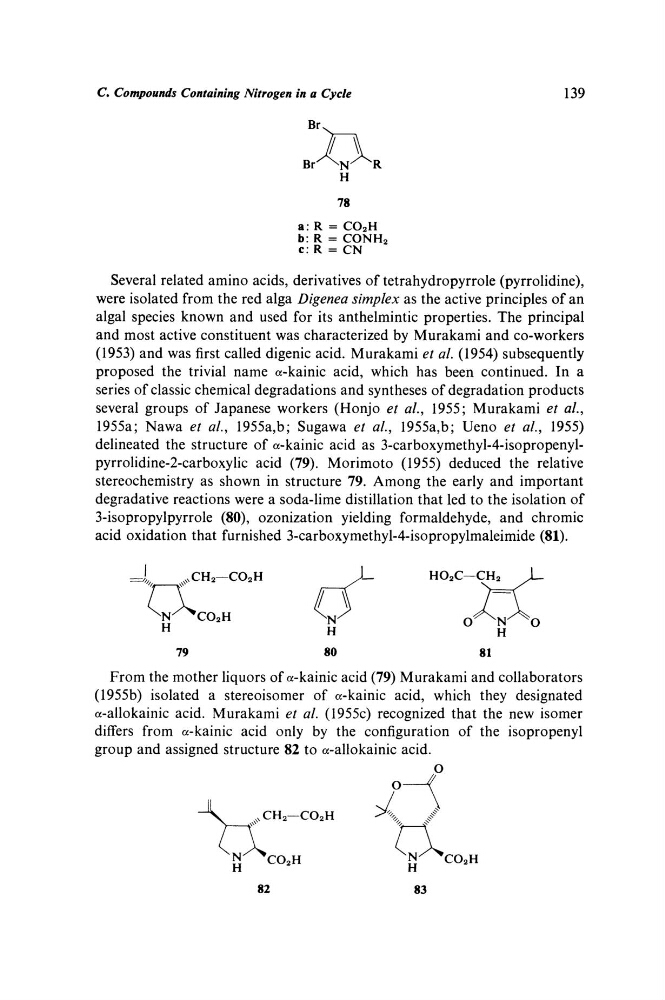
delineated the structure of α-kainic acid as 3-carboxymethyl-4-isopropenylpyrrolidine-2-carboxylic acid (79). Morimoto (1955) deduced the relative
stereochemistry as shown in structure 79. Among the early and important
degradative reactions were a soda-lime distillation that led to the isolation of
3-isopropylpyrrole (80), ozonization yielding formaldehyde, and chromic
acid oxidation that furnished 3-carboxymethyl-4-isopropylmaleimide (81).
= 4
^CHa-COaH
^JHO.C-CH. 1_
H
Η
Η
79
80
81
From the mother liquors of α-kainic acid (79) Murakami and collaborators
(1955b) isolated a stereoisomer of α-kainic acid, which they designated
α-allokainic acid. Murakami et al. (1955c) recognized that the new isomer
differs from α-kainic acid only by the configuration of the isopropenyl
group and assigned structure 82 to α-allokainic acid.
Ο
o—{
-V
CH 2 —CQ 2 H
>"o % /
Ç^C0 2 H
Ç^»CO s H
H
H
82
83
139
H
78
a: R = C0 2 H
b: R = CONH 2
c: R = CN
Several related amino acids, derivatives of tetrahydropyrrole (pyrrolidine),
were isolated from the red alga Digenea simplex as the active principles of an
algal species known and used for its anthelmintic properties. The principal
and most active constituent was characterized by Murakami and co-workers
(1953) and was first called digenic acid. Murakami et al. (1954) subsequently
proposed the trivial name α-kainic acid, which has been continued. In a
series of classic chemical degradations and syntheses of degradation products
several groups of Japanese workers (Honjo et al, 1955; Murakami et al.,
1955a; Nawa et al, 1955a,b; Sugawa et al, 1955a,b; Ueno et al, 1955)
delineated the structure of α-kainic acid as 3-carboxymethyl-4-isopropenylpyrrolidine-2-carboxylic acid (79). Morimoto (1955) deduced the relative
stereochemistry as shown in structure 79. Among the early and important
degradative reactions were a soda-lime distillation that led to the isolation of
3-isopropylpyrrole (80), ozonization yielding formaldehyde, and chromic
acid oxidation that furnished 3-carboxymethyl-4-isopropylmaleimide (81).
= 4
^CHa-COaH
^JHO.C-CH. 1_
H
Η
Η
79
80
81
From the mother liquors of α-kainic acid (79) Murakami and collaborators
(1955b) isolated a stereoisomer of α-kainic acid, which they designated
α-allokainic acid. Murakami et al. (1955c) recognized that the new isomer
differs from α-kainic acid only by the configuration of the isopropenyl
group and assigned structure 82 to α-allokainic acid.
Ο
o—{
-V
CH 2 —CQ 2 H
>"o % /
Ç^C0 2 H
Ç^»CO s H
H
H
82
83