

138
4. Nitrogenous Compounds
Perhaps the most intriguing of the derivatives of pyrrole (64) is a phenylsubstituted pyrrole with no fewer than five bromine atoms that Burkholder
et al. (1966) isolated from a marine bacterium Pseudomonas
bromoutilis.
Lovell (1966) determined its structure by single crystal X-ray techniques to
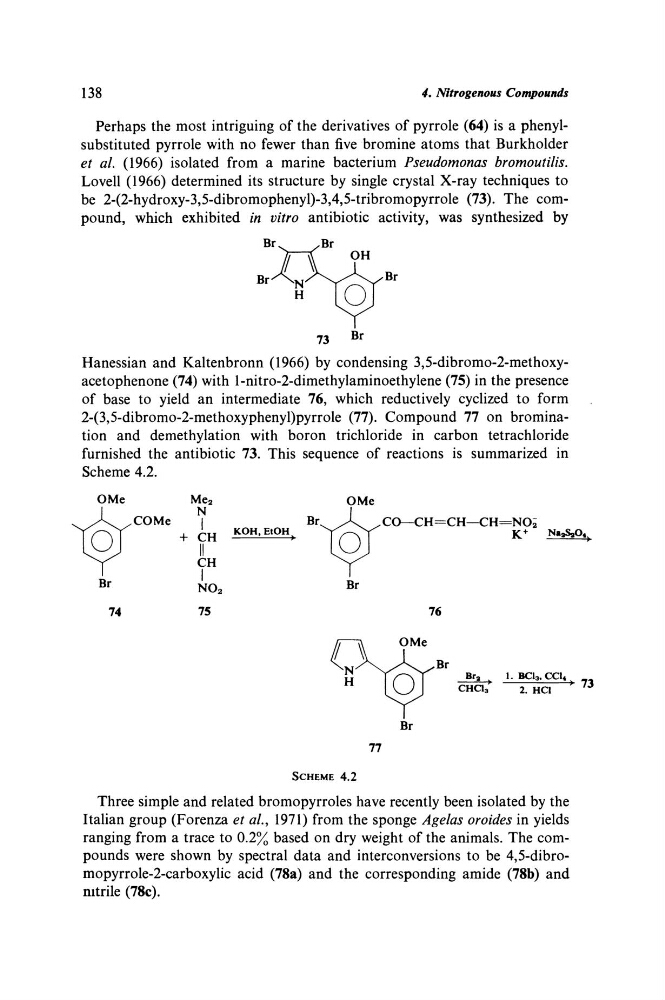
be 2-(2-hydroxy-3,5-dibromophenyl)-3,4,5-tribromopyrrole (73). The compound, which exhibited in vitro antibiotic activity, was synthesized by
Br.
.Br
73
B
r
Hanessian and Kaltenbronn (1966) by condensing 3,5-dibromo-2-methoxyacetophenone (74) with l-nitro-2-dimethylaminoethylene (75) in the presence
of base to yield an intermediate 76, which reductively cyclized to form
2-(3,5-dibromo-2-methoxyphenyl)pyrrole (77). Compound 77 on bromination and demethylation with boron trichloride in carbon tetrachloride
furnished the antibiotic 73. This sequence of reactions is summarized in
Scheme 4.2.
OMe
Me 2
OMe
.J\,COMq
I
Br
CO—CH=CH—CH=NOi
YqY
+
^
KQH.EtQH
YqT^
K+
Ν>ΑΘ Ν
Br
N0 2
Br
74
75
76
il—°
Me
Η ΎΓλΓ
Β γ
» >
1. BC1 3 ,CCU
KJI
CHQ 3 ThÖ
73
Br
77
SCHEME 4.2
Three simple and related bromopyrroles have recently been isolated by the
Italian group (Forenza et al., 1971) from the sponge Agelas oroides in yields
ranging from a trace to 0.2% based on dry weight of the animals. The compounds were shown by spectral data and interconversions to be 4,5-dibromopyrrole-2-carboxylic acid (78a) and the corresponding amide (78b) and
nitrile (78c).
4. Nitrogenous Compounds
Perhaps the most intriguing of the derivatives of pyrrole (64) is a phenylsubstituted pyrrole with no fewer than five bromine atoms that Burkholder
et al. (1966) isolated from a marine bacterium Pseudomonas
bromoutilis.
Lovell (1966) determined its structure by single crystal X-ray techniques to
be 2-(2-hydroxy-3,5-dibromophenyl)-3,4,5-tribromopyrrole (73). The compound, which exhibited in vitro antibiotic activity, was synthesized by
Br.
.Br
73
B
r
Hanessian and Kaltenbronn (1966) by condensing 3,5-dibromo-2-methoxyacetophenone (74) with l-nitro-2-dimethylaminoethylene (75) in the presence
of base to yield an intermediate 76, which reductively cyclized to form
2-(3,5-dibromo-2-methoxyphenyl)pyrrole (77). Compound 77 on bromination and demethylation with boron trichloride in carbon tetrachloride
furnished the antibiotic 73. This sequence of reactions is summarized in
Scheme 4.2.
OMe
Me 2
OMe
.J\,COMq
I
Br
CO—CH=CH—CH=NOi
YqY
+
^
KQH.EtQH
YqT^
K+
Ν>ΑΘ Ν
Br
N0 2
Br
74
75
76
il—°
Me
Η ΎΓλΓ
Β γ
» >
1. BC1 3 ,CCU
KJI
CHQ 3 ThÖ
73
Br
77
SCHEME 4.2
Three simple and related bromopyrroles have recently been isolated by the
Italian group (Forenza et al., 1971) from the sponge Agelas oroides in yields
ranging from a trace to 0.2% based on dry weight of the animals. The compounds were shown by spectral data and interconversions to be 4,5-dibromopyrrole-2-carboxylic acid (78a) and the corresponding amide (78b) and
nitrile (78c).