

C. Compounds Containing Nitrogen in a Cycle
137
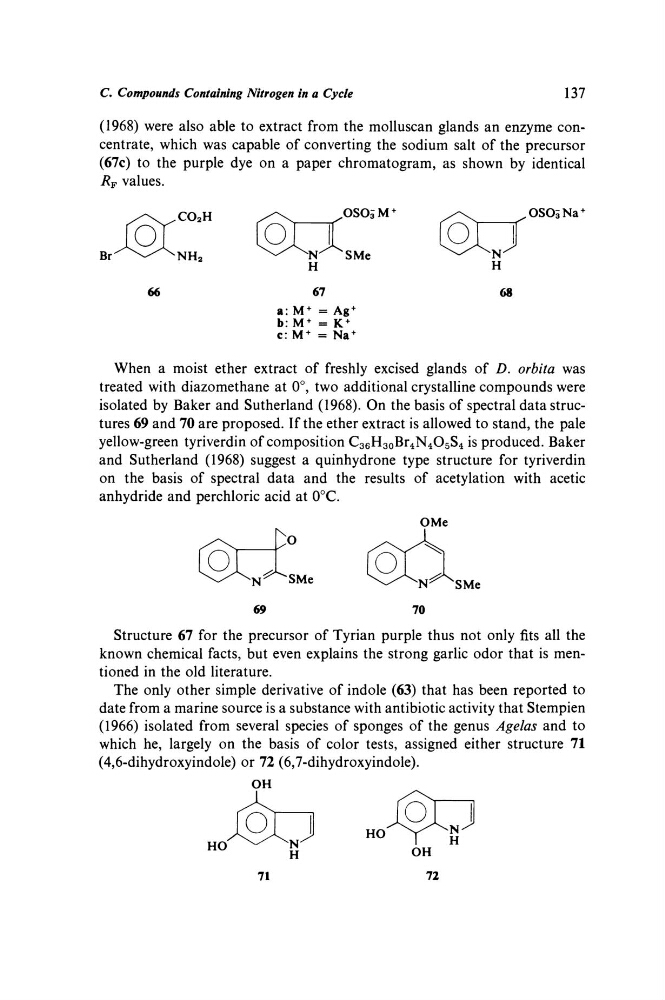
(1968) were also able to extract from the molluscan glands an enzyme concentrate, which was capable of converting the sodium salt of the precursor
(67c) to the purple dye on a paper chromatogram, as shown by identical
R F values.
jor
(ort
(dry
H
H
66
67
68
a: M
+ = Ag
+
b: M
+ = K +
c: M
+ = Na
+
When a moist ether extract of freshly excised glands of D. orbita was
treated with diazomethane at 0°, two additional crystalline compounds were
isolated by Baker and Sutherland (1968). On the basis of spectral data structures 69 and 70 are proposed. If the ether extract is allowed to stand, the pale
yellow-green tyriverdin of composition C 36 H3oBr 4 N405S 4 is produced. Baker
and Sutherland (1968) suggest a quinhydrone type structure for tyriverdin
on the basis of spectral data and the results of acetylation with acetic
anhydride and perchloric acid at 0°C.
OMe
^^N^SMe
^ S ^ S M e
69
70
Structure 67 for the precursor of Tyrian purple thus not only fits all the
known chemical facts, but even explains the strong garlic odor that is mentioned in the old literature.
The only other simple derivative of indole (63) that has been reported to
date from a marine source is a substance with antibiotic activity that Stempien
(1966) isolated from several species of sponges of the genus Agelas and to
which he, largely on the basis of color tests, assigned either structure 71
(4,6-dihydroxyindole) or 72 (6,7-dihydroxyindole).
OH
jeu
»οψ?
HO
H
OH
71
72
137
(1968) were also able to extract from the molluscan glands an enzyme concentrate, which was capable of converting the sodium salt of the precursor
(67c) to the purple dye on a paper chromatogram, as shown by identical
R F values.
jor
(ort
(dry
H
H
66
67
68
a: M
+ = Ag
+
b: M
+ = K +
c: M
+ = Na
+
When a moist ether extract of freshly excised glands of D. orbita was
treated with diazomethane at 0°, two additional crystalline compounds were
isolated by Baker and Sutherland (1968). On the basis of spectral data structures 69 and 70 are proposed. If the ether extract is allowed to stand, the pale
yellow-green tyriverdin of composition C 36 H3oBr 4 N405S 4 is produced. Baker
and Sutherland (1968) suggest a quinhydrone type structure for tyriverdin
on the basis of spectral data and the results of acetylation with acetic
anhydride and perchloric acid at 0°C.
OMe
^^N^SMe
^ S ^ S M e
69
70
Structure 67 for the precursor of Tyrian purple thus not only fits all the
known chemical facts, but even explains the strong garlic odor that is mentioned in the old literature.
The only other simple derivative of indole (63) that has been reported to
date from a marine source is a substance with antibiotic activity that Stempien
(1966) isolated from several species of sponges of the genus Agelas and to
which he, largely on the basis of color tests, assigned either structure 71
(4,6-dihydroxyindole) or 72 (6,7-dihydroxyindole).
OH
jeu
»οψ?
HO
H
OH
71
72