

136
4. Nitrogenous Compounds
production of the dye after exposure to light. He also showed that Tyrian
purple was different from the known dyes indigo and thioindigo, but that
it was related to these compounds. During the summer of 1908 Friedländer
worked up 12,000 snails {Murex brandaris) and isolated 1.4 g of analytically
pure dye (Friedländer, 1909). Of the twenty-two possible dibromoindigotins
Friedländer (1909) correctly excluded the eighteen asymmetrical compounds
on the basis of his observation that the colorless precursor of the dye was
readily soluble, from which he shrewdly concluded that the purple dye was
likely to be a symmetrical dimer of the colorless precursor. He had thus
reduced the structural possibilities from twenty-two to four! He had insufficient material for degradation of the dye—a statement that is readily
apparent when one considers that his elemental analyses for carbon, hydrogen,
nitrogen, and bromine (duplicate only of bromine) had burned up no less
than 0.5 g of his 1.4-g supply. Two of the four symmetrical compounds
had been described at the time—the 5,5'-dibromo isomer had been prepared
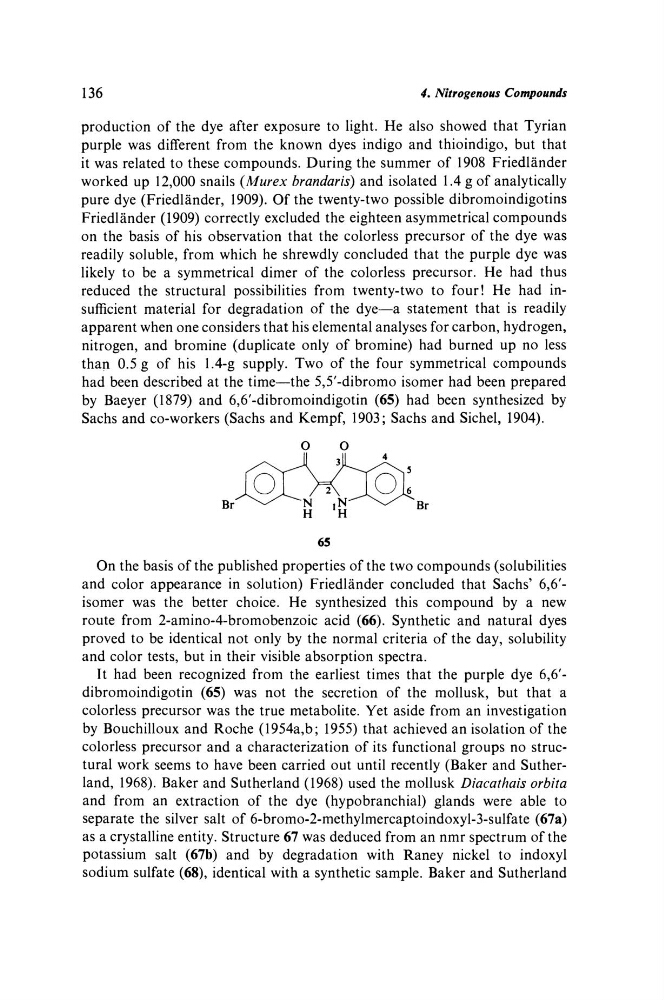
by Baeyer (1879) and 6,6'-dibromoindigotin (65) had been synthesized by
Sachs and co-workers (Sachs and Kempf, 1903; Sachs and Sichel, 1904).
65
On the basis of the published properties of the two compounds (solubilities
and color appearance in solution) Friedländer concluded that Sachs' 6,6'isomer was the better choice. He synthesized this compound by a new
route from 2-amino-4-bromobenzoic acid (66). Synthetic and natural dyes
proved to be identical not only by the normal criteria of the day, solubility
and color tests, but in their visible absorption spectra.
It had been recognized from the earliest times that the purple dye 6,6'dibromoindigotin (65) was not the secretion of the mollusk, but that a
colorless precursor was the true metabolite. Yet aside from an investigation
by Bouchilloux and Roche (1954a,b; 1955) that achieved an isolation of the
colorless precursor and a characterization of its functional groups no structural work seems to have been carried out until recently (Baker and Sutherland, 1968). Baker and Sutherland (1968) used the mollusk Diacathais orbita
and from an extraction of the dye (hypobranchial) glands were able to
separate the silver salt of 6-bromo-2-methylmercaptoindoxyl-3-sulfate (67a)
as a crystalline entity. Structure 67 was deduced from an nmr spectrum of the
potassium salt (67b) and by degradation with Raney nickel to indoxyl
sodium sulfate (68), identical with a synthetic sample. Baker and Sutherland
4. Nitrogenous Compounds
production of the dye after exposure to light. He also showed that Tyrian
purple was different from the known dyes indigo and thioindigo, but that
it was related to these compounds. During the summer of 1908 Friedländer
worked up 12,000 snails {Murex brandaris) and isolated 1.4 g of analytically
pure dye (Friedländer, 1909). Of the twenty-two possible dibromoindigotins
Friedländer (1909) correctly excluded the eighteen asymmetrical compounds
on the basis of his observation that the colorless precursor of the dye was
readily soluble, from which he shrewdly concluded that the purple dye was
likely to be a symmetrical dimer of the colorless precursor. He had thus
reduced the structural possibilities from twenty-two to four! He had insufficient material for degradation of the dye—a statement that is readily
apparent when one considers that his elemental analyses for carbon, hydrogen,
nitrogen, and bromine (duplicate only of bromine) had burned up no less
than 0.5 g of his 1.4-g supply. Two of the four symmetrical compounds
had been described at the time—the 5,5'-dibromo isomer had been prepared
by Baeyer (1879) and 6,6'-dibromoindigotin (65) had been synthesized by
Sachs and co-workers (Sachs and Kempf, 1903; Sachs and Sichel, 1904).
65
On the basis of the published properties of the two compounds (solubilities
and color appearance in solution) Friedländer concluded that Sachs' 6,6'isomer was the better choice. He synthesized this compound by a new
route from 2-amino-4-bromobenzoic acid (66). Synthetic and natural dyes
proved to be identical not only by the normal criteria of the day, solubility
and color tests, but in their visible absorption spectra.
It had been recognized from the earliest times that the purple dye 6,6'dibromoindigotin (65) was not the secretion of the mollusk, but that a
colorless precursor was the true metabolite. Yet aside from an investigation
by Bouchilloux and Roche (1954a,b; 1955) that achieved an isolation of the
colorless precursor and a characterization of its functional groups no structural work seems to have been carried out until recently (Baker and Sutherland, 1968). Baker and Sutherland (1968) used the mollusk Diacathais orbita
and from an extraction of the dye (hypobranchial) glands were able to
separate the silver salt of 6-bromo-2-methylmercaptoindoxyl-3-sulfate (67a)
as a crystalline entity. Structure 67 was deduced from an nmr spectrum of the
potassium salt (67b) and by degradation with Raney nickel to indoxyl
sodium sulfate (68), identical with a synthetic sample. Baker and Sutherland