

C. Compounds Containing Nitrogen in a Cycle
135
compound 61 could be extracted into ether from an alkaline solution.
Moreover, the desired dihydronereistoxin (61) was being oxidized to nereistoxin (52) spontaneously during work-up. The yield of nereistoxin (52) from
the mixed amines 59b and 60b was 6%. Scheme 4.1 summarizes the synthesis.
C. Compounds Containing Nitrogen in a Cycle
During the discussion of the choline ester murexine (see Section A,3)
brief reference was made to the ancient dye Tyrian purple, derived from a
few molluscan species of the genus Murex. Tyrian purple proved to be a
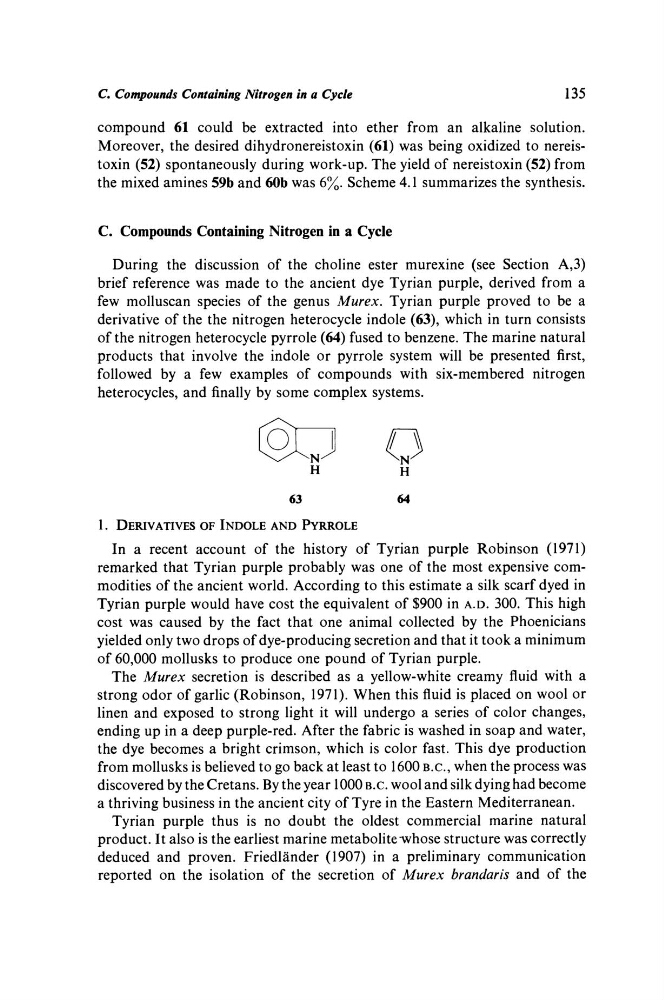
derivative of the the nitrogen heterocycle indole (63), which in turn consists
of the nitrogen heterocycle pyrrole (64) fused to benzene. The marine natural
products that involve the indole or pyrrole system will be presented first,
followed by a few examples of compounds with six-membered nitrogen
heterocycles, and finally by some complex systems.
Η
Η
63
64
1. DERIVATIVES OF INDOLE AND PYRROLE
In a recent account of the history of Tyrian purple Robinson (1971)
remarked that Tyrian purple probably was one of the most expensive commodities of the ancient world. According to this estimate a silk scarf dyed in
Tyrian purple would have cost the equivalent of $900 in A.D. 300. This high
cost was caused by the fact that one animal collected by the Phoenicians
yielded only two drops of dye-producing secretion and that it took a minimum
of 60,000 mollusks to produce one pound of Tyrian purple.
The Murex secretion is described as a yellow-white creamy fluid with a
strong odor of garlic (Robinson, 1971). When this fluid is placed on wool or
linen and exposed to strong light it will undergo a series of color changes,
ending up in a deep purple-red. After the fabric is washed in soap and water,
the dye becomes a bright crimson, which is color fast. This dye production
from mollusks is believed to go back at least to 1600 B.C., when the process was
discovered by the Cretans. By the year 1000 B.C. wool and silk dying had become
a thriving business in the ancient city of Tyre in the Eastern Mediterranean.
Tyrian purple thus is no doubt the oldest commercial marine natural
product. It also is the earliest marine metabolite-whose structure was correctly
deduced and proven. Friedländer (1907) in a preliminary communication
reported on the isolation of the secretion of Murex brandaris and of the
135
compound 61 could be extracted into ether from an alkaline solution.
Moreover, the desired dihydronereistoxin (61) was being oxidized to nereistoxin (52) spontaneously during work-up. The yield of nereistoxin (52) from
the mixed amines 59b and 60b was 6%. Scheme 4.1 summarizes the synthesis.
C. Compounds Containing Nitrogen in a Cycle
During the discussion of the choline ester murexine (see Section A,3)
brief reference was made to the ancient dye Tyrian purple, derived from a
few molluscan species of the genus Murex. Tyrian purple proved to be a
derivative of the the nitrogen heterocycle indole (63), which in turn consists
of the nitrogen heterocycle pyrrole (64) fused to benzene. The marine natural
products that involve the indole or pyrrole system will be presented first,
followed by a few examples of compounds with six-membered nitrogen
heterocycles, and finally by some complex systems.
Η
Η
63
64
1. DERIVATIVES OF INDOLE AND PYRROLE
In a recent account of the history of Tyrian purple Robinson (1971)
remarked that Tyrian purple probably was one of the most expensive commodities of the ancient world. According to this estimate a silk scarf dyed in
Tyrian purple would have cost the equivalent of $900 in A.D. 300. This high
cost was caused by the fact that one animal collected by the Phoenicians
yielded only two drops of dye-producing secretion and that it took a minimum
of 60,000 mollusks to produce one pound of Tyrian purple.
The Murex secretion is described as a yellow-white creamy fluid with a
strong odor of garlic (Robinson, 1971). When this fluid is placed on wool or
linen and exposed to strong light it will undergo a series of color changes,
ending up in a deep purple-red. After the fabric is washed in soap and water,
the dye becomes a bright crimson, which is color fast. This dye production
from mollusks is believed to go back at least to 1600 B.C., when the process was
discovered by the Cretans. By the year 1000 B.C. wool and silk dying had become
a thriving business in the ancient city of Tyre in the Eastern Mediterranean.
Tyrian purple thus is no doubt the oldest commercial marine natural
product. It also is the earliest marine metabolite-whose structure was correctly
deduced and proven. Friedländer (1907) in a preliminary communication
reported on the isolation of the secretion of Murex brandaris and of the