

130
4. Nitrogenous Compounds
but may be generated during work-up (see below). In their preliminary
communication Sharma and Burkholder ( 1967b) reported spectral data for compound 39 and the outline of a synthesis from 4-hydroxy-3,5-dibromophenylacetamide (41). Spectral data for compound 40, the ketal of 39, were reported
by Sharma et al. (1970). In addition, the ketal was readily convertible to its
CH 2 CONH 2
OH
41
parent ketone 39, thereby confirming the relationship of the two compounds.
The reverse reaction, however, ketalization of the dienone 39, was reported
not to occur under normal conditions of isolation nor by treatment with
methyl orthoformate. It would appear then that 40 should be considered a
natural product.
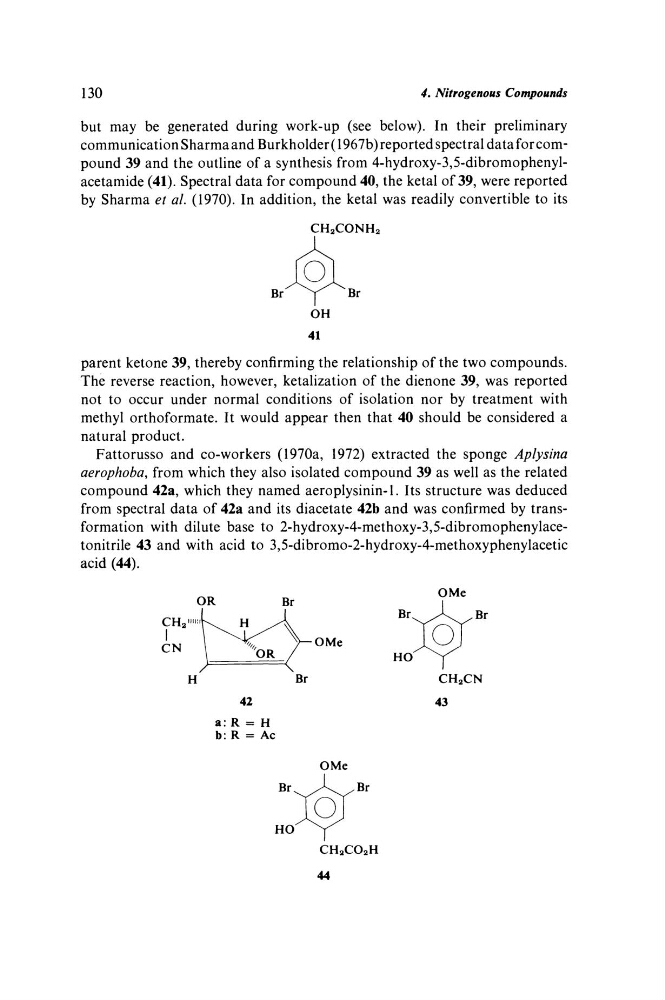
Fattorusso and co-workers (1970a, 1972) extracted the sponge Aplysina
aerophoba, from which they also isolated compound 39 as well as the related
compound 42a, which they named aeroplysinin-1. Its structure was deduced
from spectral data of 42a and its diacetate 42b and was confirmed by transformation with dilute base to 2-hydroxy-4-methoxy-3,5-dibromophenylacetonitrile 43 and with acid to 3,5-dibromo-2-hydroxy-4-methoxyphenylacetic
acid (44).
CH 2 K H J,
Β Γ
ΎθΤ
Β Γ
C N
\
Ο*
/
ΗΟ^Γ
Η
Br
CH 2 CN
42
43
a: R = Η
b: R = Ac
OMe
CH 2 C0 2 H
44
4. Nitrogenous Compounds
but may be generated during work-up (see below). In their preliminary
communication Sharma and Burkholder ( 1967b) reported spectral data for compound 39 and the outline of a synthesis from 4-hydroxy-3,5-dibromophenylacetamide (41). Spectral data for compound 40, the ketal of 39, were reported
by Sharma et al. (1970). In addition, the ketal was readily convertible to its
CH 2 CONH 2
OH
41
parent ketone 39, thereby confirming the relationship of the two compounds.
The reverse reaction, however, ketalization of the dienone 39, was reported
not to occur under normal conditions of isolation nor by treatment with
methyl orthoformate. It would appear then that 40 should be considered a
natural product.
Fattorusso and co-workers (1970a, 1972) extracted the sponge Aplysina
aerophoba, from which they also isolated compound 39 as well as the related
compound 42a, which they named aeroplysinin-1. Its structure was deduced
from spectral data of 42a and its diacetate 42b and was confirmed by transformation with dilute base to 2-hydroxy-4-methoxy-3,5-dibromophenylacetonitrile 43 and with acid to 3,5-dibromo-2-hydroxy-4-methoxyphenylacetic
acid (44).
CH 2 K H J,
Β Γ
ΎθΤ
Β Γ
C N
\
Ο*
/
ΗΟ^Γ
Η
Br
CH 2 CN
42
43
a: R = Η
b: R = Ac
OMe
CH 2 C0 2 H
44