

Β. Compounds Containing Acyclic Nitrogen
131
Aeroplysinin-1 (42a) is dextrorotatory as reported by Fattorusso et al.
(1970a) who isolated it from the sponge Aplysina aerophoba. Remarkably,
Fulmor and co-workers (1970) isolated the levorotatory antipode of aeroplysinin-1 from a sponge Ianthella ardis. Another (unspecified) Ianthella
species yielded the dextrorotatory enantiomer. Furthermore, both optical
forms exhibited equal antibacterial activity in vitro. Fulmor et al. (1970)
were able to convert aeroplysinin-1 to 39 by treatment with trifluoroacetic
acid in acetone. Aqueous acid or alkali treatment of 42a led to complex
mixtures. This inability of 42a to be readily dehydrated to the aromatic
system suggested to Fulmore et al. (1970) a trans relationship of the vicinal
hydroxyl groups. The Italian workers (Fattorusso et al, 1970a, 1972), as
was mentioned, report facile aromatization when 42a is treated with acid or
base. Cosulich and Lovell (1971) carried out a single crystal X-ray determination of the levorotatory isomer and confirmed that the two hydroxy groups
in 42a are indeed trans to each other and axial. The X-ray study also confirmed
the absolute configuration of aeroplysinin-1 (42a), which had been deduced
on the basis of circular dichroism measurements by Fulmor et al. (1970).
Two additional bromine-containing sponge constituents contain cyclic
rather than acyclic nitrogen. However, generically and biologically these
two compounds are so closely related to the aeroplysinins that they will be
discussed here. Both compounds were isolated by Fattorusso and co-workers
(1970b, 1971a) from the same two sponges Aplysina (syn. Verongid) aerophoba
and V. thiona.
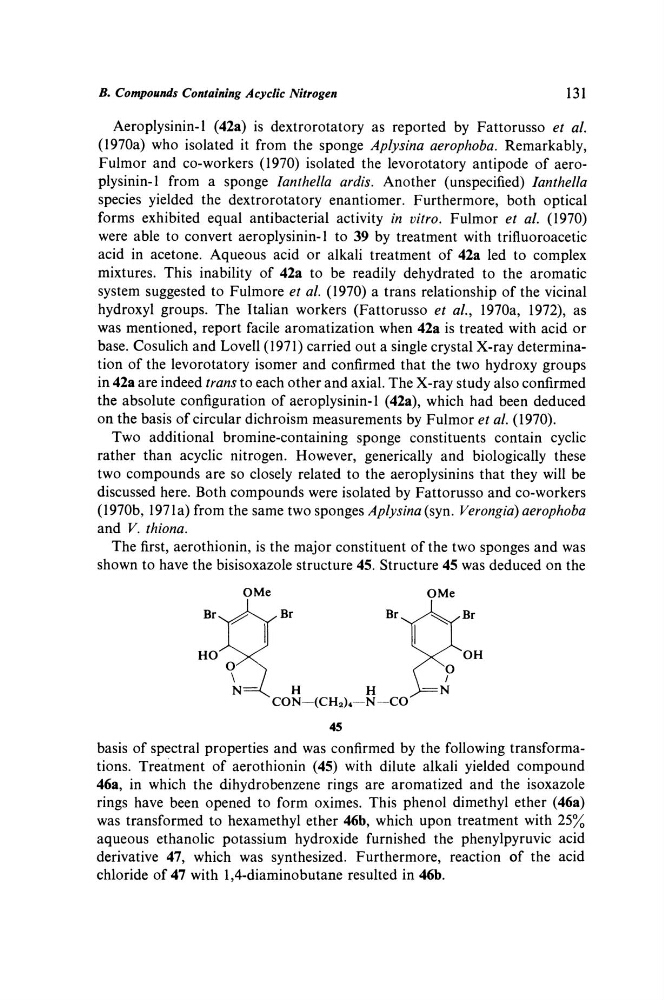
The first, aerothionin, is the major constituent of the two sponges and was
shown to have the bisisoxazole structure 45. Structure 45 was deduced on the
OMe
OMe
Br^^K^Br
ΒΓ^^Λ^ΒΓ
HO"><
>C*
O H
N=<
Η
Η
>=N
CON—(CH 2 ) 4 —N— CO
45
basis of spectral properties and was confirmed by the following transformations. Treatment of aerothionin (45) with dilute alkali yielded compound
46a, in which the dihydrobenzene rings are aromatized and the isoxazole
rings have been opened to form oximes. This phenol dimethyl ether (46a)
was transformed to hexamethyl ether 46b, which upon treatment with 25%
aqueous ethanolic potassium hydroxide furnished the phenylpyruvic acid
derivative 47, which was synthesized. Furthermore, reaction of the acid
chloride of 47 with 1,4-diaminobutane resulted in 46b.
131
Aeroplysinin-1 (42a) is dextrorotatory as reported by Fattorusso et al.
(1970a) who isolated it from the sponge Aplysina aerophoba. Remarkably,
Fulmor and co-workers (1970) isolated the levorotatory antipode of aeroplysinin-1 from a sponge Ianthella ardis. Another (unspecified) Ianthella
species yielded the dextrorotatory enantiomer. Furthermore, both optical
forms exhibited equal antibacterial activity in vitro. Fulmor et al. (1970)
were able to convert aeroplysinin-1 to 39 by treatment with trifluoroacetic
acid in acetone. Aqueous acid or alkali treatment of 42a led to complex
mixtures. This inability of 42a to be readily dehydrated to the aromatic
system suggested to Fulmore et al. (1970) a trans relationship of the vicinal
hydroxyl groups. The Italian workers (Fattorusso et al, 1970a, 1972), as
was mentioned, report facile aromatization when 42a is treated with acid or
base. Cosulich and Lovell (1971) carried out a single crystal X-ray determination of the levorotatory isomer and confirmed that the two hydroxy groups
in 42a are indeed trans to each other and axial. The X-ray study also confirmed
the absolute configuration of aeroplysinin-1 (42a), which had been deduced
on the basis of circular dichroism measurements by Fulmor et al. (1970).
Two additional bromine-containing sponge constituents contain cyclic
rather than acyclic nitrogen. However, generically and biologically these
two compounds are so closely related to the aeroplysinins that they will be
discussed here. Both compounds were isolated by Fattorusso and co-workers
(1970b, 1971a) from the same two sponges Aplysina (syn. Verongid) aerophoba
and V. thiona.
The first, aerothionin, is the major constituent of the two sponges and was
shown to have the bisisoxazole structure 45. Structure 45 was deduced on the
OMe
OMe
Br^^K^Br
ΒΓ^^Λ^ΒΓ
HO"><
>C*
O H
N=<
Η
Η
>=N
CON—(CH 2 ) 4 —N— CO
45
basis of spectral properties and was confirmed by the following transformations. Treatment of aerothionin (45) with dilute alkali yielded compound
46a, in which the dihydrobenzene rings are aromatized and the isoxazole
rings have been opened to form oximes. This phenol dimethyl ether (46a)
was transformed to hexamethyl ether 46b, which upon treatment with 25%
aqueous ethanolic potassium hydroxide furnished the phenylpyruvic acid
derivative 47, which was synthesized. Furthermore, reaction of the acid
chloride of 47 with 1,4-diaminobutane resulted in 46b.